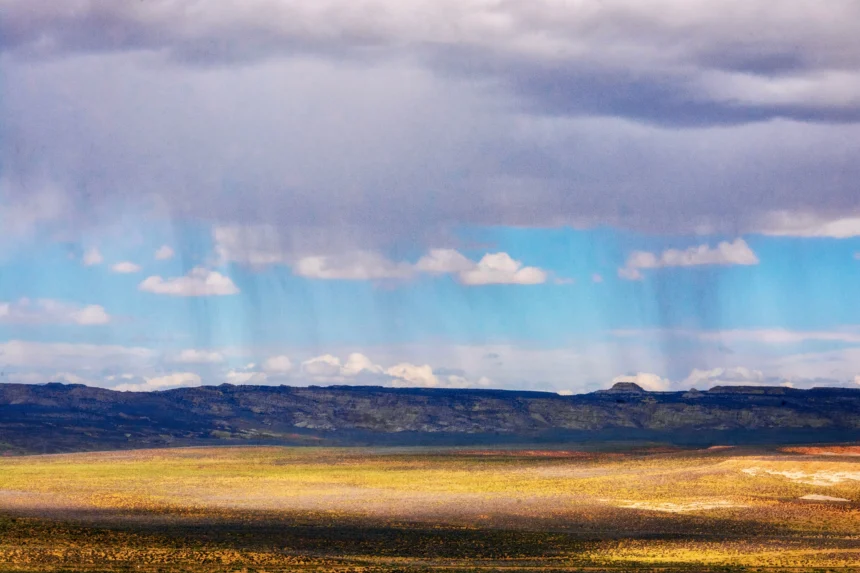
Why Are There Places Where It Almost Never Rains?
Imagine living somewhere where seeing rain is unusual enough to become an event.
Not a place experiencing a temporary drought.
A place where extreme dryness is the normal climate.
Parts of Chile’s Atacama Desert can go years without measurable rainfall. Antarctica—despite being covered in enormous quantities of ice—is technically a desert because so little new precipitation falls there. Along Africa’s Namib coast, fog can arrive regularly from the ocean while rain remains remarkably scarce.
So why are there places where it almost never rains?
The simple answer is that rain requires several atmospheric ingredients to come together.
Water must evaporate.
Moist air must reach the location.
That air usually needs to rise and cool.
Water vapor must condense into droplets or ice crystals.
Those particles must eventually become large enough to fall as precipitation.
Remove one or more parts of this process and rainfall can become rare.
In Earth’s driest regions, geography and atmospheric circulation are exceptionally good at preventing those ingredients from meeting.
Some regions sit beneath vast zones of sinking air. Others lie behind mountain ranges that squeeze moisture from clouds before the air arrives. Cold ocean currents can stabilize the atmosphere and suppress rain. Extremely cold polar air can contain remarkably little water vapor.
Sometimes several mechanisms act on the same location simultaneously.
That is what makes some places where it almost never rains extraordinarily dry for thousands or even millions of years.
Why Some Places Receive Almost No Rain
| Main Cause | How It Suppresses Rain | Example |
|---|---|---|
| Sinking subtropical air | Sinking air warms and inhibits cloud development | Sahara, Atacama |
| Rain shadow | Mountains remove moisture before air reaches the dry side | Atacama |
| Cold ocean current | Cold water stabilizes lower atmosphere and limits convection | Atacama, Namib |
| Extreme cold | Cold air holds very little water vapor | Antarctica |
| Continental location | Moist ocean air struggles to reach deep interiors | Central Asian deserts |
| Persistent high pressure | Storm systems are frequently diverted | Subtropical deserts |
| Multiple mechanisms | Several drying processes reinforce one another | Atacama |
The world’s driest climates rarely result from only one cause.
The Atacama is an excellent example: subtropical atmospheric circulation, the Andes Mountains and a cold Pacific current all reinforce its dryness. NOAA describes this combination as effectively stacking the atmospheric deck against rainfall.
1. Rain Requires Air to Rise
The first key to understanding places where it almost never rains is understanding why rain occurs at all.
Warm air can contain more water vapor than colder air.
When moist air rises through the atmosphere, pressure decreases and the air expands and cools. Eventually it may cool enough for water vapor to condense around tiny particles.
Cloud droplets or ice crystals form.
If they grow sufficiently large, precipitation can fall.
This means rising air is extremely important for producing many forms of rainfall.
But what happens when air does the opposite?
When air sinks, it is compressed by increasing atmospheric pressure.
Compression warms the air.
Warmer sinking air becomes less favorable for condensation and cloud development.
The result can be clear skies and extremely little precipitation.
This process operates on an enormous planetary scale.
2. Earth’s Atmospheric Circulation Creates Desert Belts
Look at a world map and an interesting pattern appears.
Several of Earth’s major deserts occur roughly between 20 and 30 degrees north or south of the equator.
That is not coincidence.
It is connected with a major atmospheric circulation system known as the Hadley circulation.
Near the equator, intense solar heating warms Earth’s surface.
Warm, moisture-rich air rises.
As it rises and cools, enormous quantities of rain can fall in tropical regions.
Higher in the atmosphere, that air spreads toward higher latitudes.
Eventually, roughly around the subtropics, part of it descends toward Earth’s surface again.
That sinking air becomes warmer and drier.
NOAA notes that many major deserts are concentrated around approximately 25–30 degrees latitude because subtropical regions frequently lie beneath descending atmospheric circulation.
This helps explain major dry regions including parts of:
- the Sahara;
- Arabian Peninsula;
- southern Africa;
- Australia;
- western South America.
The process is one of the fundamental reasons there are places where it almost never rains.
Why the Equator Is Different
Near the equator, strong heating encourages rising air and convection.
That is one reason many tropical rainforest regions receive huge amounts of precipitation.
Move into the subtropics and the dominant large-scale circulation can reverse.
Instead of rising, moisture-producing air, there may be descending, drying air.
Two regions can therefore receive dramatically different rainfall despite existing on the same planet and sometimes at relatively modest geographic distances.
NASA notes that deserts generally receive dramatically less rainfall than rainforest regions, whose annual precipitation can exceed 2,000 millimeters.
3. Mountains Can Steal the Rain
Mountains are another major reason places where it almost never rains exist.
The process is known as the rain-shadow effect.
Imagine moist air moving toward a mountain range.
The mountain blocks the air’s path.
To continue moving, the air is forced upward.
As it rises:
air expands → air cools → water condenses → clouds form → precipitation falls.
By the time the air reaches the mountain summit and begins descending the other side, much of its moisture may already have been lost.
The descending air then warms.
Its relative humidity falls.
Cloud formation becomes harder.
The side facing incoming moist winds is called the windward side.
The opposite side can become the leeward rain shadow.
The difference can be dramatic.
NASA describes parts of Bolivia near the Andes receiving more than 1,750 millimeters of rainfall annually, while nearby salt-flat regions receive less than 200 millimeters. The Andes intercept moisture and produce a powerful rain shadow toward northern Chile and western Bolivia.
This is one of the clearest demonstrations of how geography can create places where it almost never rains.
A mountain range can effectively separate a wet climate from an extremely dry one.
4. The Atacama Desert Gets Hit by Several Drying Mechanisms at Once
If there is one location that perfectly demonstrates Earth’s ability to suppress rainfall, it is the Atacama Desert.
Stretching along northern Chile, the Atacama is among the driest environments outside Antarctica.
NASA describes it as the world’s driest mid-latitude desert, with around 15 millimeters of precipitation annually across the broader desert, although some parts are considerably drier. Only Antarctica’s driest valleys receive less precipitation.
Why?
Because several atmospheric barriers operate simultaneously.
The Atacama Sits Beneath Descending Subtropical Air
Northern Chile lies within the subtropical latitude band where descending air associated with large-scale atmospheric circulation discourages precipitation.
That is drying mechanism number one.
The Andes Create an Enormous Rain Shadow
Moisture approaching from the South American interior encounters the Andes.
As the air rises, much of its moisture falls before crossing the mountain range.
The air that eventually reaches the western side can be extremely dry.
That is drying mechanism number two.
A Cold Ocean Current Lies Along the Coast
You might assume living next to the Pacific Ocean would guarantee moisture.
Not necessarily.
The Peru-Chile Current—also known as the Humboldt Current—carries cold water northward along western South America.
Cold surface water chills the air above it and contributes to a stable lower atmosphere.
This suppresses the strong upward convection needed to generate substantial rainfall.
NASA describes the Atacama’s position between the Andes and the cool Peru-Chile Current as central to the region’s extraordinary dryness.
Put the three together:
sinking air + enormous mountains + cold ocean = extreme desert.
That combination makes the Atacama one of the most famous places where it almost never rains.
5. How Can a Desert Beside an Ocean Be So Dry?
This is one of the strangest parts of desert climatology.
An ocean contains almost unimaginable quantities of water.
So why can land right beside it remain extremely dry?
Because having water nearby does not automatically create rain.
The atmosphere must transport that moisture inland and lift it sufficiently for precipitation-producing clouds to form.
Cold coastal currents can interfere with that process.
Cold ocean water cools the air immediately above it.
That creates a relatively cool layer close to the surface with warmer air sometimes located above.
This stable arrangement suppresses strong vertical motion.
Moisture may still exist close to the ground.
Fog can form.
Low clouds can appear.
But deep rain-producing clouds struggle to develop.
That creates the counterintuitive possibility of a desert where fog is common but rain is rare.
6. The Namib Desert Shows How Fog and Drought Can Exist Together
Africa’s Namib Desert provides another extraordinary example.
The Namib lies along the Atlantic coast of southwestern Africa.
Immediately offshore flows the cold Benguela Current.
NASA explains that cold water associated with the Benguela system suppresses cloud formation and rainfall along the coast, helping create the extremely dry Namib climate.
But the cold current can also produce fog.
NASA describes how morning fog can move onto parts of the dunes, providing enough moisture for sparse vegetation and specialized organisms even when rainfall is extremely limited.
This creates a fascinating distinction.
Humidity is not the same as rainfall.
There may be moisture in the air.
There may be fog droplets.
Yet there may not be the atmospheric instability and vertical development needed to create significant rain.
The Namib therefore belongs among the most instructive places where it almost never rains because it demonstrates that an environment can receive atmospheric moisture without receiving much precipitation.
7. Antarctica Is Actually the World’s Largest Desert
When most people imagine a desert, they picture sand dunes, scorching heat and perhaps a cactus.
That definition is incomplete.
A desert is fundamentally defined by very low precipitation, not by temperature.
That means Antarctica qualifies.
In fact, Antarctica is the world’s largest desert.
The British Antarctic Survey describes Antarctica as the coldest, highest, driest and windiest continent on Earth. Average snowfall over the continent corresponds to only about 150 millimeters of rain-equivalent precipitation per year.
Some interior areas receive considerably less.
This raises an obvious question:
How can a continent containing around 90% of Earth’s surface freshwater be dry?
Because Antarctica’s enormous ice sheet accumulated over extremely long periods.
The amount of ice already present does not tell us how much precipitation falls during a single year.
Cold Air Contains Very Little Moisture
Antarctic air is extremely cold.
Cold air can support far less water vapor than warm tropical air.
The interior is also far from open ocean moisture sources.
Air descending over Antarctica’s high plateau has already lost much of its moisture.
The British Antarctic Survey notes that most moisture has been removed by the time upper-level air descends toward the Antarctic interior.
So despite being covered in ice, Antarctica contains some of Earth’s most extreme places where it almost never rains or snows.
8. The McMurdo Dry Valleys Take Polar Dryness Even Further
Antarctica contains regions so dry that much of the ground is exposed rock rather than ice.
The best-known examples are the McMurdo Dry Valleys.
The British Antarctic Survey describes these valleys as some of the coldest and driest places on the planet.
Conditions are so unusual that researchers study the region partly because it can provide analogues for extremely cold and dry environments on Mars.
These valleys demonstrate how multiple mechanisms can create extreme polar dryness.
Precipitation is tiny.
Humidity is low.
Mountain geography limits ice movement into parts of the valleys.
Strong downslope winds can also promote evaporation and sublimation.
The result looks almost alien compared with the stereotypical image of snow-covered Antarctica.
NSF research continues to monitor the McMurdo Dry Valleys because even rare warm or wet events can have unusually large ecological effects in such a water-limited environment.
9. Being Far From the Ocean Can Also Create Deserts
Not every dry environment sits beside a cold ocean current.
Some are dry because they are simply extremely far from major sources of atmospheric moisture.
These are sometimes called continental deserts.
Ocean evaporation supplies much of the moisture that eventually falls as precipitation over land. NOAA notes that nearly all rain falling on land ultimately begins with water evaporated from the ocean.
As moist air moves inland, repeated storms and mountain crossings can remove its water.
By the time air reaches the deep interior of a huge continent, relatively little moisture may remain.
Central Asia provides important examples.
The Gobi and Taklamakan deserts are influenced by continental location as well as surrounding mountain systems.
So another pathway to creating places where it almost never rains is:
put the location far from an ocean and surround it with mountains.
Moisture then has an extraordinarily difficult journey before reaching the region.
10. High Pressure Can Keep Storms Away
Another factor is persistent atmospheric pressure.
Areas dominated by high pressure generally experience descending air.
Descending air suppresses clouds and precipitation.
High-pressure systems can also influence the paths followed by storms.
If storm tracks repeatedly pass north or south of a region, rain-producing weather systems may rarely arrive.
NASA notes that persistent high pressure contributes to the Atacama’s dryness by frequently preventing storms from entering the region.
This is important because a location does not have to prevent every drop of moisture from entering.
It simply needs atmospheric circulation that makes significant rainfall consistently unlikely.
Over decades and centuries, that can produce a true desert climate.
Seven Remarkably Dry Places on Earth
| Region | Why It Is So Dry |
|---|---|
| Atacama Desert, Chile | Hadley circulation + Andes rain shadow + cold Pacific current |
| McMurdo Dry Valleys, Antarctica | Extreme cold + low humidity + polar geography |
| Antarctic Plateau | Extremely cold air + continental interior + descending air |
| Namib Desert, Namibia | Cold Benguela Current + subtropical high pressure |
| Sahara Desert | Subtropical sinking air + persistent high pressure |
| Arabian Desert | Subtropical circulation + continental conditions |
| Central Asian deserts | Distance from oceans + major mountain rain shadows |
These locations are not dry for identical reasons.
That is one of the most important points about places where it almost never rains.
There are several pathways to extreme aridity.
Can the World’s Driest Places Ever Get Heavy Rain?
Yes.
A desert climate means rain is normally scarce.
It does not mean rainfall is impossible.
Occasionally the atmospheric pattern breaks.
A storm may penetrate unusually far into a desert.
Tropical moisture can arrive from an unusual direction.
A cutoff low can form.
Atmospheric circulation can shift.
When that happens, extreme desert landscapes may suddenly experience significant precipitation.
The Atacama provides dramatic examples.
NASA reported rare snowfall across parts of northern Chile in 2025 when an unusual cutoff low reached the region. The agency noted that such systems can occasionally break through the climatic mechanisms that normally keep the Atacama dry.
Another unusually widespread precipitation event struck the region in 2026. In Taltal on Chile’s coast, nearly 40 millimeters of rain fell in three days—about ten times its annual mean, according to NASA’s account.
This sounds small compared with rainfall totals in tropical regions.
In an extreme desert, it can be enormous.
Why Rare Rain Can Be Dangerous in Extremely Dry Places
Rain is usually associated with water supply and plant growth.
In extremely dry regions, sudden rain can become destructive.
Desert soils may absorb water differently from soils in wetter ecosystems.
Vegetation is often sparse, reducing the ability of plants to slow surface runoff.
Dry channels can suddenly fill.
Water can rush through valleys and urban areas.
Flash floods can therefore occur even in places famous for drought.
This creates an important paradox:
Some places where it almost never rains can still experience serious flooding.
Rare rainfall can also trigger spectacular ecological responses.
NASA has documented bursts of vegetation and wildflowers in the Atacama following unusual rainfall.
Seeds that remained dormant in the soil can rapidly germinate when enough moisture finally arrives.
A landscape that appeared nearly lifeless can temporarily transform.
Does “No Rain” Mean There Is No Water?
Not necessarily.
Water can exist in many forms.
A desert may contain:
groundwater;
underground aquifers;
seasonal streams;
snow on nearby mountains;
fog;
dew;
saltwater;
ancient buried water.
The Atacama, for example, contains salt flats and high-altitude lakes despite its extraordinary dryness.
The Namib receives life-sustaining fog even where ordinary rainfall is extremely limited.
Antarctica contains huge quantities of frozen water while remaining a precipitation desert.
So calling these places where it almost never rains does not mean they contain no water.
It means new water arrives from atmospheric precipitation extremely slowly.
Why Plants Can Survive Without Regular Rain
Desert plants have evolved remarkable strategies for surviving moisture scarcity.
Some store water.
Others grow extremely deep or widespread roots.
Some produce very small leaves, reducing water loss.
Others remain dormant as seeds until rare rainfall arrives.
NASA notes that some desert annual plants can complete their entire life cycle within only a few weeks after sufficient rain.
Fog deserts produce even more unusual adaptations.
Plants and animals may capture water directly from airborne fog droplets.
Life therefore does not necessarily require frequent rainfall.
It requires access to enough water, by whatever pathway is available.
This is why even some of the most extreme places where it almost never rains support specialized ecosystems.
Is the Atacama the Driest Place on Earth?
This question depends on exactly what is being compared.
The Atacama is frequently called the driest non-polar or mid-latitude desert on Earth.
NASA states that the Atacama receives roughly 15 millimeters of precipitation annually across the desert and that only Antarctica’s Dry Valleys receive less.
Specific locations within the Atacama can be far drier than that regional average.
NASA researchers have described weather monitoring in the desert’s dry core that detected no rainfall for approximately a year and a half, illustrating how extraordinarily dry individual sites can become.
But if polar deserts are included, regions of Antarctica can be even drier.
So the careful answer is:
The Atacama is among Earth’s driest places and is the driest major non-polar desert, while parts of Antarctica experience even lower precipitation.
Why Doesn’t Ocean Water Simply Blow Into the Atacama as Rain?
Because moisture and precipitation are not the same thing.
For rain to form, air generally needs to rise sufficiently to cool and condense.
The cold Pacific current beside the Atacama stabilizes the lower atmosphere.
Meanwhile, large-scale atmospheric circulation favors sinking air.
And the Andes restrict moisture arriving from the east.
The result is a remarkable situation in which one of the world’s greatest bodies of water sits directly beside one of its driest landscapes.
That contrast is one of the clearest illustrations of the atmospheric science behind places where it almost never rains.
Can Climate Change Make Dry Places Drier?
Climate change can alter rainfall, evaporation, soil moisture and atmospheric circulation, but the answer differs strongly by region.
It would be inaccurate to claim that every desert will simply become drier everywhere.
Some regions are projected to experience declining average precipitation.
Others may experience little change in annual totals but more intense rainfall when storms occur.
A warmer atmosphere can also increase evaporation, intensifying water stress even if rainfall changes only modestly.
The News Ink’s broader guide to climate change and Earth’s changing climate system explains how warming affects rainfall, oceans, drought and extreme weather without assuming that every region responds identically.
Large natural climate patterns also redistribute rainfall.
For example, El Niño can increase rain in some parts of the world while contributing to drought risk elsewhere. The News Ink’s analysis of Super El Niño and global drought and flood risks examines how changes in tropical Pacific temperatures can reorganize atmospheric circulation far beyond the ocean itself.
This distinction matters.
Climate is not simply becoming “wetter” or “drier” everywhere.
Rainfall is being redistributed in complicated ways.
How Satellites Help Scientists Study Earth’s Driest Places
Many extreme deserts are remote.
Some contain very few weather stations.
Satellites therefore provide an important way to observe:
clouds;
soil moisture;
vegetation;
snow;
surface temperature;
atmospheric water vapor;
storms;
landscape changes.
NASA routinely monitors the Atacama and other desert regions from orbit.
The exceptionally clear and dry atmosphere of northern Chile has also made the region important for astronomical observatories.
The News Ink’s guide to NASA Earth Science and its climate-monitoring missions explains how satellite observations help scientists understand rainfall, vegetation, oceans, ice sheets and atmospheric change across areas that are difficult to monitor from the ground.
Extreme dryness is therefore not merely interesting geography.
It is an important scientific laboratory.
Frequently Asked Questions
Why are there places where it almost never rains?
Places where it almost never rains generally experience atmospheric conditions that prevent moist air from rising and producing precipitation. Major causes include subtropical sinking air, rain shadows, cold ocean currents, persistent high pressure, continental isolation and extreme polar cold.
What is the driest place on Earth?
Parts of Antarctica, particularly the McMurdo Dry Valleys, are among Earth’s driest environments. The Atacama Desert is generally described as the driest major non-polar or mid-latitude desert.
Why does the Atacama Desert receive so little rain?
Three major mechanisms work together: sinking subtropical air suppresses cloud formation, the Andes create a rain shadow, and the cold Peru-Chile Current stabilizes the coastal atmosphere and limits rain-producing convection.
Why is Antarctica considered a desert?
Because deserts are defined by low precipitation rather than heat. Antarctica receives very little annual precipitation despite containing an enormous ice sheet.
Can a desert exist beside an ocean?
Yes. The Atacama and Namib deserts demonstrate this clearly. Cold coastal currents can suppress atmospheric convection and rainfall even beside an ocean.
Can it rain heavily in the world’s driest deserts?
Yes, but such events are rare. Unusual atmospheric disturbances can occasionally bring substantial rain or snow to extremely dry regions. Parts of the Atacama experienced exceptional precipitation events in both 2025 and 2026.
What is a rain shadow?
A rain shadow forms when mountains force moist air upward, causing much of its moisture to fall on the windward side. The descending air on the opposite side becomes warmer and drier, creating low-rainfall conditions.
Why does cold air make Antarctica so dry?
Very cold air contains much less water vapor than warm air. The Antarctic interior is also far from major moisture sources, and air descending over the polar plateau has often already lost much of its moisture.
Is fog the same as rain?
No. Fog consists of tiny suspended water droplets near Earth’s surface. Those droplets can provide important moisture to ecosystems without producing measurable rainfall.
The Real Reason Some Parts of Earth Almost Never See Rain
There is no invisible wall keeping rain away from Earth’s driest landscapes.
Instead, the atmosphere is following physical rules.
Near subtropical latitudes, enormous circulation systems push air downward.
Mountains can strip moisture from air before it crosses to the other side.
Cold ocean currents can prevent humid coastal air from rising.
Deep continental interiors can sit thousands of kilometers from reliable sources of ocean moisture.
Polar temperatures can make the atmosphere itself extraordinarily dry.
And in the most extreme places where it almost never rains, several of those mechanisms operate at the same time.
The Atacama Desert may be the best example.
The Andes block moisture from the east.
The cold Pacific suppresses rain from the west.
Subtropical atmospheric circulation encourages dry, descending air from above.
The desert is effectively trapped between three powerful barriers to precipitation.
Antarctica reaches the same result through completely different physics: extreme cold, low atmospheric moisture and geographic isolation.
The Namib demonstrates yet another path, where a cold ocean current creates regular fog but suppresses meaningful rainfall.
That is why Earth’s driest regions are scientifically fascinating.
They show that rainfall depends on far more than simply having water nearby.
It depends on whether Earth’s oceans, mountains, temperature and atmosphere cooperate in exactly the right way.
Where that cooperation repeatedly fails, deserts emerge.
And where it fails with extraordinary consistency, Earth creates places where it almost never rains.
Follow The News Ink
For more research-driven explainers, science coverage and global stories, follow The News Ink on X, Instagram, Threads, Medium, Substack, Bluesky, Pinterest, TikTok, Quora and Mastodon.