



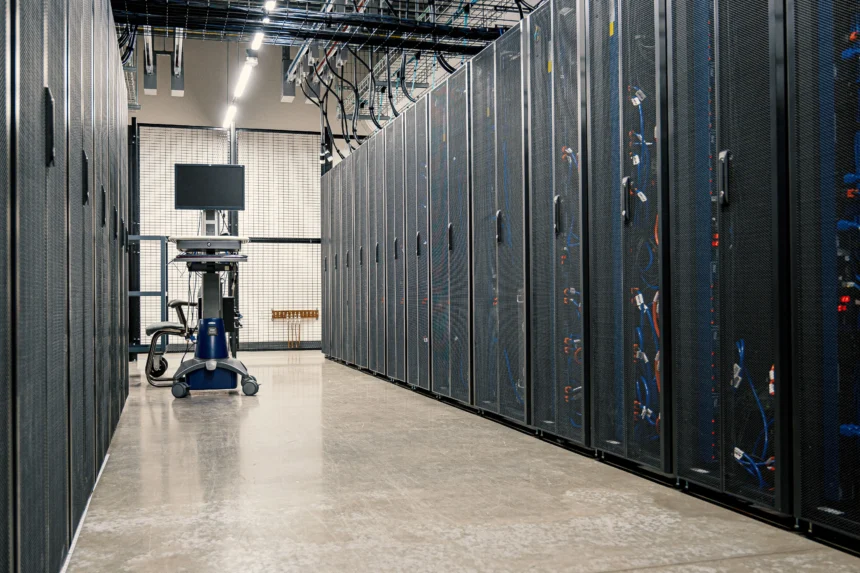
Why AI Data Centers Cost So Much: The Real Price of Building AI
A request to an AI chatbot may take only seconds, but the machines producing that answer can sit inside infrastructure projects costing billions of dollars. AI data centers are not simply warehouses filled with computers. They are industrial-scale computing facilities that combine advanced processors, high-speed networks, substantial electricity supplies and cooling systems built to operate around the clock.
The cost of AI data centers has become a defining question of the artificial intelligence boom. The scale is striking. In its 2026 global data center outlook, property consultancy JLL forecast average construction costs of approximately $11.3 million per megawatt (MW). Crucially, that covers a facility’s shell and core—not the land or the computers inside it. JLL said fitting out space with AI technology can cost as much as $25 million per MW. Those are different costs, and combining them explains how an apparently ordinary industrial building can become a multibillion-dollar project.
How Much Does an AI Data Center Actually Cost?
There is no universal price tag for AI data centers. A small enterprise facility, a leased cluster of graphics processors and a purpose-built 100 MW campus have very different budgets. A useful illustration is a hypothetical 100 MW facility. Applying JLL’s global 2026 benchmark produces the following scale estimate, not a quotation for any specific project:
| Cost category | Illustrative calculation | Amount |
|---|---|---|
| Shell and core construction | 100 MW × $11.3 million per MW | About $1.13 billion |
| AI technology fit-out | 100 MW × up to $25 million per MW | Up to $2.5 billion |
| Combined illustration | Construction plus upper-end fit-out | Up to about $3.63 billion |
The calculation deliberately excludes potentially significant land purchases, external grid upgrades, financing costs and future operating bills. Not every center uses the most expensive AI fit-out.
Still, the example reveals the central problem: constructing the building is only one part of the bill. To understand why AI data centers cost so much, it helps to examine seven expenses that reinforce one another.
1. AI Chips Are Extremely Expensive—and They Need More Than GPUs
The first major cost is computing hardware. Training large models involves performing enormous numbers of mathematical operations, often across thousands of specialized processors. AI data centers rely on graphics processing units (GPUs), tensor processing units (TPUs) and other accelerators because ordinary CPUs alone are not efficient enough for many demanding AI tasks.
Inside AI data centers, modern accelerators contain advanced semiconductor designs and high-bandwidth memory (HBM) that lets processors exchange data at very high speed. Their price reflects chip design, sophisticated manufacturing, packaging, memory and strong demand. Purchasing a processor is not like buying an ordinary desktop graphics card: operators usually procure complete server platforms with CPUs, memory, interconnects, power electronics and support contracts.
Consider NVIDIA’s GB200 NVL72 platform. Its rack-scale design brings together 72 Blackwell GPUs and 36 Grace CPUs, connected through specialized high-speed links and liquid cooling. The rack is effectively an integrated computing system rather than a stack of unrelated servers. NVIDIA does not publish a universal transaction price for every deployment, so any single online price claim should be treated cautiously.
Hardware demand in AI data centers also changes with workload. Large-scale training requires coordinated processing across an entire cluster. Inference—the work of responding to real users—may prioritize fast responses, memory capacity and efficient serving. Both consume equipment budgets, and both must support software that keeps processors busy. Our large language models guide explains these different workloads, while our AI chips and data centers guide examines the hardware behind them.
2. Networking and Storage Turn Individual Servers Into a Supercomputer
Buying thousands of accelerators does not automatically create a useful AI cluster. During training, processors must regularly exchange information and synchronize their work. If they spend too much time waiting for data, costly chips deliver far less computation than their specifications suggest.
That is why AI data centers invest heavily in high-bandwidth networking equipment: switches, network interface cards, specialized links, optical transceivers, cables and complex network management. NVIDIA’s NVLink is one example of technology designed for communication within tightly connected accelerated systems; InfiniBand and advanced Ethernet networks can connect larger groups of machines.
Storage creates another substantial expense. Operators need large, fast systems to hold training datasets, model checkpoints, application data and frequently accessed information. Data must be available without interrupting expensive processing jobs.
The networking bill for AI data centers depends on the performance required. A highly interconnected research cluster cannot always use the cheaper networking found in a conventional corporate server room. Faster networks may increase upfront spending but reduce the number of hours a training job occupies the cluster.
3. Buildings, Land and Electrical Equipment Are Industrial Projects
AI data centers need much more than empty structures. Developers must secure land, obtain permits, prepare roads and foundations, and create space for dense rows of computing racks. Facilities may require substations, transformers, switchgear, electrical distribution, fire protection, physical security, ventilation and backup-power equipment.
In AI data centers, those components must support continuous service and expansion. A building that looks like a warehouse from the outside may contain the electrical and mechanical complexity of a major industrial plant. The cost also changes dramatically between locations: land prices, construction labor, environmental requirements and access to existing transmission infrastructure can differ widely.
JLL estimates average global construction costs rose from $7.7 million per MW in 2020 to $10.7 million in 2025, with a further increase forecast for 2026. Its figures refer to shell-and-core construction; they should not be confused with the cost of the GPUs. Liquid-cooled developments can also command a construction premium over comparable air-cooled designs.
In its 2026 Asia-Pacific data center outlook, CBRE identified land prices, advanced cooling systems and regulatory compliance among the forces raising development costs. AI data centers also compete for specialist construction teams, electrical engineers and equipment suppliers.
Why the Cheapest Land Is Not Always the Best Location
For AI data centers, remote sites may offer inexpensive land but lack a suitably powerful electricity connection, adequate fiber connectivity or a trained workforce. Bringing these services to the location could erase the saving. Developers increasingly evaluate land by how quickly they can secure power—not just by its purchase price.
4. Electricity Is Both a Building Cost and a Permanent Expense
Electricity is a defining constraint on AI data centers. Large processor clusters use power to perform calculations, move information and run the support equipment that keeps those calculations possible. Operators must first secure sufficient electrical capacity, then pay for the energy used throughout the facility’s life.
The International Energy Agency’s 2026 analysis estimated that data centers consumed approximately 485 terawatt-hours (TWh) in 2025 and projected around 950 TWh in 2030 under its central scenario. These figures cover all data centers, not just AI-specific facilities. The IEA expects consumption at AI-focused sites to grow faster than the industry as a whole.
For AI data centers, getting power is often harder than paying for it. A new site may need utility studies, transmission upgrades, substations or special agreements. Transformers and other equipment can have long procurement lead times. A completed building without adequate power is not a productive AI factory.
What a 100 MW Facility Could Pay for Electricity
The electricity costs of AI data centers become clearer in a hypothetical example. Suppose a center has 100 MW of IT load, operates at that level continuously, and achieves a power usage effectiveness (PUE) of 1.2. PUE compares total facility electricity with electricity delivered to IT equipment, so the total site draw would be 120 MW.
At an assumed electricity price of $0.08 per kilowatt-hour, the annual energy bill would be:
120,000 kW × 8,760 hours × $0.08 = $84.1 million per year.
This is a hypothetical calculation, not an industry-wide tariff or a real facility’s bill. It assumes constant full load and excludes demand charges, taxes, network fees and any special power contracts. Actual utilization and electricity prices can change the result considerably.
Efficiency matters at this scale. At PUE 1.5 under the same assumptions, the facility would draw 150 MW and spend about $105.1 million annually—roughly $21 million more. The Uptime Institute’s 2026 efficiency analysis reported an industry-wide annual average PUE of 1.52, although newer large sites can achieve much lower figures. Comparing those values illustrates the potential savings; it does not mean every facility can reach PUE 1.2.
This is one reason companies invest in advanced power distribution, cooling designs and energy management. Higher construction costs can sometimes reduce years of electricity spending.
5. Cooling Becomes Harder as More Chips Fit Into Each Rack
In AI data centers, nearly all electricity used by computing equipment eventually becomes heat. Traditional air-conditioning can still serve many data centers, but very high-density AI racks often need more sophisticated approaches.
Direct-to-chip liquid cooling, for example, circulates coolant through cold plates attached to processors. The full system may include pumps, cooling distribution units, heat exchangers, piping, leak monitoring and external heat-rejection equipment. A design that uses liquid cooling for the hottest components may still need fans and air cooling for everything else.
For AI data centers, such systems are expensive to install and maintain. They may also require modifications to floor layouts, rack plumbing and building mechanical systems. Yet they can allow many more processors to fit into a smaller footprint, making the extra investment worthwhile.
Cooling raises a second question: water. Some sites use evaporative cooling, which can reduce electricity consumption but consume water. Others rely more heavily on dry cooling or closed-loop arrangements, changing their water and energy requirements. Google explained in its 2026 water stewardship update that water-cooled approaches can save electricity in some locations, while the company also faces a responsibility to manage local water impacts.
A system suitable for a cool coastal location may not make sense in a hot, water-stressed region. Operators must balance capital spending, ongoing power bills, reliability, water availability and environmental rules.
6. Reliability, Security and Backup Systems Cannot Be Optional
When a server fails in an ordinary office, a few employees may lose access to an application. When a major AI cluster goes offline, thousands of processors can stop delivering paid computing services. Long training jobs may be interrupted, and customer-facing applications can become unavailable.
Reliability therefore has a price. AI data centers need carefully designed electrical paths, uninterruptible power supplies, backup generation or other resilience arrangements, monitoring systems, spare components and maintenance programs. Their redundancy levels vary: not every facility is built to the same reliability standard, and extra redundancy must be justified against cost and business risk.
Physical security and cybersecurity add another layer. Data centers protect customer information, valuable hardware, proprietary model files and networking systems. Operators invest in access controls, surveillance, trained personnel, segmentation, incident response and continuity planning.
The Uptime Institute’s 2026 global survey identified rising costs, power constraints, supply-chain delays and staffing shortages as continuing concerns. Greater resilience protects revenue and customer trust, but it adds equipment, labor and inspection costs long before a failure ever occurs.
7. Financing, Skilled Workers and Hardware Replacement Keep the Bill Growing
For AI data centers, the expense does not end when a facility opens. Its operating budget must cover engineers, technicians, software, networking support, maintenance, security, insurance and replacement parts. Skilled workers are especially important because errors in electrical or cooling systems can damage expensive equipment or cause prolonged outages.
AI data centers also contain assets with very different useful lives. Buildings and some electrical systems may serve for decades. GPUs and other computing hardware can become less competitive much sooner as newer systems improve performance per watt or per dollar. That creates a continuing decision: keep older chips running, move them to less demanding work, or spend again to upgrade.
Financing AI data centers compounds the risk. A developer may borrow to build facilities before every tenant is signed. Interest costs, leases and construction delays can erode returns. Even well-funded technology companies must consider depreciation, utilization and whether customers will pay enough for AI services to cover their capital commitments.
This explains why the economics of the AI spending boom remain contentious. Capacity can be essential for the future of computing while individual projects still fail to earn an attractive return.
Why Is Big Tech Spending Hundreds of Billions Anyway?
The investment makes more sense when viewed as a competitive race for computing capacity. AI models must be trained, but once launched they also need hardware to serve users. Applications such as coding assistants, search tools, image generators and AI agents can produce sustained demand.
Recent corporate guidance shows the scale. In its third-quarter 2026 results, Amazon maintained an expectation of approximately $220 billion in cash capital expenditure for 2026. Meta’s third-quarter 2026 results forecast $135 billion to $145 billion of capital expenditure, including principal payments on finance leases.
These are company-wide capital spending forecasts, not the construction costs of individual AI data centers and not exclusively AI expenditures. They illustrate how much financial capacity large technology businesses are directing toward infrastructure and related investment.
JLL projects that roughly 100 GW of additional data-center capacity could be developed between 2026 and 2030. Including both real-estate development and tenant technology fit-outs, its analysis suggests investment approaching $3 trillion over the period. That is a forecast for the broader data-center market, not a guaranteed AI-only spending total.
The pressure is tangible in property markets. CBRE’s first-half 2026 North American research found that more than 80% of under-construction capacity in major markets was preleased. Securing space and power early can provide a competitive advantage, although building too quickly carries obvious financial risks.
Can AI Data Centers Become Cheaper?
AI data centers can become cheaper, but the relationship between computing efficiency and total spending is complicated. New processors can perform more work per watt. Better model architectures, quantization and smaller specialized models may reduce the computing required for an individual task. Improved networking and scheduling can also raise utilization, meaning existing equipment produces more useful output.
Energy efficiency can also improve the economics of AI data centers. Better cooling and power distribution can lower operating bills, while selecting locations with suitable grids may avoid costly delays. Companies can also lease capacity instead of building facilities themselves. That changes who pays the upfront bill, but it does not eliminate the underlying infrastructure cost; cloud and colocation operators still need to recover their investments. Our cloud computing guide explains how this pay-for-capacity model works.
However, lower cost per AI task does not guarantee lower industry electricity use or construction spending. Cheaper services can attract many more users and make computationally intensive features commercially viable. The IEA’s 2026 analysis observes this tension: efficiency per task is improving rapidly even while overall AI-related electricity demand rises.
The most important measure may therefore be cost per useful AI output, not simply cost per rack or total megawatts installed. A facility that costs more initially but generates more reliable, valuable work at lower energy use can be a better investment than a cheaper building full of inefficient hardware.
What These Expensive Facilities Mean for Everyone Else
AI data centers can bring construction activity, skilled employment and investment to their host regions, but their growth also raises difficult questions about electricity supply, local water resources and who pays for infrastructure upgrades. If a utility must expand its network for a large new customer, regulators and communities may debate how to allocate those costs.
The IEA’s October 2026 report on powering artificial intelligence examines policies intended to integrate data centers into electricity systems without compromising affordability, reliability or sustainability. The report highlights an important distinction: the effects are local and depend on planning, rate design and available power. A new data center does not automatically raise every household’s electricity bill, just as an infrastructure investment does not automatically benefit every resident. For businesses buying AI tools, these economics can surface in cloud prices, access limits, subscription tiers and charges for advanced features.
Frequently Asked Questions
Why are AI data centers more expensive than traditional data centers?
AI data centers often require dense clusters of specialized accelerators, unusually fast networking, high electrical capacity and advanced cooling. Conventional facilities may need many of the same systems, but high-performance AI deployments can require more expensive configurations per unit of space.
How much does it cost to build a 100 MW AI data center?
Using JLL’s 2026 global average, 100 MW of shell-and-core construction would illustrate about $1.13 billion before land and IT hardware. An upper-end AI fit-out could add substantially more. Actual project prices vary widely and should not be inferred from this simple calculation alone.
What costs more: the GPUs or the building?
The balance varies across AI data centers. JLL’s outlook indicates that advanced AI technology fit-outs can cost more per MW than shell-and-core construction. In less intensive deployments, the balance may be different.
The Real Reason AI Infrastructure Costs Billions
The largest misunderstanding about AI data centers is treating them as expensive buildings rather than interconnected computing systems. The GPUs need memory. The memory-intensive processors need fast networks. The networks and servers need reliable power. High power density requires cooling. All of it needs a secure building, skilled workers and continuous maintenance.
In AI data centers, these expenses multiply rather than replace one another. Saving money on one component can even increase costs elsewhere: cheaper land may require grid upgrades, denser racks can demand liquid cooling, and faster GPUs may expose slow networking as the next bottleneck.
That is why AI data centers are becoming some of the most capital-intensive projects in the technology industry. The next phase of competition will not simply reward whoever installs the most chips. It will reward those who can turn enormous infrastructure spending into useful, reliable computing services at a sustainable cost.
For continuing analysis of artificial intelligence, infrastructure and technology markets.
Follow The News Ink
For more research-driven explainers, science coverage and global stories, follow The News Ink on X, Instagram, Threads, Medium, Substack, Bluesky, Pinterest, TikTok, Quora and Mastodon.