




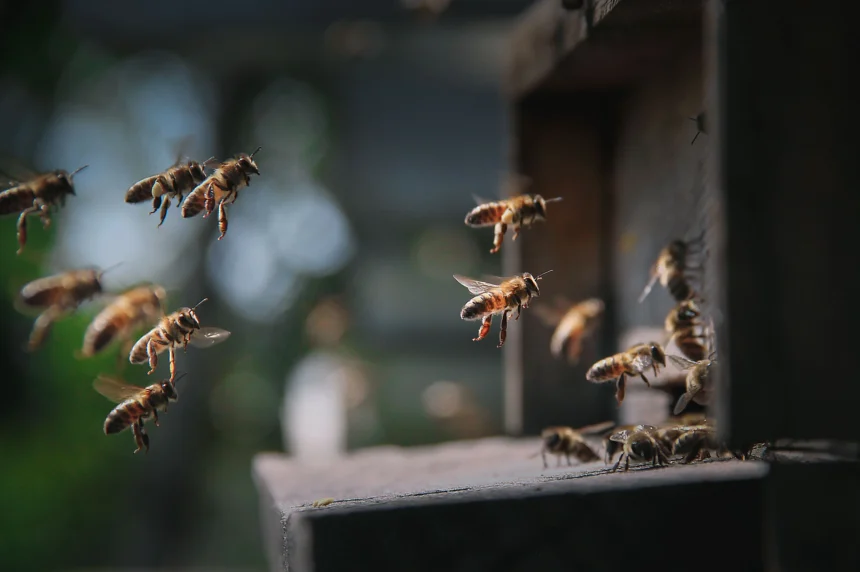
What Would Happen If Bees Disappeared From Earth?
Imagine waking up one spring morning and hearing something missing.
No buzzing around flowering trees.
No honey bees entering orchards.
No bumblebees moving between tomato flowers.
No solitary bees emerging from holes in the ground.
Every one of Earth’s thousands of bee species has disappeared.
What happens next?
The popular version of this scenario usually becomes apocalyptic within seconds: crops fail, supermarkets empty and humanity starves.
The reality is more complicated.
If bees disappeared, humans would not immediately run out of food. Rice would still grow. Wheat would still grow. Corn would still grow. Potatoes, cassava and many other major staple foods do not require bees to produce the calories humanity depends on.
But that should not make the scenario sound harmless.
Bees are among the world’s most important pollinators, and losing them would transform agriculture, diets and natural ecosystems.
Foods such as almonds, apples, blueberries, cherries, pumpkins and many other fruits, vegetables, nuts and seeds would become more difficult and expensive to produce. Some harvests could fall sharply. Food quality could decline. Farmers would need alternative pollination methods. Wild flowering plants would lose some of their most important reproductive partners.
The effects would then spread outward.
Fewer flowers produce fewer fruits and seeds.
Animals that eat those fruits and seeds lose food.
Plant communities begin changing.
Farmers expand land or attempt expensive artificial pollination.
Consumers pay more for nutrient-rich foods.
The result would not be the instant end of civilization.
It would be a slower and much broader ecological and economic shock.
According to the UN Food and Agriculture Organization, roughly three-quarters of the world’s major food-crop types benefit to some degree from animal pollination, while about 35% of global crop-production volume is associated with crops that depend at least partly on pollinators. Bees are only part of that system—flies, moths, butterflies, beetles, birds and bats pollinate too—but bees are among its most important members. FAO’s global pollination program identifies more than 25,000 bee species worldwide.
So what would really happen if bees disappeared?
If Bees Disappeared: What Would Change?
| Area | Likely Consequence |
|---|---|
| Wheat, rice and maize | Continue growing because they do not depend strongly on bees |
| Fruits and nuts | Many yields fall, sometimes substantially |
| Vegetables | Some remain largely unaffected; others produce fewer fruits or seeds |
| Almond production | Severe disruption because commercial orchards rely heavily on bee pollination |
| Honey | Disappears completely |
| Food prices | Many pollinator-dependent foods become more expensive |
| Human nutrition | Diets become less diverse and micronutrient-rich foods become harder to obtain |
| Wild plants | Reproduction declines in many bee-pollinated species |
| Wildlife | Seed- and fruit-eating animals lose food resources |
| Agriculture | More hand pollination, managed alternative pollinators and technology |
| Ecosystems | Long-term shifts in plant and animal communities |
| Humanity | Survives, but with a poorer, more expensive and ecologically damaged food system |
The most important detail is that bee extinction and complete pollinator extinction are not the same scenario.
Even if bees disappeared, butterflies, flies, beetles, moths, birds, bats and other pollinators would remain.
They could replace some lost pollination.
They could not necessarily replace all of it.
There Is Not Just One Kind of Bee
When people imagine what happens if bees disappeared, they usually picture the Western honey bee, Apis mellifera.
But honey bees represent only a tiny fraction of bee diversity.
FAO estimates that there are more than 25,000 bee species, most of them wild rather than managed.
They include:
bumblebees,
mason bees,
leafcutter bees,
mining bees,
sweat bees,
carpenter bees,
stingless bees,
and thousands of less familiar species.
Many live alone rather than in colonies.
Some nest underground.
Others live inside hollow stems or wood.
And different species are good at pollinating different plants.
This diversity matters.
A honey bee does not perform every agricultural pollination job equally well.
Bumblebees, for example, are exceptionally effective at buzz pollination, in which vibrations release pollen from flowers such as tomatoes and blueberries.
Certain native bees are particularly effective at squash and pumpkin pollination.
The U.S. Geological Survey notes that the United States alone has roughly 4,000 native bee species and that many crops benefit significantly from native bee activity. USGS’s native bee overview also notes that a substantial share of native bees specialize on particular groups of plants.
So if bees disappeared, agriculture would lose much more than commercial honey-bee colonies.
It would lose an enormous library of specialized pollination behavior that evolved over millions of years.
1. Supermarkets Would Not Become Empty Overnight
This is the first myth worth correcting.
Most human calories come from crops that are not primarily bee-pollinated.
These include major staples such as:
wheat,
rice,
maize,
potatoes,
cassava,
and many other grasses or root crops.
Wheat, rice and maize are largely wind-pollinated or self-pollinating.
Bees are not required to move pollen from flower to flower for these crops to produce grain.
The IPBES global pollinator assessment concluded that around 60% of global crop-production volume comes from crops that do not depend on animal pollination, while about 35% comes from crops that benefit from it. The IPBES pollinator assessment also showed that the degree of dependence varies greatly from one crop to another.
That means if bees disappeared, humanity would still produce vast quantities of calories.
Bread would not vanish.
Rice would not vanish.
Corn would not vanish.
The crisis would instead hit the diversity and nutritional quality of the food system much harder than its basic calorie supply.
2. Fruit Aisles Would Change Dramatically
Walk through the fruit section of a supermarket and the effect becomes much easier to understand.
Bee pollination contributes to many crops including:
apples,
pears,
cherries,
blueberries,
raspberries,
strawberries,
peaches,
plums,
kiwifruit,
and melons.
The level of dependence differs.
Some crops can produce fruit without bees but yield more or produce better-shaped fruit when pollination is strong.
Others are substantially more dependent.
If bees disappeared, the likely result would therefore not be that every apple tree instantly stopped producing apples.
Instead, yields could decline, fruit quality could become less consistent and production costs could rise.
A major 2024 global study examined more than 198,000 plant-pollinator interactions across 32 crop species and found that 28% to 61% of studied crop systems showed evidence of insufficient pollinator visitation. Blueberries, coffee and apples were among crops frequently showing pollination limitation. The Nature Ecology & Evolution study found that improving pollinator visitation could close a substantial share of yield gaps in affected fields.
And that is with bees still present.
If bees disappeared completely, many of those systems would face a much more severe problem.
3. Almond Farming Would Face an Immediate Crisis
Few agricultural industries demonstrate bee dependence better than almonds.
Commercial almond orchards produce enormous numbers of flowers within a short blooming period.
Growers need those flowers pollinated quickly.
In major producing regions, managed honey-bee colonies are transported into orchards specifically for this task.
The USDA notes that honey bees contribute to more than $15 billion worth of U.S. crop production annually, including almonds, apples and numerous fruits and vegetables. USDA’s pollinator overview describes managed honey bees as a major agricultural pollination resource.
If bees disappeared, conventional almond production would therefore face an enormous disruption.
Some newer almond varieties are self-fertile, and other insects could provide limited assistance, but simply replacing the existing pollination system would not happen overnight.
The industry could respond by:
developing more self-compatible varieties,
encouraging non-bee pollinators,
using artificial pollination,
or changing orchard designs.
All of these require time and money.
Almonds would probably still exist.
They would likely become considerably more expensive.
4. Honey Would Disappear Completely
One product has a much simpler outcome.
Honey would be gone.
No bees means no honey.
Commercial beekeeping would disappear as an industry, along with products including:
beeswax,
royal jelly,
bee pollen,
propolis,
and other materials derived from managed bee colonies.
That economic damage would be significant for millions of beekeepers and rural households.
But honey production is actually the smaller issue.
The agricultural value of bees as pollinators is much greater than the value of the honey they produce.
A hive sitting in an orchard may create far more value through the fruit it helps produce than through honey.
That is why if bees disappeared, the biggest losses would occur outside the honey aisle.
5. Vegetables Would Become Less Diverse
The vegetable section would not disappear either.
Leafy vegetables such as lettuce can still be grown for their leaves without needing bees to create the part consumers eat.
Root crops such as carrots can similarly produce edible roots before flowering.
But there is a catch.
Farmers still need seeds to grow the next generation.
Some vegetable seed production relies on insect pollination.
Other vegetables are grown for fruits that develop after pollination.
Examples include:
cucumbers,
squash,
pumpkins,
peppers,
eggplants,
and tomatoes.
The degree of bee dependence varies among them.
Tomatoes can self-pollinate, for example, but bumblebee buzz pollination is widely used in greenhouse tomato production because it can improve pollination efficiency.
So if bees disappeared, the vegetable supply would become more complicated rather than simply disappearing.
Some crops would continue normally.
Others would become harder to produce efficiently.
6. Food Would Become Less Nutritious
This may be one of the most important consequences.
Staple crops are excellent at supplying calories.
But fruits, vegetables, nuts and seeds provide many of the vitamins, minerals and beneficial compounds required for healthy diets.
Pollinator-dependent foods are disproportionately represented among these nutrient-rich categories.
A modeling study published in Environmental Health Perspectives estimated that current inadequate pollination already reduces global fruit, vegetable and nut production by several percent and associated those losses with a substantial health burden through poorer diets. The study indexed by PubMed modeled approximately 427,000 excess deaths annually under current pollination deficits, although such numbers depend strongly on model assumptions.
That study examined all animal pollinators rather than bees alone.
Still, it shows why if bees disappeared, the health consequences would not simply be about hunger.
People could replace some missing calories with:
rice,
bread,
corn,
potatoes,
and other staple foods.
Replacing the vitamins and dietary diversity lost from fruit, nuts and vegetables would be harder.
The News Ink’s Healthy Lifestyle guide explains why dietary diversity and nutrient-rich foods matter beyond simply consuming enough calories.
7. Food Prices Would Rise
Reduced production does not automatically mean a food disappears.
Markets react.
When supply falls while demand remains high, prices tend to rise.
Farmers would also face higher costs.
They might need to:
hire workers for manual pollination,
rent alternative pollinators,
invest in mechanical systems,
change crop varieties,
expand farmland,
or accept lower yields.
All of those costs eventually move through supply chains.
A 2025 Nature Communications study modeled a hypothetical collapse of wild pollinators in Europe—not bees specifically—and estimated that pollination-dependent crop output could fall sharply while producer prices for those products increased by roughly 19%. The European pollinator-collapse study also projected wider effects on trade and consumer welfare.
The exact numbers cannot simply be transferred to a worldwide bee-extinction scenario.
But the economic mechanism is clear.
If bees disappeared, strawberries would not necessarily become extinct.
They could become a luxury.
8. Farmers Would Try to Pollinate Crops by Hand
Artificial pollination already exists.
In some agricultural regions where natural pollination is insufficient, workers manually transfer pollen between flowers.
Humans can:
use brushes,
carry pollen,
shake flowers,
spray pollen,
or operate specialized machines.
But scaling that approach across global agriculture would be extraordinarily expensive.
Consider the basic difference.
A bee:
flies independently,
locates flowers,
collects food while working,
moves between thousands of flowers,
and requires no hourly wage.
A human worker performing the same function needs transport, training and payment.
Robotic pollination could eventually help.
Drones and autonomous machines are already being researched for precision agriculture and flower-level tasks, but they remain nowhere close to replacing tens of thousands of bee species operating across natural and agricultural landscapes.
The News Ink’s guide to agricultural robots explains how rapidly farm automation is progressing—and why unpredictable living environments remain difficult for machines.
If bees disappeared tomorrow, technology would not be ready to fill the gap tomorrow afternoon.
9. Other Pollinators Would Take Over Some of the Work
This distinction is essential.
The disappearance of bees does not mean the disappearance of pollination.
Flowers are also visited by:
flies,
hoverflies,
butterflies,
moths,
beetles,
wasps,
birds,
bats,
and other animals.
Wind and self-pollination also reproduce many plants.
Some non-bee pollinators could increase in abundance when competition from bees disappeared.
Over evolutionary timescales, some plant-pollinator relationships might also change.
That provides a partial biological safety net.
But not a complete one.
Bees are extraordinarily efficient pollinators because their entire lifestyle revolves around collecting pollen and nectar.
Many have hairy bodies that pick up pollen grains.
They deliberately visit flowers repeatedly.
Some species specialize in particular plants.
FAO emphasizes that agricultural resilience comes from diversity among pollinators, not dependence on one managed species.
Therefore the correct statement is not:
If bees disappeared, pollination would stop.
It is:
If bees disappeared, one of the world’s largest and most specialized groups of pollinators would suddenly be removed.
10. Wild Plant Communities Would Begin Changing
Agriculture is only part of the story.
Bees existed long before humans created farms.
Their ecological relationships are embedded in natural ecosystems.
The USGS says roughly 75% of North American plant species require insects—mostly bees—to transfer pollen effectively.
Some native bees specialize so strongly that they collect pollen only from one plant species or a small group of related plants.
That creates a delicate relationship.
Plant feeds bee.
Bee pollinates plant.
Remove either side and the other may decline.
If bees disappeared, some flowering plants could continue using alternative insects.
Others would reproduce less successfully.
Some specialist plants could gradually disappear from particular ecosystems.
The News Ink’s article on how cities are helping wildflowers survive shows how strongly plant diversity already depends on available habitat and pollinator-friendly environments.
Bee extinction would add another enormous pressure.
The Problem Would Spread From Plants to Animals
A plant does more than make flowers.
It may produce:
berries,
nuts,
seeds,
leaves,
shelter,
and nesting habitat.
Birds eat berries.
Rodents eat seeds.
Mammals eat fruit.
Caterpillars consume leaves.
Predators then eat those herbivores.
This means if bees disappeared, the ecological consequences would travel through food webs.
A decline in one bee-dependent flowering plant could reduce food for several animal species.
Those animals could then decline or shift to other resources.
That increases pressure elsewhere.
Ecological collapse rarely happens because every species disappears simultaneously.
It happens through chains of dependency.
Plant Diversity Would Matter More Than Ever
Modern agricultural landscapes often contain enormous fields of one crop.
From the perspective of a bee, such environments can alternate between abundance and starvation.
When the crop flowers, food appears everywhere.
After flowering ends, resources can disappear.
Natural habitats provide a more continuous mixture of:
flowers,
nesting locations,
wood,
bare soil,
hedgerows,
and vegetation.
That is one reason habitat conservation matters so much for wild bees.
A 2025 global study across 681 crop fields found that both pesticide pressure and declining semi-natural habitat were associated with lower wild-bee abundance and species richness. The Nature Ecology & Evolution analysis found the pressures could act together rather than simply substituting for one another.
This matters because if bees disappeared is a hypothetical extreme.
The real conservation challenge is preventing losses from moving further in that direction.
Climate Change Would Make Replacement Harder
Bee populations do not experience one threat at a time.
Climate change can alter:
flowering dates,
temperature extremes,
drought frequency,
rainfall,
and geographic ranges.
A flower may begin blooming earlier.
Its traditional pollinator may not shift its life cycle by exactly the same amount.
The relationship can become less synchronized.
Habitat loss, disease and pesticide exposure can then add additional stress.
UNEP identifies land-use change, intensive agriculture, pesticides, invasive species, pests, disease and climate change among the major pressures affecting pollinators. UNEP’s pollinator assessment summary emphasizes that causes and vulnerability differ among regions and species.
The News Ink’s Climate Change Explained guide covers how temperature and rainfall changes can affect ecosystems and agriculture more broadly.
If bees disappeared, other pollinators would inherit more ecological work precisely while many of those species are facing environmental pressures of their own.
Would Forests Disappear?
No.
Many forest trees are wind-pollinated.
Conifers do not need bees.
Many major temperate trees including oaks also rely heavily on wind.
So bee extinction would not cause every forest to collapse.
But forests are more than trees.
Their understory can contain:
flowering shrubs,
wildflowers,
berries,
vines,
and other bee-pollinated plants.
Those species help feed wildlife and contribute to ecosystem diversity.
If bees disappeared, the structure of some forest ecosystems could gradually change even if the dominant trees survived.
Again, the effect is about biodiversity rather than simply whether vegetation remains green.
NASA studies these kinds of connections between vegetation, climate, water and land as part of its broader Earth-system work. The News Ink’s NASA Earth Science guide explains why changes to one biological component can influence much larger environmental systems.
Would Coffee Disappear?
Probably not completely.
This is another area where headlines often oversimplify.
Coffee species differ in their pollination biology.
Arabica coffee can self-pollinate, but insect visitation—particularly by bees—can increase fruit set, yield or quality under many conditions.
Robusta coffee is more dependent on cross-pollination.
So if bees disappeared, coffee production could decline in some regions and become more expensive.
But saying all coffee would instantly disappear would be inaccurate.
The same caution applies to many crops.
“Pollinator-dependent” does not necessarily mean:
zero bees = zero crop.
It can mean:
zero bees = lower yield, lower quality or higher production cost.
What About Chocolate?
Chocolate provides an even better example of why “all pollinators” should not be confused with “all bees.”
Cacao flowers are pollinated primarily by tiny insects such as biting midges, not honey bees.
Therefore if bees disappeared, chocolate would not automatically disappear simply because bees were gone.
Cacao could still face indirect ecological effects, but its main pollinating system is different.
This matters because popular bee articles frequently list every pollinator-dependent food as though bees alone are responsible.
Science is messier.
Different plants evolved with different pollinators.
Could Evolution Eventually Replace Bees?
Given enough time, ecosystems would adapt.
Plants that could:
self-pollinate,
use wind,
or attract other insects
might gain an advantage.
Non-bee pollinators could expand into newly available ecological niches.
Plant species completely dependent on specialized bees would be at much greater risk.
Over thousands or millions of years, new relationships could evolve.
But evolution would not rescue twenty-first-century agriculture quickly.
Humans depend on food systems operating this year and next year.
Farmers cannot wait 50,000 years for a fly lineage to evolve into a perfect replacement for a lost bee.
That is why if bees disappeared suddenly, the speed of disappearance would matter as much as the eventual ability of ecosystems to adapt.
More Farmland Might Be Needed
Suppose a pollinator-dependent crop loses 20% of its yield.
Society still wants the same amount.
One response is to grow more land.
That creates another problem.
Additional farmland can mean:
forest clearing,
grassland conversion,
habitat destruction,
higher water demand,
more fertilizer,
and more greenhouse-gas emissions.
Older global agricultural modeling has estimated that total loss of animal pollination could directly reduce overall crop production by several percent and increase pressure to expand agricultural land.
That again concerns all animal pollination, not bees alone.
But if bees disappeared, similar pressure could emerge for heavily bee-dependent crops.
The irony is obvious.
Bee loss could encourage agricultural expansion.
Agricultural expansion can destroy additional pollinator habitat.
It becomes a reinforcing cycle.
Would Humanity Go Extinct?
There is no scientific basis for claiming humans would automatically go extinct a few years if bees disappeared.
Humans are extremely adaptable omnivores.
Major staple foods would continue.
Other pollinators would remain.
Farmers would change crops.
Breeders would favor self-fertile plants.
Artificial pollination would expand.
Greenhouse systems would adapt.
Governments would subsidize affected foods.
Agriculture would survive.
But survival is a very low standard.
A civilization can survive while becoming:
less healthy,
more expensive,
less biodiverse,
and more vulnerable.
That is the realistic danger.
Current Bee Declines Are Not the Same as Global Bee Extinction
There is another important correction.
Bees are under pressure, but every bee species on Earth is not currently disappearing at the same rate.
Some species are declining seriously.
Some populations remain stable.
Managed honey-bee numbers can increase even while wild-bee diversity declines.
Regional patterns differ.
And agricultural systems have sometimes compensated by moving managed colonies into crops that lack sufficient natural pollination.
A new 2026 global analysis of pollinator-dependent crops found that pollination limitation remains widespread but appears to have declined over recent decades, particularly where managed pollinators are used. The 2026 PNAS study argues that modern pollination management has so far helped buffer some agricultural impacts of wild-pollinator declines.
That finding does not mean bee conservation is unnecessary.
It means the present situation should not be exaggerated into a fictional worldwide agricultural collapse.
Ironically, the study also demonstrates why if bees disappeared completely would be so disruptive.
One of agriculture’s current methods for dealing with weak natural pollination is to bring in managed bees.
In this thought experiment, that backup disappears too.
What Would Happen During the First Few Years?
The sequence might look something like this.
First Growing Season
Farmers immediately discover which crops depended most heavily on bee visitation.
Pollination services disappear.
Fruit and seed set decline in vulnerable crops.
Almonds and many orchard crops experience serious disruption.
First Few Years
Prices rise.
Farmers reduce production of uneconomic crops.
Researchers accelerate work on:
self-pollinating varieties,
mechanical pollination,
alternative insects,
and robotic systems.
Longer Term
Agriculture becomes reorganized around crops easier to pollinate without bees.
Some foods become uncommon or expensive.
Wild plant communities change.
Bee-dependent species decline.
Wildlife responds to changing seed and fruit availability.
Over Generations
Other pollinators expand into some ecological niches.
Evolution begins favoring plants less dependent on bees.
Some ecological relationships disappear permanently.
That is a far more realistic picture of what would happen if bees disappeared than an overnight global famine.
Why Pollinator Diversity Matters
A 2025 global meta-analysis found that reductions in pollinator diversity consistently lowered plant reproductive success, including seed set and fruit production. Importantly, the effects were often stronger when wild pollinator diversity was lost. The Nature Ecology & Evolution study reinforces why having many different pollinator species provides ecological resilience.
Think of pollinator diversity as biological insurance.
One bee species may perform better in cool weather.
Another handles heat.
One pollinates early in the season.
Another emerges later.
One can reach deep flowers.
Another specializes in a particular crop.
If agriculture relies on one pollinator, one disease can become devastating.
If dozens of species contribute, the system has backup.
That is why protecting bees does not simply mean protecting honey bees.
What Can Actually Help Bees?
Preventing the hypothetical world in which bees disappeared requires much less dramatic actions than trying to rebuild pollination afterward.
Important strategies include:
protecting semi-natural habitat;
planting diverse native flowers;
maintaining flowering plants across the growing season;
reducing unnecessary pesticide exposure;
preserving nesting areas;
supporting hedgerows and field margins;
reducing habitat fragmentation;
protecting wild bees alongside managed colonies.
Agriculture and conservation do not have to be enemies.
Better-designed landscapes can produce food while also maintaining pollinator habitat.
And cities can contribute.
Gardens, parks, roadside vegetation and urban wildflower areas can provide feeding and nesting opportunities when they contain appropriate plants.
Frequently Asked Questions
What would happen if bees disappeared?
If bees disappeared, many fruits, nuts, vegetables and seeds would experience reduced yields, agriculture would become more expensive, honey would vanish and thousands of wild plant relationships would be disrupted. Humanity would survive, but food systems and ecosystems would change substantially.
Would humans die without bees?
Not automatically. Major staple crops including wheat, rice and maize do not depend heavily on bee pollination. Humans could survive, although diets would become less diverse and many nutrient-rich foods would become scarcer and more expensive.
Would all plants die if bees disappeared?
No. Many plants are pollinated by wind, self-pollination or other animals. However, some plants depend strongly on bees and could experience severe reproductive declines.
Would all fruit disappear?
No. Dependence varies among fruits. Many would suffer lower yields or quality rather than complete extinction.
Would almonds disappear?
Commercial almond farming would face severe disruption because bee pollination is extremely important to conventional almond production. Alternative varieties and artificial pollination could eventually compensate partly.
Would coffee disappear if bees disappeared?
Probably not completely. Some coffee plants can self-pollinate, while bees improve production in many systems. Coffee could become harder or more expensive to produce.
Would chocolate disappear without bees?
Not directly. Cacao is mainly pollinated by tiny midges rather than bees. Complete loss of all pollinators would be a different scenario.
Would honey disappear?
Yes. If every bee disappeared, natural and commercial honey production would disappear with them.
Could humans pollinate crops manually?
Yes, for certain crops. But doing it globally would require enormous labor and expense. Artificial systems would work best for high-value crops rather than replacing every wild bee.
Can robots replace bees?
Not at present on anything close to a global ecological scale. Robotic pollination could help selected agricultural crops, but machines cannot currently replace the millions of independent pollination interactions occurring across farms and wild ecosystems.
If Bees Disappeared, We Would Learn Their Value Too Late
Bees are easy to ignore.
They are small.
Most work without anyone watching.
Their economic contribution rarely appears as a separate charge on a supermarket receipt.
An apple does not come with a line saying:
Pollination service: $0.14.
But the service is there.
A bee leaves its nest because it needs food.
It enters a flower.
Pollen attaches to its body.
It visits another flower.
The plant reproduces.
Fruit develops.
Seeds form.
An animal eats those seeds.
A farmer harvests the fruit.
A truck carries it to a store.
A person buys it.
One small biological interaction becomes part of a global food system.
That is why the question of what happens if bees disappeared matters.
The answer is not that humanity immediately dies.
It is more subtle—and, in some ways, more disturbing.
Our calorie supply would continue.
Our food diversity would not.
Wheat fields could still stretch across continents while apples, berries, almonds, pumpkins and many other foods become harder to produce.
Some supermarket shelves would become more expensive rather than completely empty.
People with higher incomes would still obtain many foods through artificial pollination and international trade.
Poorer households would feel the loss much more severely.
Meanwhile, the wild ecosystem would undergo changes that cannot simply be solved by hiring workers with brushes.
Thousands of plant species evolved alongside bees.
Some relationships are specialized.
Others involve networks of many pollinating species.
Remove every bee simultaneously and those networks lose one of their largest components.
Wildflowers decline.
Fruit and seed production shifts.
Animals lose food.
Plant communities reorganize.
And agricultural land may expand as farmers try to compensate for weaker yields.
The world would still be recognizably Earth.
But it would be biologically poorer.
The most important lesson is also the simplest.
If bees disappeared, humans could probably engineer ways to replace some of what they do.
We could breed different crops.
Hire workers.
Build machines.
Move other pollinators.
Change diets.
What we could not do cheaply is recreate the enormous natural system bees already provide every day.
For free.
That is what makes them valuable.
And protecting that system is far easier than trying to rebuild it after it is gone.
Follow The News Ink
Follow The News Ink for research-driven science, nature, agriculture and environmental explainers on X, Instagram, Threads, Medium, Substack, Pinterest, TikTok, Quora, Bluesky and Mastodon.


