Mohamed Salah: Powerful 2026 Farewell After a Painful Liverpool Drought
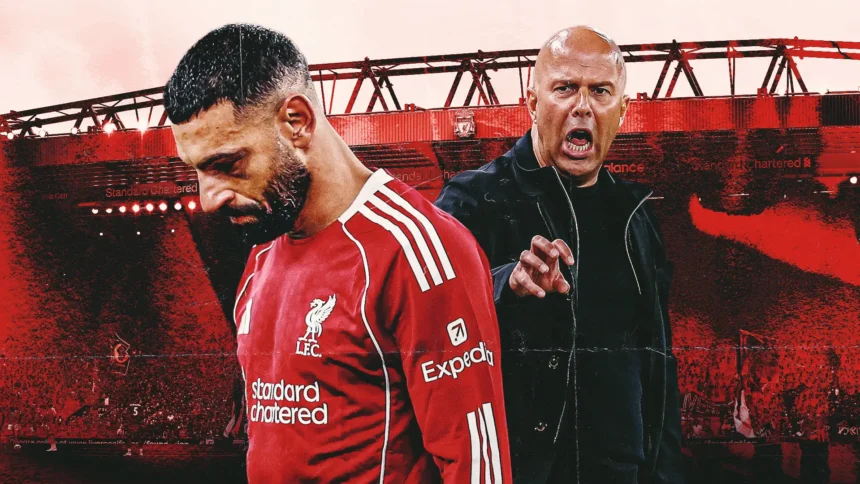
Mohamed Salah’s Premier League goal drought once looked like a temporary form problem. By the end of the 2025/26 season, it had become part of something much bigger: the final chapter of one of the greatest Liverpool careers, the collapse of Arne Slot’s second season and the start of a new Anfield era under Andoni Iraola.
The original question was simple. What lies ahead for Mohamed Salah and Liverpool after a rare dry spell? At the time, Salah had returned from the Africa Cup of Nations, regained his starting place and appeared focused on proving that his relationship with Slot could still work. Liverpool needed goals, balance and leadership. Salah needed rhythm.
The answer now looks very different. Liverpool later announced that Mohamed Salah would leave the club at the end of the 2025/26 season, closing a nine-year spell that brought two Premier League titles, a Champions League, 257 goals, four Golden Boots and a place among the club’s greatest players. Slot also left, and Liverpool appointed Iraola to lead the next rebuild.
That means this article should no longer be written as a short mid-season form update. It should be read as a turning point. The drought did not define Mohamed Salah, but it revealed how fragile the final months had become for both player and club.
For wider tactical background, The News Ink’s football guide explains why attacking output depends on team structure as much as individual finishing.
Why Mohamed Salah’s drought became a bigger Liverpool story
Mohamed Salah has set such extreme standards that a normal dip always looks dramatic. For most forwards, 10 league goal involvements would be a respectable season. For Salah, a long run without a Premier League goal became a crisis because his Liverpool career had been built on relentless consistency.
The drought reached 10 Premier League games after Liverpool beat West Ham 5-2 in February. AP reported that Salah’s last league goal had come on 1 November against Aston Villa and that this was his longest league scoring drought since joining Liverpool from Roma in 2017. That is why the issue attracted so much attention.
But the drought was never only about finishing. It reflected Liverpool’s attacking shape, the way Slot used Salah, the team’s loss of rhythm and the wider question of whether an ageing superstar could still be the centre of a system that needed renewal.
Mohamed Salah was still contributing. He worked harder defensively than critics expected. He created chances. He remained a threat. Yet the numbers around shots, box touches and expected goals suggested a player receiving the ball in less dangerous areas and attacking fewer high-value situations.
That is why the drought mattered. It did not prove Salah was finished. It proved Liverpool had changed around him.
The key timeline of Salah’s final Liverpool season
| Date / period | Development | Why it mattered |
|---|---|---|
| November 2025 | Salah scored his last league goal before the drought against Aston Villa | The run without a Premier League goal began |
| December 2025 | Salah was benched during a difficult period under Arne Slot | His role became a public issue |
| January 2026 | Salah returned from AFCON contention with Egypt | Liverpool needed him back in a difficult run |
| February 2026 | His league drought reached 10 games after the West Ham win | The form debate became impossible to ignore |
| 24 March 2026 | Liverpool announced Salah would leave at the end of the season | The drought became part of a farewell story |
| 24 May 2026 | Salah said goodbye at Anfield after the Brentford match | His Liverpool career ended emotionally |
| 30 May 2026 | Liverpool confirmed Arne Slot would depart | The club’s transition deepened |
| 4 June 2026 | Liverpool appointed Andoni Iraola | A new tactical era began |
This timeline explains why the Mohamed Salah story cannot be frozen at the Nottingham Forest match. The season moved quickly, and the ending changed the meaning of the middle.
Why the drought was not only Salah’s problem
A scoring drought is usually blamed on the striker or winger, but that can be too simple. Mohamed Salah was still the same left-footed forward with elite movement, timing and penalty-box instincts. What changed was the way Liverpool reached him.
Under Jurgen Klopp, Liverpool were built around pace, counter-pressing, quick switches and repeated high-value moments. Salah often received the ball early, wide and with space to attack. He also benefited from the chemistry of Roberto Firmino, Sadio Mane, Trent Alexander-Arnold and Andy Robertson at different stages of the era.
Slot’s Liverpool was different. The team tried to become more controlled and less frantic, but that control often cost them the chaos in which Salah had done so much damage. When Liverpool slowed down, Salah could be easier to isolate. When the right side lacked runners around him, defenders could double up. When the midfield did not break lines quickly enough, Salah received the ball with his back to pressure rather than facing goal.
That tactical shift matters more than one missed chance. Mohamed Salah’s drought was a symptom of Liverpool’s identity problem.
The News Ink’s analysis of Liverpool appointing Andoni Iraola is relevant because Iraola’s arrival signals a desire for more front-foot energy and a clearer pressing structure.
Arne Slot’s praise could not hide the tension
Slot publicly praised Mohamed Salah’s defensive work and team effort during the season. That was important because one of the old questions about Salah had always been whether he could adapt when a coach demanded more off-ball responsibility from him.
Yet praise did not remove the underlying tension. Salah had already been frustrated by being left out of the starting XI in a sequence of matches. The issue settled temporarily after talks with Slot and teammates, but it never fully disappeared from the season’s background.
The Guardian later reported that Salah’s final months included public criticism of Liverpool’s direction under Slot, and that his departure created a difficult situation for a head coach already under pressure. Liverpool then confirmed on 30 May that Slot would leave with immediate effect, saying the club had concluded that change was necessary for the team to keep moving forward.
That does not mean Salah alone caused Slot’s exit. Liverpool’s problems were broader: defensive vulnerability, loss of intensity, inconsistent recruitment impact and a title defence that did not match expectations. But the Salah issue became a visible symbol of the disconnect.
Mohamed Salah had been the face of Liverpool’s most successful modern attack. If he no longer looked fully aligned with the team’s direction, supporters noticed.
The farewell announcement changed everything
Liverpool’s 24 March announcement transformed the conversation. Mohamed Salah would leave at the end of the 2025/26 season. The club said he had reached an agreement to close his Anfield chapter and wanted supporters to have clarity because of his respect and gratitude for them.
That moment shifted the mood. Before the announcement, every quiet game invited questions about selection, confidence and form. After it, every appearance carried the weight of farewell.
Liverpool’s official tribute language was clear about his place in history. The club credited him with two Premier League titles, the Champions League, the FIFA Club World Cup, the UEFA Super Cup, the FA Cup, two League Cups and a Community Shield. It also listed his huge goal return and his status among Liverpool’s all-time leading scorers.
The drought suddenly looked smaller beside the full story. Mohamed Salah’s final season was imperfect, but his Liverpool career was monumental.
That is the balance the article needs. It should not pretend the decline did not happen. It should not let the decline erase nine years of greatness.
What the numbers said about the final season
The public conversation around Salah’s drought focused on goals, but the deeper numbers told a more useful story. His shot volume dropped. His expected goals per 90 minutes fell. His touches inside the opposition box declined compared with his peak output.
Those trends suggested that he was not simply missing the same chances he used to finish. He was getting fewer of the chances that had once made him so devastating.
That matters for Liverpool because a forward’s output is partly individual and partly structural. A winger can still be sharp, but if he receives fewer passes behind the defence, fewer cutbacks and fewer transition moments, his goal numbers will fall.
Mohamed Salah’s expected goals decline was therefore not only a personal warning. It was a team warning. Liverpool were not creating the same kind of Salah chances.
The News Ink’s piece on how Arsenal used tactics to win the Champions League gives a useful comparison: elite attacking output usually follows clear tactical relationships, not isolated brilliance alone.
Why AFCON briefly changed the mood
The Africa Cup of Nations offered a reset. Salah returned from Egypt duty having played important football for his country, and Slot said he was happy to have him back in contention. TNT Sports reported that Salah scored four goals in five games at the tournament before Egypt’s semi-final defeat to Senegal.
That period mattered emotionally. Around Egypt, Salah seemed refreshed, important and trusted. For Liverpool, his return offered the hope that international rhythm might restore club confidence.
For a while, it appeared possible. Salah started again, contributed in cup matches and gave Liverpool more balance on the right. But the league drought continued, and the bigger questions returned.
That contrast is revealing. Mohamed Salah still looked capable of carrying national expectation and producing decisive moments. The problem was not that he had forgotten how to play. It was that the Liverpool environment around him no longer seemed as natural as it once had.
Liverpool’s final-day goodbye gave the ending dignity
The season ended with an emotional farewell at Anfield. Liverpool’s official site said Mohamed Salah and Andy Robertson said goodbye after the final Premier League fixture against Brentford, with dedicated tributes, presentations and supporter recognition.
That mattered because football endings can become bitter if handled poorly. Salah’s final months had included tension and debate, but the farewell restored perspective. Supporters were not saying goodbye to a problem. They were saying goodbye to a legend.
Liverpool confirmed that Salah’s final total stood at 257 goals in 441 appearances before the Brentford fixture coverage, with only two players ahead of him in the club’s all-time scoring list at that point. That number is the real frame for his Anfield story.
The News Ink’s world cup legends ranked feature is useful here because legacy in football is rarely judged by one season. It is judged by decisive moments, sustained excellence and the emotional imprint left on supporters.
Mohamed Salah left with all three.
What Liverpool lose without Salah
Liverpool lose goals, but that is only the obvious part. They also lose fear. For nearly a decade, opponents had to build defensive plans around Salah’s movement from the right. Full-backs could not overcommit. Centre-backs had to slide across. Midfielders had to protect the passing lane into his left foot. That attention created space for others.
Without Mohamed Salah, Liverpool must rebuild that gravity. A new winger may have speed. A new forward may score goals. But very few players force opponents to change behaviour before the match has even begun.
Liverpool also lose availability. Salah’s durability was one of his greatest strengths. In an era when soft-tissue injuries and congested schedules break squads, he remained remarkably reliable. That is hard to replace.
They lose leadership too. Salah was not a traditional shouting captain, but he led through standards. Training, body care, consistency, finishing pressure and ambition all formed part of his influence.
That is why Liverpool’s rebuild is not only about buying another right winger. It is about replacing a system of certainty.
What Iraola must solve now
Andoni Iraola takes over a Liverpool side that has lost Salah, Robertson and the final connection to several parts of the Klopp era. Liverpool’s official appointment announcement praised Iraola’s three seasons at Bournemouth, including European qualification after a sixth-place finish and an 18-match unbeaten run in the second half of the season.
That appointment makes sense. Iraola’s teams are aggressive, organised and clear in their pressing. Liverpool have chosen a coach who can restore energy.
But replacing Mohamed Salah remains one of his biggest challenges. Iraola must decide whether Liverpool keep a right-sided attack built around an inverted scorer, or whether the team evolves into something more distributed. He must also decide how to use existing forwards such as Federico Chiesa, Cody Gakpo, Hugo Ekitike, Darwin Núñez or newer signings depending on the final summer squad.
The key is not to find “the next Salah.” That is unrealistic. The key is to build an attack that no longer depends on one player providing a decade of elite output.
The News Ink’s article on Arne Slot keeping a Mohamed Salah decision secret fits this transition because it shows how selection around Salah had become one of Liverpool’s biggest late-season storylines.
What comes next for Mohamed Salah
Mohamed Salah’s next club remains one of the biggest questions in world football. Reuters reported during Egypt’s 2026 World Cup run that Salah had changed the narrative around his international career by captaining Egypt into the knockout stage for the first time. Even while dealing with a hamstring strain, he scored, assisted and created 16 chances in four matches.
The Guardian also reported that Salah’s club future remained unresolved after his Liverpool exit, with Saudi Pro League interest and possible European options still part of the conversation. That uncertainty makes the next step important.
A move to Saudi Arabia would bring money, status and cultural comfort, but it would also remove him from the highest weekly European stage. A move to another European heavyweight would preserve elite competition, but it could be emotionally complicated for Liverpool supporters. A move to MLS would offer a different commercial and lifestyle route, especially after a World Cup hosted in North America.
Wherever he goes, Mohamed Salah still has enough quality to matter. His World Cup performances with Egypt showed that even when not fully fit, he remains a creative and emotional force.
Why his Egypt resurgence matters to the Liverpool story
Salah’s Egypt breakthrough is important because it prevents the Liverpool ending from becoming a decline-only narrative. If he had left Anfield after a drought and then disappeared from relevance, the final chapter would feel bleak. Instead, he led Egypt into a historic World Cup knockout stage and reminded the world that his influence was not limited to Liverpool.
Reuters reported that Salah scored, assisted and created 16 chances in Egypt’s first four World Cup games, while also converting a Panenka penalty against Australia in the shootout. That is not the profile of a player who has lost his nerve.
It suggests a different reading. Mohamed Salah may have outgrown the final Liverpool version around him, or Liverpool may have needed to move away from a Salah-centred model. Both can be true.
The News Ink’s coverage of Lamine Yamal at World Cup 2026 offers a useful generational contrast. Football constantly moves from one era-defining attacker to the next. Salah is now moving into the late-career phase where choices matter as much as talent.
The fairest way to remember the drought
The drought should not be erased from the record. It happened, and it reflected real problems. Mohamed Salah was not at his devastating Premier League best for a long stretch. Liverpool were not functioning with the fluency that once made him almost impossible to stop.
But a 10-game drought cannot outweigh 257 goals. It cannot erase two league titles. It cannot erase the Champions League. It cannot erase the weekly fear he gave opponents from 2017 onward.
The fairest reading is this: the drought was the sign of an ending, not the definition of the player. It showed that Liverpool and Salah were no longer perfectly matched in the way they had been at their peak. It showed that time, tactics and team direction had changed. It also accelerated the conversation that led to clarity.
That clarity may help both sides. Liverpool can now rebuild under Iraola without pretending the old right-sided formula will last forever. Salah can choose a final major chapter without being judged every week against his 2018 or 2022 version.
The final takeaway
Mohamed Salah’s goal drought started as a form concern and ended as part of a farewell season. Liverpool needed to know whether their greatest modern forward could still carry them through another cycle. The answer became more complicated than a run of goals or blanks.
He could still influence matches. He could still lead Egypt. He could still command love at Anfield. But Liverpool had reached the end of the tactical, emotional and contractual road with him.
That is why the question “what lies ahead?” now has two answers.
For Mohamed Salah, the next step is choosing the club and competition that best fit the final years of an extraordinary career. For Liverpool, the next step is building an attack that honours what he gave them without trying to recreate it exactly.
The drought was painful. The farewell was powerful. The legacy is secure.
For more football analysis and sports features from The News Ink, follow The News Ink on X.