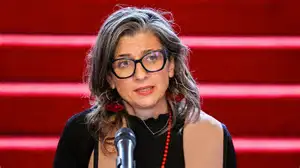
A federal judge has overturned the controversial US sanctions on Francesca Albanese, the United Nations official who called for investigations into alleged war crimes linked to the Gaza conflict.
The ruling marks a significant legal setback for the Trump administration and reignites debate over free speech, international law, and U.S. policy toward Israel and Gaza.
Judge Richard Leon ruled that the sanctions violated constitutional protections because they targeted Albanese’s public statements and opinions rather than unlawful actions.
Federal Judge Blocks US Sanctions on Francesca Albanese
The case centered on US sanctions on Francesca Albanese, who serves as the United Nations special rapporteur for Palestinian human rights.
Francesca Albanese has repeatedly urged the International Criminal Court to investigate alleged war crimes connected to the Gaza conflict.
Last year, Marco Rubio imposed sanctions against Albanese under an executive order signed by Donald Trump.
The executive order authorized sanctions against individuals accused of directly supporting International Criminal Court investigations involving Gaza.
However, U.S. District Judge Richard Leon ruled that Albanese’s actions amounted to protected speech.
Judge Says Albanese Was Punished for Speaking
In his 26-page ruling, Judge Leon strongly criticized the administration’s decision to impose the US sanctions on Francesca Albanese.
The judge wrote:
“Albanese has done nothing more than speak!”
Leon emphasized that Albanese’s recommendations carried no legal authority over the International Criminal Court.
He stated her comments represented personal opinions rather than binding legal directives.
According to the judge:
- Albanese did not control ICC investigations
- Her statements were non-binding recommendations
- The sanctions targeted protected speech
- Free expression applies even to controversial opinions
The ruling concluded that sanctioning Albanese solely for advocating investigations violated the First Amendment.
Trump Administration Defended the Sanctions
Justice Department lawyers defended the US sanctions on Francesca Albanese during court proceedings.
Government attorneys argued that Albanese could not claim First Amendment protections because:
- She is an Italian citizen
- She currently lives in Tunisia
- Her public comments occurred outside the United States
Officials maintained that constitutional free speech protections should not apply in this case.
However, Judge Leon rejected those arguments.
Judge Cites Albanese’s US Connections
Judge Leon ruled that Albanese’s personal and professional ties to the United States gave her standing to challenge the sanctions.
The court noted several key connections, including:
- Her family previously lived in Washington
- Her daughter was born in the United States
- The family owns property in Washington
The judge said these “extensive connections” strengthened her legal claim.
As a result, the court determined the US sanctions on Francesca Albanese directly affected her constitutional rights.
Sanctions Allegedly Disrupted Family Finances
Albanese and her husband argued the sanctions caused severe financial and personal hardship.
Her husband, Massimiliano Cali, joined the lawsuit filed earlier this year.
According to court filings, the sanctions:
- Restricted access to international banking services
- Prevented travel to the United States
- Complicated health insurance payments
- Impacted the family’s financial stability
The family claimed insurers even refused payments for some medical services received by Albanese.
Administration Claimed Licenses Reduced Impact
The Trump administration argued that special licenses reduced the effects of the sanctions.
Officials said exemptions allowed:
- Transactions related to the family’s Washington property
- Support for their U.S.-citizen daughter
- Certain “necessary” financial activities
However, Judge Leon dismissed those arguments.
In his ruling, he criticized the unclear wording of the licenses and questioned whether they truly protected the family.
The judge wrote that the exemptions were too vague to justify the restrictions imposed through the US sanctions on Francesca Albanese.
Debate Over Gaza War Crimes Intensifies
The case has intensified political divisions surrounding the Gaza conflict and international investigations into alleged war crimes.
Albanese has become a controversial figure because of her outspoken criticism of Israeli military actions in Gaza.
Supporters argue she defends international law and human rights.
Critics accuse her of bias and antisemitism.
The sanctions originally imposed by the Trump administration reflected growing tension between the United States and international legal bodies examining the Gaza conflict.
Key Facts About the Case
Important Details
- A federal judge blocked US sanctions on Francesca Albanese
- The ruling said the sanctions violated free speech rights
- Marco Rubio imposed the sanctions last year
- The sanctions targeted calls for Gaza war crimes investigations
- Albanese serves as a UN special rapporteur
- Judge Richard Leon issued the ruling
- The court cited Albanese’s ties to the United States
- Her family claimed the sanctions caused financial hardship
Legal Experts Watch Wider Implications
Legal experts say the ruling could affect future sanctions tied to speech and international advocacy.
The decision may also influence how U.S. courts interpret constitutional protections involving foreign nationals with strong American connections.
Some analysts believe the ruling could limit the government’s ability to punish individuals for public advocacy tied to international legal investigations.
Others expect the Trump administration to appeal the decision.
Gaza Conflict Continues to Shape International Politics
The controversy surrounding the US sanctions on Francesca Albanese reflects broader global divisions over the Gaza war.
International courts and human rights organizations continue examining allegations involving both Israeli military operations and militant attacks.
At the same time, political pressure surrounding these investigations continues growing in Washington and across global diplomatic circles.
Final Thoughts
The federal court ruling blocking the US sanctions on Francesca Albanese represents a major legal and political development tied to the Gaza conflict.
Judge Richard Leon’s decision emphasized that advocacy and public opinion remain protected forms of speech, even in highly controversial international disputes.
As tensions over Gaza continue shaping global politics, the case is likely to remain at the center of debates over free speech, sanctions, and international justice.
- Read more global political news on The News Ink TOP STORIES.
- Explore our latest Middle East coverage
- Check more international legal developments