US House Redistricting 2025: How Republicans Are Targeting a Full Congressional Sweep
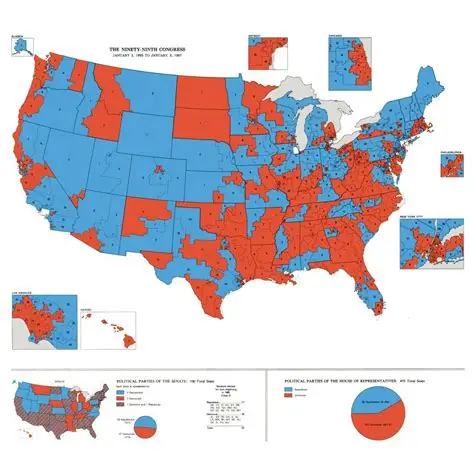
Republicans across the United States are aggressively pushing a US House redistricting plan in 2025 that could redraw the political map in their favor. From South Carolina to Texas, state lawmakers are redrawing congressional boundaries — and Democrats are fighting back.
The redistricting effort comes after a recent U.S. Supreme Court ruling weakened Voting Rights Act protections for minority districts. That decision has opened a legal path for Republicans to redraw districts that have traditionally elected Democrats, especially those with large Black populations.
What Is Driving the US House Redistricting Push?
At the heart of the 2025 US House redistricting battle is a simple goal: Republicans want to lock in a congressional majority and protect President Donald Trump from potential Democratic impeachment efforts.
State governors and legislative leaders are calling special sessions to redraw maps before upcoming primary elections. The urgency is clear — whoever controls the maps controls the seats.
Key reasons behind the redistricting push:
- A Supreme Court ruling weakened minority voter protections under the Voting Rights Act
- Republicans see an opportunity to pick up as many as 15 new House seats nationwide
- Trump has publicly urged Republican-led states to redraw their congressional maps
- State leaders want to prevent Democrats from regaining control of the U.S. House
South Carolina: Ground Zero for the Congressional Map Battle
South Carolina has become a flashpoint in the US House redistricting debate. The state’s Republican governor called a special legislative session specifically to address congressional boundaries.
The central target is a seat held by veteran Democratic congressman Jim Clyburn — the only Democrat among the state’s seven House members. Republicans are eyeing a 7-0 congressional sweep in the state by diluting the largely Black district that has kept Clyburn in office for decades.
Clyburn, however, is not backing down. He told reporters he maintains addresses in three different locations across the state and plans to decide strategically where to run.
“It ain’t about Jim Clyburn’s district,” he said, framing the effort as a rollback of civil rights progress — what he called “Jim Crow 2.0.”
Early voting for South Carolina’s statewide primaries is set to begin May 26, ahead of a June 9 primary date. Legislation also pending in the state House proposes shifting the congressional primaries to August — a move that adds another layer of political maneuvering to the process.
The National Redistricting Scoreboard: Where Things Stand
The US House redistricting battle is not limited to South Carolina. Republicans are playing offense in at least seven states, while Democrats are trying to offset those gains in two others.
States where Republicans expect gains:
- Texas – Redistricting already underway after Trump’s direct push to state leaders
- North Carolina – New maps could flip multiple seats
- Florida – GOP-controlled legislature has drawn aggressive boundaries
- Ohio – Republicans target competitive districts
- Tennessee – Tense debates have already played out over new maps
- Alabama – Federal court battles continue after Supreme Court ruling
- Missouri – Additional seats could shift to Republicans
Republican strategists believe these new maps could yield as many as 15 additional House seats combined.
States where Democrats expect gains:
- California – Democrats believe new maps could produce up to four new seats
- Utah – One or two additional Democratic seats possible under redrawn maps
Democrats estimate a net gain of around six seats from their redistricting efforts — still far short of the Republican advantage.
Legal Battles Are Slowing the Process
Not every newly drawn map will hold up in court. Litigation is ongoing in several key states, and federal judges have already intervened in Alabama and Louisiana over racial gerrymandering concerns.
The Supreme Court’s recent ruling changed the legal standard, but it did not eliminate oversight entirely. Courts are still examining whether new maps unlawfully pack or crack minority communities to suppress their voting power.
This legal uncertainty means the final count of seats won or lost through redistricting could look very different by Election Day.
What legal challenges could affect:
- Whether newly drawn districts survive court scrutiny before primaries
- How quickly new maps can take effect in states with pending litigation
- Whether minority voters can mount successful legal challenges under remaining Voting Rights Act protections
Why Some Republicans Have Doubts
Not all Republicans are enthusiastic about pursuing an aggressive clean-sweep strategy. Some veteran lawmakers within the party have privately expressed concern that spreading Republican voters too thinly across newly drawn districts could backfire.
If Republican votes are redistributed to create more safe seats in traditionally Democratic areas, existing Republican-held seats could become more competitive — and potentially flippable by Democrats.
This internal debate reflects the fine line redistricting planners must walk: aggressive enough to gain seats, but not so aggressive that it creates unexpected vulnerabilities.
What Happens Next
The coming weeks will determine how far Republicans can push the US House redistricting effort before courts intervene or time runs out ahead of primary deadlines.
Key upcoming milestones to watch:
- South Carolina’s full House debate on the new congressional map
- A vote on whether to move the state’s U.S. House primaries to August
- Federal court rulings in Alabama, Tennessee, and Louisiana
- Final map approvals in Texas, Ohio, and North Carolina
- November general elections — where voters will ultimately decide
Redistricting shapes the political battlefield, but it does not guarantee victory. Candidate quality, voter turnout, and national political sentiment will all play a role in determining whether Republican map-drawers achieve their goal of a clean House sweep.
The Bigger Picture: Democracy and Representation
Critics argue that aggressive redistricting — regardless of which party pursues it — undermines the principle that voters should choose their representatives, not the other way around.
Supporters of aggressive map-drawing counter that it is a legal and legitimate strategy that both parties use when they hold power.
What is clear is that the 2025 US House redistricting effort represents one of the most consequential political battles of the current election cycle. The maps drawn this year will shape congressional representation for the next decade.
For background on how redistricting works and its legal framework, the Brennan Center for Justice offers detailed nonpartisan analysis. Academic research on gerrymandering is also available through the Harvard Kennedy School’s Shorenstein Center.