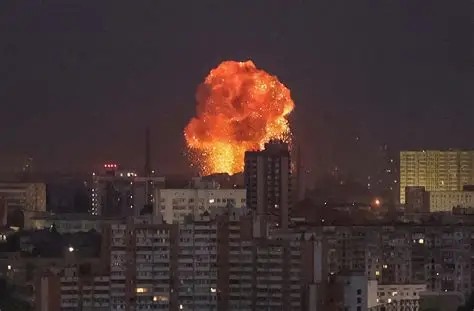
Russian Missile Component Factory Hit in Deadly Bryansk Strike
A Russian missile component factory in Bryansk became the centre of competing wartime claims after Ukraine said Storm Shadow cruise missiles struck the Kremniy El microelectronics plant on 10 March 2026. President Volodymyr Zelensky said the facility produced electronics and components used in Russian missiles that attack Ukrainian cities. Russian officials said the wider strike killed six civilians and injured 37 people, while accusing Britain of direct involvement.
The attack brought together several of the most difficult issues in the Russia-Ukraine war: Ukraine’s right to strike military production inside Russia, the civilian risks of long-range attacks, Moscow’s claims about Western participation and the growing importance of specialised electronics to modern weapons.
Ukraine described the Russian missile component factory as one of the country’s most important military-industrial targets. Russia did not publicly confirm damage to the plant in its initial casualty statement and called the operation a deliberate attack on civilians. The independently verified public record confirms a strike in Bryansk, Ukraine’s claim that Kremniy El was targeted, Russia’s report of deaths and injuries, and the use of British-supplied Storm Shadow missiles according to both sides. The full extent of damage to the factory and the precise circumstances of the civilian casualties remain less clear.
The article’s original description of an approaching peace process also needs updating. Diplomatic contacts continued through 2026, but by late July Moscow was waiting for new American proposals while continuing its military campaign. Fighting and long-range attacks remained intense.
What Happened at the Russian Missile Component Factory
Ukraine’s military said it conducted a coordinated strike against the Kremniy El plant in Bryansk, a Russian city roughly 100 kilometres from the Ukrainian border. Ukrainian accounts said Storm Shadow missiles hit the Russian missile component factory and caused significant damage.
Zelensky later described Kremniy El as a key producer of electronics for Russian weapons. Ukraine has repeatedly argued that factories supplying missiles, drones and military communications are legitimate targets because they directly support attacks on Ukrainian territory.
Bryansk governor Alexander Bogomaz gave a different account. He said six civilians were killed and 37 injured in what he called a terrorist missile attack. He published footage from the scene but did not initially identify the Russian missile component factory as the target.
The difference does not necessarily mean one claim excludes the other. A missile strike can target a military-industrial facility and still kill civilians in the surrounding area. It is also possible for damage, interception debris or an impact away from the intended aim point to cause casualties. Public evidence available immediately after the Russian missile component factory operation did not establish the complete sequence.
That uncertainty should remain visible in responsible reporting. Ukraine’s military-target claim and Russia’s casualty claim are both attributed statements, not a jointly verified account of every impact.
Why This Russian Missile Component Factory Matters
Kremniy El is a major Russian microelectronics manufacturer. The plant has been linked in Ukrainian and Western reporting to components used in missile systems, military aircraft, radar and other defence equipment.
Modern missiles depend on far more than explosives and propulsion. They require guidance electronics, power-control systems, processors, sensors, communication links and specialised semiconductors capable of operating under vibration, heat and electronic interference.
A Russian missile component factory that supplies even a small number of hard-to-replace parts can become strategically important. Russia may possess large missile inventories, but sustained production depends on industrial supply chains extending through electronics manufacturers, machine-tool companies, chemical plants and testing centres.
Ukraine has therefore expanded its campaign beyond launchers and ammunition depots. It has targeted oil refineries, airfields, factories, warehouses and transport nodes inside Russia. The goal is to increase the cost of the invasion and reduce Moscow’s ability to manufacture and deploy long-range weapons.
The News Ink has documented the consequences of record Russian drone attacks and deadly aerial strikes across Ukraine. Kyiv presents operations against a Russian missile component factory as part of preventing future attacks rather than as retaliation alone.
What Storm Shadow Missiles Can Do
Storm Shadow is an air-launched cruise missile developed by Britain and France. It is designed to fly at low altitude, navigate towards a programmed target and strike hardened or high-value sites from long range.
Britain supplied the weapon to Ukraine for use against Russian military targets. Kyiv has used Storm Shadow missiles against command posts, naval facilities, ammunition sites and infrastructure in occupied Ukrainian territory and inside Russia.
The missile’s range allows Ukrainian aircraft to launch without flying directly over heavily defended targets. Its warhead is designed to penetrate structures before detonating, making it suitable for facilities that ordinary bombs may not seriously damage.
The operation against the Russian missile component factory demonstrated why long-range weapons are politically sensitive. Their effectiveness depends on intelligence, mission planning and detailed targeting data. Russia argues that Ukraine could not employ them without Western specialists. Britain and other supporters generally say Ukraine selects and attacks its own targets using weapons supplied for self-defence.
The exact level of foreign technical support for the Bryansk strike has not been established publicly.
Russia’s Claim of British Involvement
Kremlin spokesman Dmitry Peskov said the Storm Shadow launch would have been impossible without British specialists and that Moscow would take Britain’s alleged involvement into account.
The statement was an allegation by the Russian government. It did not include publicly verifiable evidence showing that British personnel selected the Russian missile component factory, programmed the missiles or participated at the time of launch.
Advanced weapons naturally require training, maintenance and technical knowledge. That does not prove foreign personnel controlled a specific operation. Russia has repeatedly used the presence of Western weapons and intelligence cooperation to argue that NATO countries are direct parties to the war.
Britain has maintained broad support for Ukraine’s right to defend itself against Russia’s invasion, including attacks on military objectives that enable strikes on Ukrainian territory.
The legal and political line is contested. Supplying weapons does not automatically make a state a belligerent, but direct operational participation could carry different implications. Without released evidence, the claim concerning British specialists should remain attributed to the Kremlin.
Six Deaths and the Civilian-Casualty Question
Russia said the Bryansk attack killed at least six civilians and injured 37. Later reports gave slightly higher injury figures, illustrating how casualty totals can change as hospitals update information.
Civilian casualties require investigation regardless of which side conducts the strike. International humanitarian law obliges attackers to distinguish military objectives from civilian people and objects, assess whether expected harm would be excessive, and take feasible precautions.
A Russian missile component factory involved in weapons production may qualify as a military objective. That classification would not permit indiscriminate attacks on the surrounding city. Ukraine would still need to select weapons, timing and aim points intended to minimise civilian harm.
Russia accused Ukraine of deliberately targeting civilians. Ukraine said the military plant was the objective. Public reporting has not proved deliberate civilian targeting.
The strongest wording is therefore that a Ukrainian strike aimed, according to Kyiv, at Kremniy El was accompanied by civilian deaths and injuries reported by Russian authorities. An independent investigation would need strike data, impact locations, fragments, surveillance records and access to the damaged area to establish more.
What the Russian Missile Component Factory Strike May Have Achieved
Ukraine said the Russian missile component factory was successfully hit, but damage assessments in wartime are often difficult to verify.
A dramatic fire or destroyed building does not necessarily mean a plant has been permanently disabled. Production can be dispersed, equipment moved, damaged lines repaired and orders transferred to other facilities. Conversely, the loss of a specialised clean room, testing machine or experienced engineers can create delays larger than the visible destruction suggests.
The important questions include:
- Which production buildings were struck?
- Were unique manufacturing tools destroyed?
- How much inventory had already been moved?
- Can substitute suppliers produce the same components?
- How quickly can damaged production resume?
- Did the attack interrupt current missile assembly or only future orders?
Ukraine’s broader deep-strike campaign is designed to make Russia spend resources on air defence and industrial protection as well as repairs. Even a Russian missile component factory that resumes production may require new defensive systems that would otherwise protect airfields, cities or front-line forces.
Deep Strikes Have Become a Central Ukrainian Strategy
Ukraine entered the war with fewer aircraft, missiles and industrial resources than Russia. Long-range attacks offer a way to impose costs beyond the immediate front line.
Rather than trying to match Russia weapon for weapon, Kyiv has targeted nodes that support the larger military machine. These include fuel refineries, depots, railway junctions, naval bases, radar installations and defence manufacturers.
The strike on the Russian missile component factory fits that pattern. It also carries escalation risks. Operations deep inside Russia allow Moscow to present itself domestically as defending Russian territory, while creating pressure for retaliation against Ukrainian cities and Western-linked interests.
The News Ink’s report on deadly Russian strikes that shattered a fragile pause shows how attacks and diplomatic efforts repeatedly overlap. Each side argues that military pressure is necessary to improve its negotiating position.
Long-range strikes are therefore not separate from diplomacy. They are tools used to shape what each government believes it can demand at the negotiating table.
Russia’s Military Support From Iran and North Korea
Moscow has condemned Western military support for Ukraine while building its own international supply relationships.
Iranian-designed Shahed drones have become a major part of Russian attacks, although Russia increasingly manufactures versions domestically. North Korea has supplied ammunition and ballistic missiles, according to Ukraine and Western governments, and deployed troops to support Russian operations.
This internationalisation matters when Russia describes the attack on the Russian missile component factory as proof of a Western proxy war. Both combatants rely on external technology, weapons, finance or personnel. The difference lies in scale, legal justification and each partner’s level of operational involvement.
Civilian Harm Continues on Both Sides of the Border
The Bryansk deaths occurred amid a much larger civilian toll in Ukraine. UN monitors recorded 1,396 civilians killed and 7,978 injured in Ukraine during the first half of 2026, 37% more casualties than during the corresponding period in 2025.
Russian attacks have damaged homes, hospitals, energy systems and transport infrastructure. Ukraine also conducts strikes inside Russia, some of which Russian authorities say have killed civilians.
Both governments deny deliberately targeting civilians. Independent monitoring is much more extensive in Ukrainian-government territory than in Russia or Russian-occupied areas, making direct comparison difficult.
The existence of Russian attacks on Ukrainian cities does not remove Ukraine’s obligation to protect civilians during its own operations. Nor do casualties in Bryansk erase the military significance of a factory producing weapon components.
A credible account must hold both realities together: the Russian missile component factory was presented as a strategic target, and civilians were reported killed during the attack.
The Battlefield Was Not Simply a Stalemate
The original article described the war as a military stalemate. That wording is too broad.
The front has often moved slowly relative to the size of the conflict, but both armies have continued local offensives, withdrawals, counterattacks and long-range campaigns. Russia has made gains in some sectors while Ukraine has regained limited territory elsewhere and expanded attacks against Russian logistics and maritime targets.
Slow movement does not mean inactivity. It often reflects dense minefields, drone surveillance, artillery, electronic warfare and the difficulty of concentrating forces without detection.
Russia continued pressing for battlefield advantage while publicly maintaining maximal demands.
The strike on the Russian missile component factory should be understood within this war of industrial attrition. Both sides are trying to damage the other’s capacity to continue months and years into the future.
Where Peace Talks Stand Now
Donald Trump has remained involved in diplomatic efforts, but the prospects have shifted repeatedly.
By 24 July, Moscow said it would wait for new Trump proposals while continuing military operations. Washington and Kyiv were also discussing a possible air-ceasefire proposal ahead of another planned Trump-Zelensky meeting.
Russia continues to demand that Ukraine withdraw from regions Moscow claims, abandon NATO ambitions and accept limits on its military alignment. Ukraine rejects surrendering territory as a precondition and argues that any settlement must include credible security guarantees.
The Donbas remains central. Russia controls most of Luhansk and large parts of Donetsk, but percentages shift with battlefield changes and depend on whether analysts count the entire internationally recognised regions or only contested zones. Stating a fixed figure without a date can quickly become misleading.
Why the Russian Missile Component Factory Story Matters
The Russian missile component factory strike matters beyond one night in Bryansk because it shows how the war has expanded into a contest over production.
Russia uses missiles and drones to exhaust Ukrainian air defences and damage civilian and military infrastructure. Ukraine seeks to interrupt the factories, fuel networks and logistics supporting those attacks.
The Russian missile component factory was valuable precisely because sophisticated weapons depend on small parts. A cruise missile may weigh more than a tonne, but production can be delayed by a missing processor, sensor or control module.
The Russian missile component factory operation also illustrates the moral difficulty of striking military industry embedded within populated areas. A target can be militarily important while the attack still causes unacceptable or tragic civilian harm. The facts must be investigated rather than reduced to propaganda from either side.
The Bottom Line
Ukraine says Storm Shadow missiles hit the Kremniy El Russian missile component factory in Bryansk on 10 March 2026. Zelensky described the plant as a major producer of electronics used in Russian missiles. Russia said the wider attack killed six civilians and injured at least 37 people, while accusing Britain of direct technical involvement.
The strike on the Russian missile component factory is confirmed as a Ukrainian operation, but important details remain disputed. Russia did not initially acknowledge the plant as the target, Ukraine did not provide a full public damage assessment, and the Kremlin did not release evidence supporting its claim that British specialists participated directly.
The attack formed part of Ukraine’s effort to damage Russia’s military-industrial base before missiles reach the battlefield or Ukrainian cities. It also demonstrated the continuing civilian and escalation risks of deep strikes.
Months later, the war has not moved into a reliable peace process. Fighting continues, negotiations remain uncertain and both sides are trying to improve their positions through military pressure.
The Russian missile component factory may have been one significant target, but the larger contest is over whether either country can weaken the other’s ability and willingness to continue the war.
For continuing coverage of Ukraine, Russia and global security, follow The News Ink on X.