


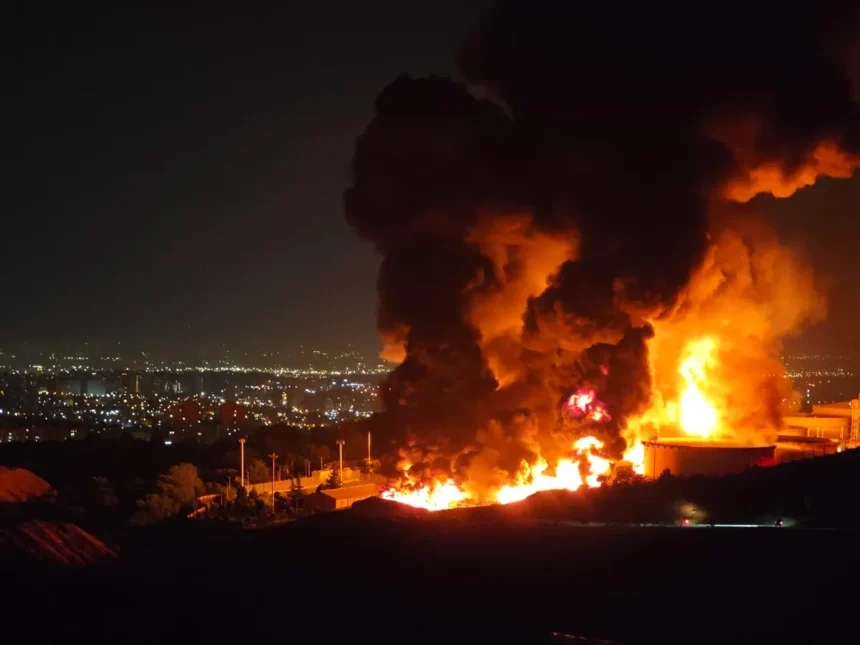
Oil prices climbed above $100 per barrel on Thursday as three more cargo vessels were hit in the Gulf, sending stock markets lower.
Brent crude rose more than 9% before easing slightly to $98.42, despite the International Energy Agency (IEA) announcing a record release of 400 million barrels to ease supply pressures from the US-Israel war with Iran.
Investors fear the global economy could face longer recovery times if attacks on shipping and energy infrastructure around the Strait of Hormuz continue. The strait is a key energy passage for oil and liquefied natural gas, and regional refineries supply jet fuel and diesel.
An Islamic Revolutionary Guard Corps spokesperson warned that vessels linked to the US, Israel, or their allies would be targeted, saying:
“You will not be able to artificially lower the price of oil. Expect oil at $200 per barrel.”
Stock markets fell in response to the conflict. Europe’s FTSE 100 dropped 0.4%, while Germany’s DAX, France’s CAC, and Spain’s IBEX all declined. Japan’s Nikkei closed down 1%.
The IEA said the war is causing “the largest supply disruption in the history of the global oil market.” Iraq, Qatar, Kuwait, the UAE, and Saudi Arabia have cut total production by at least 10 million barrels per day. Recovery to pre-crisis levels could take weeks or months, depending on resources and field complexity.
Experts say the IEA oil release helps but is insufficient to offset the Gulf supply loss. Bill Farren-Price, Oxford Institute for Energy Studies, explained:
“We’re losing about 20 million barrels a day of supply from the Gulf. 400 million barrels is a lot, but it’s a sticking plaster on a much bigger problem.”
Martin Ma, Singapore Institute of Technology, added that oil prices will remain high while supply risks persist, signaling prolonged market disruptions.
The conflict has also increased fuel costs worldwide. In Asia, petrol queues appeared in the Philippines, Thailand, and Vietnam, while governments urged energy conservation. Thailand asked many agencies to work from home, and the Philippines introduced a four-day government work week.
Higher energy costs could slow central bank interest rate cuts. In the UK, the Bank of England had forecast two rate cuts this year, but experts now predict none and possible increases.
Global oil markets have been volatile since US and Israeli airstrikes against Iran began on 28 February, with Brent crude briefly reaching nearly $120 per barrel earlier this week.