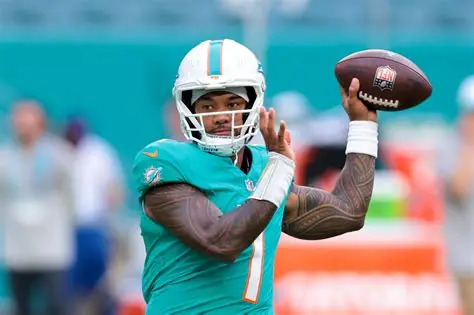
Miami Dolphins Release Tua Tagovailoa in Record NFL Salary Cap Hit
Tua Tagovailoa is no longer the quarterback of the Miami Dolphins, and the financial cost of that decision will follow the franchise for two more seasons. Miami released the former first-round pick with a post-June 1 designation, creating a record $99.2 million dead-money charge after a dramatic collapse in the team’s long-term quarterback plan.
The move ended one of the NFL’s most complicated modern quarterback stories. Tua Tagovailoa was drafted fifth overall in 2020, developed into a Pro Bowl passer, led the league in key categories, signed a huge extension, battled injuries, faced constant debate over durability and finally became the centre of a record salary-cap hit.
This was not a normal release. It was a franchise reset. Less than two years after the Dolphins gave Tua Tagovailoa a four-year extension worth more than $212 million, the team decided the contract no longer matched its future. The result was a dead-cap charge bigger than the Denver Broncos’ $85 million hit from releasing Russell Wilson in 2024, making Miami’s decision one of the most expensive roster reversals in NFL history.
The Dolphins officially confirmed the release on March 12, 2026, while the Atlanta Falcons announced the next day that they had signed Tua Tagovailoa, giving him a quick second chance and giving Miami a painful lesson in how fast a quarterback investment can turn into a cap burden.
Why the Tua Tagovailoa Release Became an NFL Record
The reason the Tua Tagovailoa release became historic is the structure of his contract. NFL teams often lower short-term salary-cap numbers by spreading signing-bonus money across future years. That helps a team build a competitive roster in the present, but the bill does not disappear. If the player is released or traded before the bonus proration has fully counted, the remaining amount accelerates onto the salary cap as dead money.
In simple terms, dead money is salary-cap space spent on a player who is no longer on the roster.
The Associated Press reported that Miami’s decision to move on from Tua Tagovailoa would leave a $99.2 million dead-money charge, passing the previous record set when Denver released Russell Wilson. The Dolphins could split the hit across 2026 and 2027 by using the post-June 1 designation, but the total still had to count against the cap.
That is the brutal part for Miami. The release created flexibility at quarterback emotionally and strategically, but not financially. The team moved on from the player, yet the contract remained.
This is why NFL teams fear failed quarterback extensions. When a team pays a quarterback like a long-term answer, then decides he is not the answer, the consequences can reshape an entire roster.
The End of a Six-Year Miami Era
Tua Tagovailoa arrived in Miami with enormous expectations. The Dolphins selected him fifth overall in the 2020 NFL Draft after his brilliant college career at Alabama, where he had been one of the most accurate and celebrated quarterbacks in the country.
His Miami career was never simple. There were flashes of high-level play, questions about arm strength, injuries, coaching changes, debates about support around him and constant comparisons with other quarterbacks from his draft class. Still, the production was real.
The Dolphins’ official release statement said Tua Tagovailoa appeared in 78 career games with 76 starts across six seasons in Miami, completing 68.0% of his passes for 18,166 yards and 120 touchdowns. The team also noted that he holds franchise records for career completion percentage, single-season completion percentage and career passer rating.
That résumé matters. This was not a draft bust who never played. Tua Tagovailoa had real success in Miami. He led the NFL in passer rating in 2022, passing yards in 2023 and completion percentage in 2024. He was a 2023 Pro Bowl selection and a four-time Dolphins captain.
Those achievements make the ending more complicated. Miami did not release a failure. Miami released a quarterback who had been good enough to earn a massive contract but not reliable or effective enough, in the team’s view, to keep building around.
The Contract That Became an Albatross
When the Dolphins extended Tua Tagovailoa in 2024, the logic was understandable. Quarterback prices were rising. Miami had built its offense around timing, accuracy and speed. Tagovailoa had led the league in passing yards in 2023 and had shown he could operate Mike McDaniel’s system at a high level.
The risk was also obvious. Injuries had followed him since college, including concussion concerns that had already created debate over his long-term future. Quarterbacks with elite production still carry risk when durability becomes a recurring issue.
That tension sat inside the contract. The Dolphins were betting that the best version of Tua Tagovailoa would remain available often enough to justify franchise money. By 2026, the new Miami leadership clearly decided that bet had failed.
This is why the dead-cap number is more than accounting. It is a scoreboard for a decision that did not age well. A $99.2 million dead-money charge tells fans, rivals and future negotiators that Miami changed course after paying like it had found stability.
For readers interested in how modern teams use data and recovery systems to manage player performance, The News Ink’s sports training technology guide offers wider context. In the NFL, health risk and contract risk are often tied together.
Why Miami Chose a Post-June 1 Designation
The post-June 1 designation matters because it allowed the Dolphins to spread the cap damage across two seasons instead of taking the entire hit immediately. That does not erase the money, but it changes when it hits the books.
Teams use the designation when they want to release a player while managing the timing of the salary-cap charge. It is one of the tools front offices use to survive expensive mistakes. In Miami’s case, it softened the short-term blow but did not change the historic total.
The Dolphins’ official transaction page confirmed that Tua Tagovailoa was released with a post-June 1 designation on March 12. That same transaction list showed how wide the rebuild had become. Miami signed quarterback Malik Willis, released linebacker Bradley Chubb with a post-June 1 designation, released wide receiver Tyreek Hill earlier in February and agreed to trade safety Minkah Fitzpatrick to the New York Jets.
That was not a one-player adjustment. It was a franchise reset.
The release of Tua Tagovailoa was the headline because of the dead money, but the full transaction pattern showed a team trying to clear the past and build around a different structure.
A New Front Office, a New Coach, a New Quarterback Room
The Dolphins’ quarterback decision cannot be separated from the leadership changes. Miami moved on from head coach Mike McDaniel and hired Jeff Hafley as head coach in January 2026. Sky Sports reported that Hafley replaced McDaniel after the Dolphins failed to reach the playoffs for a second straight season. The same report said Chris Grier was fired as general manager during Miami’s 7-10 season and replaced by Jon-Eric Sullivan.
That context explains the timing. New football leadership often wants freedom to build around its own quarterback and cap plan. Sullivan had already signalled that Miami needed to get healthier financially. NFL.com reported in February that he said “everything is on the table” with Tua Tagovailoa and acknowledged the team was under salary-cap strain.
By March, the decision was made.
Miami signed Malik Willis as an unrestricted free agent on the same day it officially released Tua Tagovailoa. That move did not automatically solve the quarterback position, but it showed the direction. The Dolphins were no longer trying to rescue the old plan. They were creating a new one.
For a franchise that had spent years trying to maximise Tua’s quick-release strengths, this was a major identity shift.
The Dolphins’ 2026 Reset at a Glance
| Move | What it showed |
|---|---|
| Fired Mike McDaniel | Miami wanted a new coaching voice after missing the playoffs again |
| Hired Jeff Hafley | The franchise shifted toward a new leadership structure |
| Replaced Chris Grier with Jon-Eric Sullivan | Front-office control changed before major roster decisions |
| Released Tua Tagovailoa | Miami accepted a record dead-cap hit to reset at quarterback |
| Signed Malik Willis | The Dolphins began rebuilding the quarterback room |
| Released Tyreek Hill | Miami moved on from another expensive star contract |
| Traded Minkah Fitzpatrick to the Jets | The roster reset extended beyond offense |
This table is important because the Tua Tagovailoa release was not an isolated surprise. It was part of a wider teardown. Miami looked like a team choosing short-term pain for long-term control.
That does not guarantee success. It only shows the intention.
The Injury Question Never Went Away
No discussion of Tua Tagovailoa is complete without the injury issue. His concussion history became one of the defining themes of his Miami career. After suffering multiple concussions during the 2022 season, he openly considered his future and became a central figure in league-wide conversations about player safety.
He returned and played excellent football in 2023, leading the league in passing yards and helping Miami reach the playoffs. But injury concerns remained part of every long-term evaluation. Even when he played well, the question was not only whether he could execute the offense. It was whether Miami could depend on him year after year.
The Dolphins’ official release statement did not frame the move around injury. It honoured his production and listed his franchise records. But from a roster-building perspective, durability was always part of the calculation.
Quarterbacks are the most expensive players in football because they define the ceiling of a team. When a quarterback carries both high cap cost and high availability risk, the front office must decide how much uncertainty it can carry.
In the end, Miami decided the answer was no longer enough.
The News Ink’s report on Fred Kerley’s anti-doping ban covers a different kind of athlete uncertainty, but the broader lesson is similar: elite careers can change quickly when off-field or health-related questions overtake performance.
The 2025 Decline Changed the Conversation
Tua Tagovailoa’s 2023 and 2024 production made the extension look defensible. His 2025 season changed the conversation.
Reports around the release pointed to a disappointing final year in Miami, including interceptions, benching and a team slide that left the Dolphins outside the playoffs. When a quarterback with a large contract plays well, the cap hit is accepted as the cost of contention. When the performance drops, every dollar becomes a debate.
That is what happened in Miami. The same contract that once represented confidence became a weight. The same quarterback once viewed as the system’s perfect point guard became a symbol of a roster that had grown expensive without becoming championship-level.
The brutal truth is that quarterback contracts are judged by playoff success. Tua Tagovailoa had strong numbers, but Miami did not become a deep postseason team during his tenure. When the new leadership arrived, it looked at the cost, the injuries, the regression and the roster holes, then chose a reset.
That choice may be defensible. It is also expensive enough to haunt the franchise if the next plan fails.
Why the Falcons Move Made Sense
The Atlanta Falcons moved quickly after the Miami decision, officially signing Tua Tagovailoa on March 13. For Atlanta, the logic was very different from Miami’s. The Dolphins were escaping a massive contract. The Falcons were taking a low-cost chance on a quarterback with proven NFL production.
The Falcons’ announcement noted that Tua Tagovailoa compiled a 44-32 record as Miami’s starting quarterback and highlighted his league-leading passer rating, passing-yard and completion-percentage seasons. Atlanta did not need to pretend the Miami ending was perfect. It only needed to believe the upside was worth the price.
That is the strange beauty of the NFL market. A contract that is unbearable for one team can become attractive for another if the financial terms are different. Miami carried the dead money. Atlanta got the player at a much lower cost.
Tua Tagovailoa also entered a quarterback room with Michael Penix Jr., who was recovering from a knee injury. That gave Atlanta experience, competition and insurance. It gave Tagovailoa something just as valuable: a chance to rebuild his career without immediately carrying a $200 million contract narrative.
Miami Still Pays While Atlanta Benefits
The awkward part for Dolphins fans is that Miami still carries the financial pain while Atlanta gets the football chance. That is how guaranteed money and NFL cap rules work. Releasing a player does not automatically remove previous commitments.
AP reported that Miami was still responsible for $54 million in guaranteed salary for 2026, though any salary Tua Tagovailoa earns from another team can eventually offset part of that amount. That makes the Falcons move even more painful from Miami’s perspective. Atlanta gets a quarterback with a Pro Bowl background while the Dolphins carry the record cap charge.
This is why front offices care so much about guarantees, bonus structure and exit points. The headline number of a contract matters, but the escape route matters just as much.
The Tua Tagovailoa deal became difficult because Miami’s escape route was expensive. Once performance and direction changed, the team had to choose between keeping a quarterback it no longer wanted or paying heavily to move on.
The Dolphins chose the second option.
Comparing Tua to Russell Wilson’s Dead Money Record
Before this move, Russell Wilson’s Broncos exit was the NFL’s most famous dead-money warning. Denver absorbed an $85 million charge after releasing Wilson in 2024, admitting that a blockbuster quarterback trade and extension had not delivered the expected result.
Miami’s $99.2 million charge for Tua Tagovailoa went beyond that. The comparison matters because both cases show how quickly teams can become trapped by quarterback decisions. Denver paid heavily to move off a veteran trade acquisition. Miami paid heavily to move off a quarterback it drafted and developed.
The emotional difference is important. Wilson was an outside star brought in to solve Denver’s problem. Tua Tagovailoa was Miami’s own pick, captain and franchise record-holder. His release was not just a financial failure. It was the end of a long internal project.
That is why the move will be studied by NFL teams. It asks a hard question: when should a franchise extend a quarterback who is very good but not clearly elite, especially if health concerns exist?
There is no easy answer. Waiting can make the price higher. Paying early can make the mistake bigger.
What This Says About NFL Quarterback Economics
Quarterback economics have become one of the NFL’s biggest roster-building problems. Teams need a strong quarterback to compete, but the cost of keeping one can limit the roster around him. If the quarterback is elite, the trade-off is usually worth it. If he is only good, injured or inconsistent, the contract can trap the team.
Tua Tagovailoa sits at the centre of that debate. His best seasons were statistically excellent. His accuracy, timing and rhythm made him dangerous in Miami’s system. But his injury history, playoff limitations and 2025 decline created enough doubt for new leadership to choose a painful exit.
The lesson is not that Miami was foolish to extend him. At the time, the market and production made the decision understandable. The lesson is that quarterback contracts contain very little middle ground. They either support a franchise plan or become the plan’s biggest obstacle.
The News Ink’s story on Daniel Berger’s pressure at Bay Hill showed how one late collapse can change the story around an athlete. In the NFL, one poor season after a huge contract can change an entire franchise.
What Miami Loses on the Field
Moving on from Tua Tagovailoa gives Miami strategic freedom, but it also removes a quarterback who did several things well. At his best, he got the ball out quickly, anticipated throwing windows, trusted timing routes and helped create explosive yards after the catch. He was not a traditional big-armed off-script quarterback, but he was highly efficient when the structure worked.
Replacing that is not easy. Malik Willis brings a different profile. He is more mobile and physically dynamic, but he does not replicate Tagovailoa’s quick processing and timing in the same way. Miami’s offense will likely need to change.
That may be the point. Hafley and Sullivan may want a tougher, more flexible, less cap-heavy roster. But offensive transitions can be rough. Receivers must adjust. Linemen must adapt to different pocket timing. Play-callers must build around new strengths.
The Dolphins are not simply replacing a name. They are replacing a style.
What Tua Tagovailoa Gains in Atlanta
For Tua Tagovailoa, Atlanta offers a strange kind of freedom. He no longer carries Miami’s contract expectations. He no longer has to answer whether he was worth the Dolphins’ extension. He can compete for a role, prove health and show that his best football was not only a product of Miami’s system.
The Falcons have offensive talent and uncertainty at quarterback. That is a useful combination for a veteran trying to restart. If Michael Penix Jr. is not fully ready or if competition remains open, Tagovailoa has a real chance to play.
He also gets a new narrative. In Miami, every throw became part of a debate over whether he was the franchise answer. In Atlanta, the question is more practical: can he help now?
That lower-pressure framing could help him. Quarterbacks often benefit when expectations become more realistic. Tua Tagovailoa does not need to justify a $212 million extension in Atlanta. He needs to show he can still lead an NFL offense.
Why Dolphins Fans Are Divided
Dolphins fans have every reason to feel conflicted. Tua Tagovailoa gave Miami real hope. He was accurate, respected in the locker room and productive enough to create some of the franchise’s best offensive seasons in years. He also left without a playoff breakthrough and with a record cap charge.
Some fans will blame the front office for the extension. Some will blame injuries. Some will blame McDaniel’s system. Some will argue Miami should have kept him because finding a better quarterback is difficult. Others will say the team had to accept the financial pain and stop delaying the rebuild.
All sides have arguments.
What cannot be denied is that the ending is costly. Releasing Tua Tagovailoa does not guarantee Miami improves. It only guarantees Miami has chosen a new path. Whether that path works will depend on Willis, future draft decisions, Hafley’s coaching staff and Sullivan’s ability to rebuild a roster carrying heavy dead money.
The News Ink’s report on Victor Wembanyama’s comeback win shows how quickly sports narratives can change when a young star delivers. Miami now needs its next quarterback story to change the mood just as quickly.
The Real Risk for Miami
The biggest risk is not only that Tua Tagovailoa plays well in Atlanta. The bigger risk is that Miami remains unsettled at quarterback while paying for the old one.
That is the nightmare scenario for any franchise. A released quarterback finds stability elsewhere. The replacement struggles. The cap hit limits roster improvement. Fans watch the old plan fail and the new plan stall at the same time.
Miami can avoid that only by making the reset count. If Willis develops, if the draft brings a long-term answer, if the defense improves and if the cap clears by 2027, the pain may look necessary. If not, the release will become another chapter in the Dolphins’ long search for post-Dan Marino quarterback certainty.
The NFL is unforgiving that way. Bold decisions are praised only if the next decision works.
The Bottom Line
Tua Tagovailoa has been released by the Miami Dolphins in one of the most expensive roster moves in NFL history. The Dolphins used a post-June 1 designation, but the total dead-money charge still reaches a record $99.2 million, surpassing the $85 million hit the Denver Broncos took after cutting Russell Wilson.
The move ends a six-year Miami career that included real success. Tua Tagovailoa became a Pro Bowler, led the league in passer rating, passing yards and completion percentage in different seasons, and finished with several Dolphins franchise records. But injuries, a disappointing 2025 season, a new front office, a new head coach and a strained salary cap pushed Miami toward a complete reset.
The Dolphins have moved on to a new era under Jon-Eric Sullivan and Jeff Hafley, with Malik Willis joining the quarterback room and several expensive veterans leaving the roster. Atlanta, meanwhile, has given Tua Tagovailoa a low-cost chance to compete and revive his career with the Falcons.
For Miami, the release is a painful admission that the franchise quarterback plan did not reach its final destination. For Tua Tagovailoa, it is a second chance. For the NFL, it is another warning about the danger of massive quarterback contracts when performance, health and team direction stop lining up.
Tua Tagovailoa leaves Miami with records, respect and unfinished business. The Dolphins are left with a new quarterback search and the biggest dead-cap bill the league has ever seen.
For more NFL and sports coverage, readers can follow The News Ink on X.