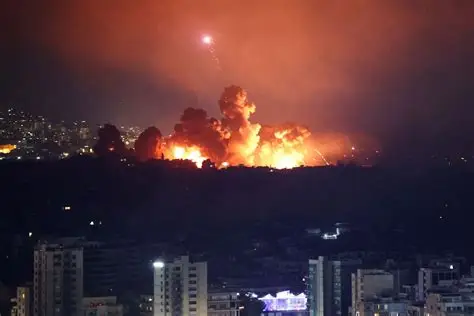
The Israel Beirut strike 2026 has killed at least 31 people and injured 149 others after Israeli jets bombed Lebanon’s capital in direct response to a Hezbollah rocket and drone attack on a military base in Haifa, northern Israel. Lebanon’s state-run National News Agency confirmed the casualty figures on Monday, as the violence marked a significant and dangerous escalation in what has become an increasingly regional conflict involving multiple armed actors across the Middle East.
The strike on Beirut followed Hezbollah’s claimed attack on Haifa, which the Iran-allied Lebanese armed group said was a retaliatory response to the killing of Iranian Supreme Leader Ayatollah Ali Khamenei. Israel responded rapidly with air attacks on southern Beirut, while local reports also confirmed Israeli strikes on multiple villages in south Lebanon and the Bekaa Valley in the east of the country.
Israel Beirut Strike 2026: What Happened and When
The Israel Beirut strike 2026 sequence of events unfolded rapidly on Monday, with each action triggering an immediate and escalatory response from the other side.
Hezbollah launched what it described as a coordinated rocket and drone attack against a military base in Haifa, in northern Israel. The group stated that the attack was carried out in retaliation for the killing of Ayatollah Ali Khamenei and in response to what it described as repeated Israeli aggressions against Lebanon over a fifteen-month period.
Israel responded with swift and significant air power. Israeli jets targeted Beirut, with strikes concentrated on southern areas of the capital. Additional attacks were reported across villages in south Lebanon and in the Bekaa Valley in eastern Lebanon.
Key events in the Monday escalation:
- Hezbollah launches rocket and drone attack on a military base in Haifa, northern Israel
- Israel responds with immediate airstrikes on southern Beirut
- 31 people killed and 149 injured in the Beirut strikes, per Lebanese official sources
- Israeli strikes also reported in south Lebanon villages and the Bekaa Valley
- Israeli Defence Minister Israel Katz threatens Hezbollah Secretary-General Naim Qassem directly
- Katz declares Qassem “a marked target for assassination”
- Hezbollah issues a statement claiming its right to defend Lebanon and respond to Israeli aggression
The speed of Israel’s response and the scale of the strikes on Beirut signal that this exchange represents a qualitative escalation beyond previous incidents in the ongoing conflict.
Israel Beirut Strike 2026: Hezbollah’s Justification
Hezbollah issued a formal statement explaining its decision to launch the Haifa attack, framing the operation as defensive in nature and directly connected to the killing of Ayatollah Khamenei.
“The resistance leadership has always affirmed that the continuation of Israeli aggression and the assassination of our leaders, youth and people gives us the right to defend ourselves and respond at the appropriate time and place,” the group stated. The statement referred explicitly to what Hezbollah described as near-daily Israeli attacks on Lebanese territory over a prolonged period.
The group further stated that its attack was delivered “in defence of Lebanon and its people” and “in response to the repeated Israeli aggressions.” Its broader statement declared that Israel “cannot continue its 15-month-long aggression without a warning response to halt this aggression and withdraw from the occupied Lebanese territories.”
Hezbollah’s stated reasons for the Haifa attack:
- Direct retaliation for the killing of Ayatollah Ali Khamenei
- Response to what it described as fifteen months of continuous Israeli aggression against Lebanon
- Defence of Lebanon and its civilian population
- Demand for Israeli withdrawal from what it calls occupied Lebanese territories
- Assertion of the right to respond to the killing of Hezbollah leaders and members
Hezbollah operates independently from the Lebanese government, and its military decisions do not reflect official Lebanese state policy. The Lebanese government and its civilian population bear the consequences of the conflict regardless of that distinction — as Monday’s death toll of 31 civilians in Beirut makes painfully clear.
Israel Beirut Strike 2026: Israel’s Response and Threats
Following the Israel Beirut strike 2026, Israeli Defence Minister Israel Katz delivered an unambiguous public statement making clear that Israel considers the exchange far from over.
Katz warned that Hezbollah would pay a “heavy price” for firing at Israel. He then made a direct and personal threat against Hezbollah’s current Secretary-General, Naim Qassem, declaring that Qassem was “now a marked target for assassination.”
The language of Katz’s statement was explicit and threatening. “Anyone who follows Khamenei’s path will soon find himself in the depths of hell with all the thwarted members of the axis of evil,” the Israeli Defence Minister said — a clear reference to the killing of Khamenei and a warning that Israel considers Qassem’s life under direct threat from Israeli military action.
Israel’s position following the Beirut strikes:
- Israel framed its Beirut strikes as a direct and proportionate response to the Haifa attack
- Defence Minister Katz promised Hezbollah would pay a “heavy price”
- Katz named Hezbollah Secretary-General Naim Qassem as “a marked target for assassination”
- Israel carried out additional strikes in south Lebanon and the Bekaa Valley beyond Beirut
- Israel has not indicated any willingness to de-escalate at this stage
- Israeli statements connect the Haifa attack directly to Iran’s wider regional influence
The threat against Qassem follows a pattern established during earlier phases of the conflict, in which Israel targeted and killed multiple senior Hezbollah military and political figures including former Secretary-General Hassan Nasrallah in 2024.
Israel Beirut Strike 2026: The Broader Regional Context
The Israel Beirut strike 2026 does not occur in isolation. It forms part of a rapidly widening regional conflict that now involves the United States and Israel on one side, and Iran alongside its network of allied armed groups on the other.
The killing of Ayatollah Ali Khamenei — a seismic event in regional geopolitics — has fundamentally altered the dynamics of this conflict. Khamenei’s death removed the supreme authority within Iran’s political and military structure and prompted immediate vows of retaliation from Iran’s allied forces across the region, including Hezbollah in Lebanon.
Hezbollah’s position following the 2024 war with Israel is significantly weaker than it was before that conflict. Israel’s military campaign in 2024 killed most of Hezbollah’s senior military and political leadership, degraded its weapons stockpiles, and reduced its operational capability. The group’s current ability to sustain a prolonged military campaign against Israel — or to meaningfully shift the balance of power in Iran’s favour — remains unclear and deeply uncertain.
Regional context behind Monday’s escalation:
- The killing of Ayatollah Khamenei fundamentally changed the regional conflict dynamic
- Iran’s allied groups including Hezbollah pledged retaliation following Khamenei’s death
- Hezbollah was significantly weakened during the 2024 Israel-Lebanon war
- Israel killed most of Hezbollah’s senior military and political leadership in 2024
- The current conflict involves the United States and Israel on one side, Iran and allies on the other
- Monday’s exchange represents a serious escalation in an already volatile regional situation
- Additional strikes in south Lebanon and the Bekaa Valley suggest Israel’s military response extends well beyond Beirut
The involvement of the United States alongside Israel, and the deaths of Iranian and Hezbollah leaders, mean this conflict carries the potential for further escalation that extends beyond Lebanon and Israel alone. The regional dimensions of Monday’s events make the situation significantly more dangerous than a bilateral exchange between Israel and Hezbollah would be on its own.
Israel Beirut Strike 2026: The Human Cost in Lebanon
Behind every statistic in the Israel Beirut strike 2026 story lies a human reality that demands recognition. Lebanon’s state-run National News Agency confirmed 31 people killed and 149 injured in Monday’s Israeli strikes on Beirut — figures that represent individual lives, families, and communities devastated by violence in which they are not combatants.
Lebanon as a country has endured repeated cycles of conflict, economic collapse, political crisis, and now renewed bombardment. Its civilian population continues to suffer the consequences of a conflict driven by decisions made by armed and political actors far removed from the neighbourhoods where the bombs fall.
The human and humanitarian impact:
- 31 people confirmed killed in the Beirut strikes on Monday
- 149 people confirmed injured — many requiring hospital treatment
- Strikes concentrated in southern Beirut — a densely populated urban area
- Additional strikes reported in south Lebanon villages and the Bekaa Valley
- Lebanese civilians bear the direct consequences of strikes carried out in response to Hezbollah military action
- Lebanon’s already fragile infrastructure faces further strain from the renewed conflict
- International humanitarian organisations are monitoring the situation closely
The pattern of strikes on south Beirut — an area with high civilian population density — raises serious questions about civilian protection that international humanitarian law requires all parties to address regardless of the military justification offered for any given strike.
Israel Beirut Strike 2026: What Comes Next
The Israel Beirut strike 2026 and the events surrounding it point toward a period of continued and potentially intensifying violence unless diplomatic intervention succeeds in creating space for de-escalation. Several factors shape what the coming days and weeks may bring.
Israel’s explicit threat to assassinate Hezbollah’s Secretary-General Naim Qassem suggests further targeted strikes against Hezbollah leadership remain a near-term probability. Hezbollah’s own statements assert the right to continue responding to Israeli actions. The wider regional conflict involving Iran and the United States adds layers of complexity and risk that extend far beyond Lebanon’s borders.
Factors shaping what comes next:
- Israel’s threat against Qassem suggests further targeted strikes are likely
- Hezbollah has asserted its right to continue military responses to Israeli actions
- The wider US-Israel versus Iran-allied groups conflict remains active
- Diplomatic pressure from third parties will determine whether de-escalation is possible
- Lebanon’s government has limited ability to influence Hezbollah’s military decisions
- International bodies including the United Nations are monitoring the situation
- The fate of ceasefire discussions — if any exist — will be critical in the coming days
Final Word on the Israel Beirut Strike 2026
The Israel Beirut strike 2026 represents a deeply serious moment in a conflict that has already caused immense suffering across the region. Thirty-one people died in Beirut on Monday. One hundred and forty-nine more were injured. Those figures do not capture the full weight of what Monday’s events mean for the people of Lebanon — a country that has endured so much, for so long, with so little relief.
The cycle of attack and retaliation, threat and counter-threat, that defines this conflict shows no signs of breaking on its own. What happens next depends on decisions made not only by armed groups and military commanders, but by political leaders and international actors with the capacity — if the will exists — to create conditions for something other than continued escalation.