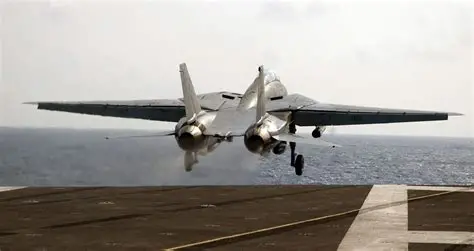
F-14 Tomcat Return Proposal Advances Through US Congress Bill
The possibility of an F-14 Tomcat return has gained attention after a new US congressional bill moved forward that could allow limited restoration and transfer of the iconic fighter jet. The proposal, known as the “Maverick Act,” has passed the Senate and now awaits a House vote.
If approved, the bill could authorize the transfer of retired F-14D Tomcats for preservation and possible restoration, marking one of the most ambitious aviation heritage projects in recent years.
The F-14 Tomcat return plan focuses on museum display and potentially limited flight operations, depending on technical feasibility and funding.
What the F-14 Tomcat Return Bill Proposes
The proposed legislation, known as the Maverick Act, was introduced by lawmakers and co-sponsored across party lines, reflecting bipartisan interest in preserving historic military aircraft.
Under the F-14 Tomcat return proposal, the bill would:
- Authorize transfer of three F-14D Tomcat aircraft
- Send aircraft to a space and aviation museum facility in Huntsville, Alabama
- Allow one aircraft to be restored for static display or possible flight
- Require all restoration costs to be funded privately
- Ensure aircraft are demilitarized with no combat capability
The bill explicitly states that the government will not bear any financial burden for restoration or maintenance.
The proposal now moves to the House of Representatives for further consideration.
F-14 Tomcat Return and Its Historical Significance
The F-14 Tomcat return proposal has drawn strong attention due to the aircraft’s legendary status in US naval aviation history.
The F-14D Tomcat served as a carrier-based fighter jet designed for air superiority and fleet defense missions. It became one of the most recognizable military aircraft of its era.
Key historical points include:
- Entered US Navy service during the Cold War
- Known for variable-sweep wing design
- Featured in naval interception and strike missions
- Retired from active service in 2006
- Became an aviation icon in popular culture
Because of its historical importance, supporters of the F-14 Tomcat return argue that the aircraft deserves preservation for future generations.
Why the F-14 Tomcat Return Is Technically Challenging
Despite growing interest, experts warn that the F-14 Tomcat return would face significant technical and logistical challenges.
Since retirement, many original components have become unavailable due to military restrictions and long-term storage policies.
Major challenges include:
- Limited spare parts availability
- Structural degradation after long storage periods
- High maintenance and operational costs
- Complex avionics systems requiring rebuilding
- Regulatory certification for any flight operations
The US Navy previously restricted access to F-14 components to prevent sensitive technology from being exported or misused. As a result, many parts were destroyed or permanently removed from circulation after retirement.
Restoring even a single aircraft to flying condition would require extensive engineering work and millions of dollars in funding.
F-14 Tomcat Return and Museum Restoration Plans
Under the current F-14 Tomcat return proposal, the aircraft would be transferred to a museum-focused aviation commission in Huntsville, Alabama.
The goal is to preserve at least one aircraft in a condition suitable for public education and potential demonstration purposes.
The restoration plan could include:
- Static museum display aircraft
- Partial restoration for ground operations
- Possible limited airworthy restoration
- Educational exhibits on naval aviation history
- Collaboration with aviation heritage foundations
However, full operational flight status remains uncertain due to cost and technical limitations.
F-14 Tomcat Return Faces Financial Responsibility Shift
One key condition in the F-14 Tomcat return bill is that all financial responsibility would fall on the receiving institution.
The US government would not fund restoration or maintenance.
Instead, costs would likely be covered by:
- Private donors
- Aviation heritage foundations
- Museum funding programs
- Corporate sponsorships
Experts estimate that restoring an F-14 Tomcat to flying condition could require multi-million-dollar investment and years of work.
F-14 Tomcat Return and Engineering Complexity
The F-14 Tomcat return effort would involve major engineering challenges due to the aircraft’s advanced but aging systems.
Potential restoration tasks include:
- Rebuilding hydraulic systems
- Restoring flight control surfaces
- Replacing obsolete avionics
- Inspecting airframe integrity
- Recreating missing components
In addition, certification for any airworthy restoration would require compliance with strict aviation safety regulations.
Even if restored, ongoing maintenance costs would remain extremely high compared to modern aircraft.
F-14 Tomcat Return and Military Aviation Heritage
Supporters of the F-14 Tomcat return argue that the project is more about preservation than practical use.
The aircraft is widely regarded as one of the most iconic fighter jets in US military history.
Preserving it could:
- Educate future generations about Cold War aviation
- Preserve engineering heritage
- Support aviation museums and tourism
- Highlight naval aviation history
- Inspire aerospace engineering interest
Many aviation museums already preserve retired military aircraft, but few attempt full operational restorations.
F-14 Tomcat Return Compared to Other Restoration Projects
Aviation historians compare the F-14 Tomcat return proposal to earlier restoration efforts involving other retired military aircraft.
Some heritage organizations have successfully restored older jets for:
- Airshow demonstrations
- Static displays
- Limited flight operations
However, the F-14 is significantly more complex than many earlier aircraft due to its advanced systems and size.
This makes the F-14 Tomcat return one of the most ambitious proposals of its kind.
F-14 Tomcat Return and Long-Term Timeline
If the bill is approved by the House, the transfer process would begin immediately after final authorization.
However, experts estimate that full restoration could take:
- Several years for structural evaluation
- Additional years for parts sourcing and rebuilding
- Extended time for testing and certification
The aircraft would also need to be carefully transported, inspected, and reassembled under strict safety conditions.
Even under ideal conditions, the F-14 Tomcat return would be a long-term project rather than an immediate restoration effort.
F-14 Tomcat Return and Public Interest
Public interest in the F-14 Tomcat return remains high due to the aircraft’s cultural and historical legacy.
The fighter jet has appeared in films, documentaries, and aviation exhibits, making it one of the most recognizable military aircraft in the world.
Enthusiasts and aviation communities continue to follow developments closely, particularly as Congress considers final approval.
F-14 Tomcat Return and Future Aviation Preservation
The proposal reflects a broader trend in preserving historic military aviation assets.
As newer aircraft replace older fleets, governments and museums increasingly face decisions about how to preserve aviation history.
The F-14 Tomcat return initiative highlights:
- Growing interest in military heritage preservation
- Increased funding challenges for restoration projects
- Rising public engagement with aviation history
- Balancing historical value with technical feasibility
Final Outlook on F-14 Tomcat Return
The F-14 Tomcat return remains a developing proposal that could bring one of the most legendary fighter jets in US naval history back into public view.
While full flight restoration remains uncertain, the legislation aims to ensure that at least some aircraft are preserved for educational and historical purposes.
If approved, the project could become one of the most ambitious aviation preservation efforts in recent decades, blending history, engineering, and public heritage into a single initiative.