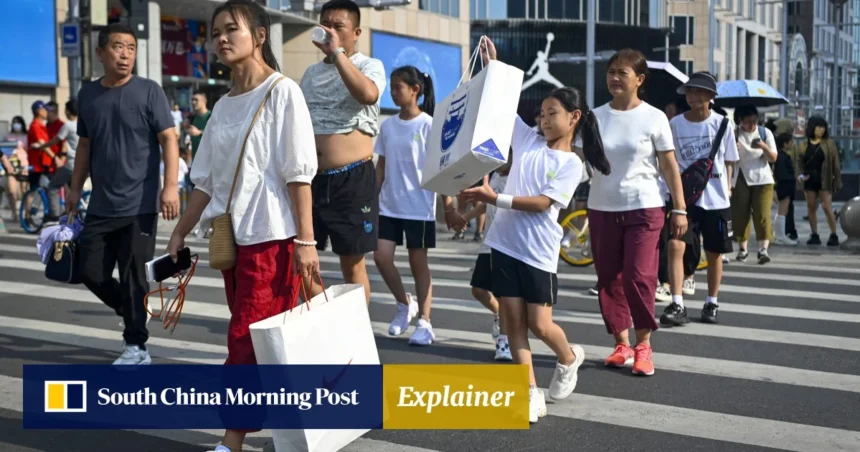
China’s leaders are trying a new strategy to support the country’s slowing economy. They want people to spend more money.
At the annual Two Sessions in Beijing, officials set a growth target of 4.5% to 5%. This is the lowest target since 1991.
Along with the target, policymakers announced several steps to increase household spending. The move signals that China’s traditional growth model may no longer work as before.
Shift in China’s Growth Strategy
In the past, China responded to slower growth by investing heavily in construction and industry. The government built apartments, highways, factories, and industrial parks. Exports and the property market also played a key role in driving growth.
Now the government wants to focus more on raising household income and boosting consumption.
Experts say the change shows that Beijing understands the limits of its old economic model.
Policies to Encourage Spending
The government introduced several measures to encourage spending. These include:
-
Expanding services for elderly citizens
-
Enforcing paid annual leave for workers
-
Offering more support to families raising children
Officials also proposed an urban-rural income growth plan. The plan aims to increase household earnings and reduce income gaps.
Chinese leaders describe this approach as “investing in people.” The idea is simple: when people feel secure about healthcare, retirement, and family costs, they are more likely to spend.
Technology and Manufacturing Still a Priority
At the same time, China continues to invest in advanced manufacturing and technology.
The upcoming 15th Five-Year Plan aims to expand industrial capacity and integrate Artificial Intelligence across the economy.
However, relying on exports alone may not be enough. Global demand for Chinese goods is weakening, and protectionist policies are increasing in many countries.
Weak Consumer Spending Remains a Challenge
Chinese households spend a smaller share of their income compared with people in many other countries.
Household consumption makes up about 40% of China’s GDP. The global average is around 55%, and it reaches about 60% in advanced economies.
Recent government stimulus shows mixed results. During the Spring Festival, authorities issued billions of yuan in vouchers to encourage spending on travel and entertainment.
Travel revenue increased by 19% compared with last year. However, average spending per traveller dropped, and cinema revenues declined. This suggests people remain cautious with their money.
Concerns About Debt and Policy Impact
China’s leaders have long avoided large-scale household stimulus. They worry such policies could increase already high levels of debt.
Some analysts also believe the current measures may not be enough to shift the economy toward consumer-led growth.
Public Reaction Online
The new policies have sparked debate on Weibo.
Some users questioned the real reason behind encouraging paid leave. One user wrote that the policy aims to push people to spend money rather than rest.
Others argued the government should first enforce a proper work-life balance, including an eight-hour workday and a five-day workweek.
Discussions about marriage and parental leave also triggered strong reactions. Some users called for longer marriage leave across the country, while others pointed out the high cost of raising children.
Many people believe young workers need stable jobs, better incomes, and more rest before they can think about marriage or having children.
A Difficult Transition Ahead
China’s plan to increase consumer spending reflects a major shift in economic policy. But transforming consumption into a strong growth driver will not be easy.
Deep structural challenges still affect the country’s consumer economy. Whether Beijing can successfully encourage people to spend more remains a key question for the years ahead.