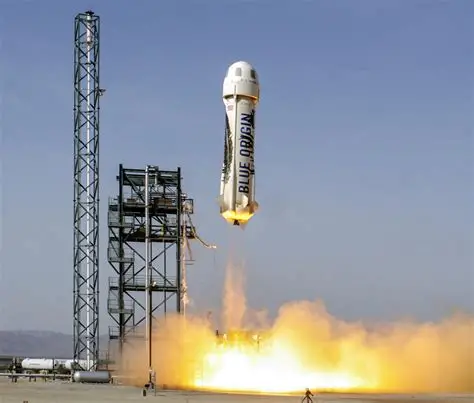
The Blue Origin Rocket Explosion has raised fresh questions about the challenges of modern spaceflight after one of the company’s rockets erupted into a massive fireball during testing at a launch facility in Florida.
The dramatic incident occurred during a routine hotfire test, a critical phase of rocket development designed to evaluate engines and systems before launch. Although no injuries were reported and all personnel were safely accounted for, the explosion marked a significant setback for the aerospace company founded by Jeff Bezos.
The event serves as another reminder that rocket development remains one of the most demanding and high-risk engineering challenges in the world.
What Happened During the Blue Origin Rocket Explosion?
The Blue Origin Rocket Explosion took place at a launch facility in Cape Canaveral, Florida, during a scheduled hotfire test.
Witness footage showed the rocket suddenly erupting into a massive fireball that engulfed the surrounding launch infrastructure. The blast illuminated the night sky and generated immediate concern across the aerospace community.
Fortunately, safety procedures worked as intended.
According to company officials:
- All personnel were accounted for
- No injuries were reported
- No threat existed to the public
- Emergency response teams quickly secured the area
- Investigators immediately began examining the incident
The explosion happened before launch, meaning the rocket never left the ground.
What Is a Hotfire Test?
A hotfire test is one of the most important steps in rocket development.
During the procedure, engineers ignite rocket engines while the vehicle remains secured to the launch pad. The test allows teams to evaluate performance under realistic operating conditions.
The purpose of a hotfire test includes:
Engine Verification
Engineers assess whether the engines produce the expected thrust levels.
System Validation
The test verifies that fuel systems, software, sensors, and communication systems operate correctly.
Safety Assessment
Potential problems can be identified before an actual launch attempt.
Performance Analysis
Data collected during testing helps engineers improve future missions.
Because rockets contain enormous amounts of highly energetic fuel, hotfire testing carries significant risks despite extensive safety precautions.
Why Rocket Explosions Still Happen
The Blue Origin Rocket Explosion highlights the complexity of spaceflight.
Even with modern technology, rockets remain among the most sophisticated machines ever built.
Several factors can contribute to testing failures:
Fuel System Issues
Rocket fuel systems operate under extreme pressure and temperature conditions.
Engine Malfunctions
A small mechanical failure can trigger catastrophic consequences during ignition.
Software Problems
Modern rockets rely heavily on computer-controlled systems that must function flawlessly.
Structural Failures
Components must withstand enormous forces during testing and launch operations.
Sensor Errors
Incorrect readings can lead to dangerous operating conditions.
Investigators will likely examine all these possibilities as they work to determine the root cause.
Jeff Bezos Responds to the Explosion
Following the Blue Origin Rocket Explosion, company founder Jeff Bezos addressed the incident publicly.
He confirmed that all personnel were safe and acknowledged the seriousness of the event.
Bezos emphasized that it was too early to determine the exact cause but stated that teams were already working to understand what went wrong.
His comments reflected a common reality within the aerospace industry: setbacks are often part of the development process.
Rocket companies routinely learn from failures and use investigations to improve future designs.
How Government Agencies Are Responding
Several government organizations are involved in reviewing the incident.
Space Force Assessment
Officials are working with Blue Origin engineers to gather data and assess the damage.
Federal Aviation Review
Although the test reportedly fell outside certain licensed launch activities, federal regulators are monitoring the situation.
Safety Evaluation
Authorities will review available information to determine whether additional safety measures are needed.
The investigation could take weeks or even months depending on the complexity of the findings.
A Challenging Period for Blue Origin
The Blue Origin Rocket Explosion comes during a period of increased scrutiny for the company.
Recent months have seen both successes and setbacks.
Recent Successes
Blue Origin successfully launched its New Glenn rocket and achieved important milestones in reusable rocket technology.
Recent Challenges
The company has also faced technical issues involving launch missions and satellite deployment operations.
Each success and failure contributes valuable data that helps engineers refine future systems.
The aerospace industry has long recognized that progress often comes through repeated testing, troubleshooting, and improvement.
Why Heavy-Lift Rockets Are So Difficult to Build
Developing heavy-lift launch vehicles remains one of the most difficult engineering tasks in modern technology.
Heavy-lift rockets must:
- Carry enormous payloads
- Generate millions of pounds of thrust
- Operate reliably under extreme conditions
- Survive intense vibrations
- Function across multiple mission phases
- Return accurate performance data
Even minor design flaws can produce significant consequences.
History shows that nearly every major space company has experienced testing failures while developing advanced launch systems.
What This Means for Future Blue Origin Missions
The immediate impact of the Blue Origin Rocket Explosion will likely include schedule adjustments.
Potential consequences may involve:
Delayed Launches
Upcoming missions could face postponements while engineers complete their investigation.
Additional Testing
Blue Origin may conduct further ground tests before approving future launches.
Design Reviews
Engineers could implement hardware or software modifications based on investigation findings.
Regulatory Oversight
Authorities may require additional documentation or safety reviews before future operations proceed.
However, aerospace experts generally view such investigations as a normal part of the development cycle.
The Bigger Picture for the Space Industry
The commercial space industry continues to grow rapidly.
Private companies are investing billions of dollars into:
- Satellite deployment
- Lunar exploration
- Space tourism
- Deep-space missions
- Cargo transportation
- National security launches
As competition increases, companies face pressure to innovate while maintaining safety standards.
The Blue Origin Rocket Explosion demonstrates that even experienced organizations encounter obstacles when pushing technological boundaries.
Failures can be costly, but they often provide critical lessons that improve future mission reliability.
Lessons From Previous Rocket Failures
Space exploration history is filled with setbacks that ultimately led to breakthroughs.
Many successful programs experienced major failures during development phases.
Key lessons include:
Thorough Investigations Matter
Understanding root causes prevents repeat incidents.
Testing Saves Lives
Ground testing identifies problems before operational missions.
Engineering Improves Through Failure Analysis
Every anomaly generates valuable technical data.
Patience Is Essential
Rushing development can increase risks.
These principles continue to guide modern aerospace programs around the world.
Final Thoughts
The Blue Origin Rocket Explosion represents a significant challenge for the company, but it is also part of the reality of spaceflight development. While the dramatic fireball captured global attention, the most important outcome remains that all personnel were safely accounted for and no injuries were reported.
The coming investigation will determine what caused the anomaly and what changes may be necessary moving forward. Until then, engineers, regulators, and industry observers will closely monitor developments.
Space exploration has never been easy. Every successful launch is built on years of testing, problem-solving, and perseverance. While this incident may temporarily slow Blue Origin’s progress, it is unlikely to diminish the broader ambition driving the modern commercial space industry.
As investigators work to uncover the cause of the explosion, the company faces the challenge of learning from the setback and continuing its mission to expand humanity’s presence beyond Earth.
MORE INFO ON THE NEWS INK TECHNOLOGY.