



Bacteroides fragilis toxin colon cancer 2026 research has delivered a major scientific breakthrough after a multi-institutional team led by Johns Hopkins University scientists identified the precise mechanism by which a common gut bacterium drives colorectal cancer development. The study, published on April 22 in the prestigious journal Nature, reveals that the B. fragilis toxin — known as BFT — must first bind to a specific host receptor called claudin-4 before it can damage the lining of the colon and trigger the inflammatory cascade that leads to tumour formation.
The discovery resolves a mystery that has puzzled researchers since a landmark 2009 study first established the connection between Bacteroides fragilis and colon cancer. It also opens promising new avenues for prevention, detection, and treatment — including a molecular decoy already developed by the research team that successfully blocked the toxin’s damaging effects in animal models.
Bacteroides Fragilis Toxin Colon Cancer 2026: What Researchers Discovered
The Bacteroides fragilis toxin colon cancer 2026 breakthrough centres on a single critical discovery — the identification of claudin-4 as the receptor that allows BFT to attach to colon lining cells and begin its destructive process.
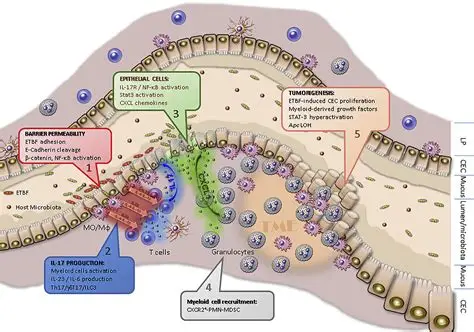
For more than fifteen years, scientists knew that B. fragilis caused colon damage and tumour formation through its secreted toxin BFT. They also knew that BFT achieved this damage by cleaving — or splitting — E-cadherin, a protein essential for maintaining the protective barrier of the colon. However, BFT did not appear to directly attach to E-cadherin itself. Something else was happening first — a missing link in the chain of events that no research team had previously identified.
The Johns Hopkins-led team finally found that missing link. BFT must first bind claudin-4 before it can access and cleave E-cadherin. Without that initial binding step, the toxin cannot trigger the damage that drives inflammation and tumour formation.
The discovery in simple terms:
- B. fragilis bacteria secrete a toxin called BFT into the colon
- BFT must first attach to the host receptor claudin-4 on colon lining cells
- Once attached to claudin-4, BFT gains the ability to cleave E-cadherin
- E-cadherin is a protein essential for maintaining the colon’s protective barrier
- Cleaving E-cadherin triggers chronic inflammation in the gut
- That chronic inflammation drives colon tumour formation over time
- Without claudin-4, BFT cannot bind to cells — and E-cadherin remains undamaged
“We’ve made several attempts over time to identify the receptor, so this is an exciting moment,” said Dr. Cynthia Sears, senior author of the study and Bloomberg~Kimmel Professor of Cancer Immunotherapy at Johns Hopkins. “Understanding how bacterial toxins work can open doors to new approaches for detection and therapy for associated diseases, including diarrhoea, colorectal cancer and bloodstream infections.”
Bacteroides Fragilis Toxin Colon Cancer 2026: How the Research Was Conducted
The Bacteroides fragilis toxin colon cancer 2026 discovery resulted from a sophisticated and methodical scientific process that combined cutting-edge gene editing technology with careful laboratory validation across multiple leading research institutions.
The critical breakthrough came through a genome-wide CRISPR screen led by Maxwell White, an MD/PhD candidate in the Sears laboratory, working in collaboration with the laboratory of Matthew Waldor at Harvard Medical School. CRISPR gene editing technology allows researchers to systematically knock out — or deactivate — individual genes across an entire genome, observing the effect of each deletion on a biological process.
By applying this approach to colon epithelial cells, White and colleagues from the Waldor laboratory could identify which genes were essential for BFT’s ability to bind and damage those cells. When a specific gene was knocked out and the toxin lost its ability to cause damage, that gene’s product — the protein it encodes — became a candidate for the missing receptor.
How the CRISPR screen identified claudin-4:
- Researchers systematically knocked out genes in colon epithelial cells one by one
- After each gene deletion, they tested whether BFT could still bind to the cells
- When the claudin-4 gene was knocked out, BFT lost its ability to bind entirely
- Without BFT binding, E-cadherin remained intact and undamaged
- Claudin-4 emerged as a “clear, resounding top hit” from the entire genome-wide screen
- The finding was then validated through additional laboratory experiments
Maxwell White described the moment the results became clear. “It took a while to get the assay working and validate the approach, but once we were able to do the screen, claudin-4 was a clear, resounding top hit,” he said. “That was an exciting moment.”
The research was supported in part by the National Institutes of Health and involved collaboration across Johns Hopkins University, Johns Hopkins School of Medicine, and Harvard Medical School — a multi-institutional effort that brought together complementary expertise in cancer immunotherapy, microbiology, and molecular biology.
Bacteroides Fragilis Toxin Colon Cancer 2026: Why Claudin-4 Was a Surprise
The Bacteroides fragilis toxin colon cancer 2026 discovery surprised even the scientists who made it. Dr. Sears acknowledged that she and others in the field had long expected the missing receptor to be a signalling protein — specifically a G-coupled protein receptor, which represents the most common class of cell surface receptors involved in toxin interactions.
Claudin-4 is not a G-coupled protein receptor. It belongs to a different class entirely — the claudin family of proteins, which play a structural role in maintaining the tight junctions between cells in epithelial barriers including the colon lining. Its identification as the BFT receptor was not predicted by existing models of how bacterial toxins interact with host cells.
The surprise extended further when the team reviewed the scientific literature. They could not identify any other known toxin that functions in the same way — binding a separate receptor first before cleaving its actual target. Most proteases — the class of enzymes to which BFT belongs — attack their targets directly without the intermediate receptor binding step that BFT uses.
Why this discovery is scientifically unusual:
- Claudin-4 is a structural protein — not the signalling protein researchers expected
- BFT’s two-step mechanism — binding claudin-4 first, then cleaving E-cadherin — is unique
- No other known toxin operates through this indirect receptor-binding mechanism
- Most proteases attack their molecular targets directly without an intermediate step
- The discovery requires a fundamental revision of how BFT’s mechanism of action is understood
- It opens an entirely new category of toxin-receptor interaction for future research
This uniqueness makes the discovery not just significant for colorectal cancer research, but potentially important for the broader understanding of how bacterial toxins interact with human cells.
Bacteroides Fragilis Toxin Colon Cancer 2026: The Molecular Decoy Breakthrough
Perhaps the most immediately clinically significant aspect of the Bacteroides fragilis toxin colon cancer 2026 research is what happened after the receptor was identified. The discovery of claudin-4 as the binding target did not remain a purely scientific finding — it almost immediately led to the development of a practical intervention strategy.
The research team developed a molecular decoy — a synthetic molecule designed to mimic claudin-4 and attract BFT away from actual colon cells. When BFT binds to the decoy molecule instead of to claudin-4 on real colon cells, it cannot cleave E-cadherin, cannot trigger inflammation, and cannot drive tumour formation.
Testing of this molecular decoy in animal models produced encouraging results. The decoy successfully blocked the toxin’s damaging effects, reducing the cellular damage that would otherwise lead to chronic inflammation and colon tumour development. These results, while preliminary, offer a potential pathway toward clinical application — a drug or treatment that could prevent B. fragilis-driven colorectal cancer before it develops.
The molecular decoy — what we know:
- The decoy mimics claudin-4 to attract and neutralise BFT before it reaches colon cells
- When BFT binds the decoy instead of real claudin-4, it cannot access E-cadherin
- Testing in animal models successfully blocked BFT’s damaging effects
- The approach offers a potential prevention strategy for B. fragilis-driven colorectal cancer
- Further research and clinical trials will be needed before human application
- The decoy represents a direct translation from scientific discovery to therapeutic concept
This rapid progression from receptor identification to therapeutic concept is unusual and reflects both the clarity of the claudin-4 finding and the team’s deliberate focus on translating scientific discovery into medical application.
Bacteroides Fragilis Toxin Colon Cancer 2026: The Scale of the Public Health Problem
The Bacteroides fragilis toxin colon cancer 2026 research addresses a public health challenge of significant scale. B. fragilis is not a rare or exotic bacterium — it is a common inhabitant of the human gut, detectable in up to 20% of healthy individuals.
That prevalence means a substantial proportion of the global population carries a bacterium with the demonstrated ability to drive colon inflammation and tumour formation. Not everyone who carries B. fragilis will develop colorectal cancer — but the bacterium’s presence raises risk in ways that are only now becoming fully understood at the molecular level.
Colorectal cancer is one of the most common and deadly cancers worldwide. It represents the second leading cause of cancer death in the United States and affects hundreds of thousands of people globally each year. Identifying a bacterial driver of tumour formation — and now understanding exactly how that driver operates at the molecular level — offers a new category of targets for prevention and treatment that did not previously exist.
The public health significance:
- B. fragilis is detectable in up to 20% of healthy individuals worldwide
- The bacterium has a potent ability to induce colon inflammation and tumour formation
- Colorectal cancer is among the most common and deadly cancers globally
- Understanding BFT’s mechanism opens new prevention and detection strategies
- A molecular decoy approach could eventually offer a targeted prevention tool
- The discovery may also have implications for B. fragilis-linked diarrhoea and bloodstream infections
- Research into bacterial drivers of cancer represents a growing and significant field
Dr. Sears specifically highlighted that the implications of this research extend beyond colorectal cancer to other B. fragilis-associated conditions including diarrhoea and potentially life-threatening bloodstream infections — conditions that affect millions of people globally each year.
Bacteroides Fragilis Toxin Colon Cancer 2026: What Comes Next
The Bacteroides fragilis toxin colon cancer 2026 discovery sets up several important next steps in the research process. The identification of claudin-4 as the BFT receptor and the successful development of a molecular decoy in animal models represent the beginning of a translational research journey rather than its end.
The research team and the broader scientific community will now focus on understanding claudin-4’s role in greater detail, optimising the molecular decoy for potential clinical use, and investigating whether the same mechanisms operate in human colorectal cancer patients in clinical settings.
Research priorities following the discovery:
- Further investigation of claudin-4’s structural role and how BFT exploits it
- Optimisation of the molecular decoy for safety and efficacy in further animal studies
- Development of clinical trial frameworks to test the decoy approach in human patients
- Investigation of whether claudin-4 expression levels in individuals affect colorectal cancer risk
- Exploration of whether other bacterial toxins might use similar indirect receptor mechanisms
- Development of diagnostic tools to identify B. fragilis-driven cancer risk in patients
- Investigation of potential synergies between the decoy approach and existing cancer therapies
The path from animal model success to approved human therapy is long and carries no guarantee of success. But the clarity and precision of the claudin-4 discovery — and the speed with which it led to a functional blocking strategy — give researchers genuine grounds for optimism.
Final Word on Bacteroides Fragilis Toxin Colon Cancer 2026
The Bacteroides fragilis toxin colon cancer 2026 research published in Nature represents one of the most significant advances in understanding the bacterial drivers of colorectal cancer in many years. It resolves a fifteen-year-old mystery, reveals a previously unknown class of toxin-receptor interaction, and immediately points toward a potential prevention strategy through the molecular decoy approach.
For the millions of people who carry B. fragilis — and the hundreds of thousands diagnosed with colorectal cancer each year — this discovery represents genuine scientific progress toward better understanding, earlier detection, and ultimately more effective prevention of a devastating disease.
Science rarely delivers moments of complete clarity. The identification of claudin-4 as the missing link in BFT’s mechanism is one of those rare moments — and its consequences for cancer research and treatment could prove profound.