


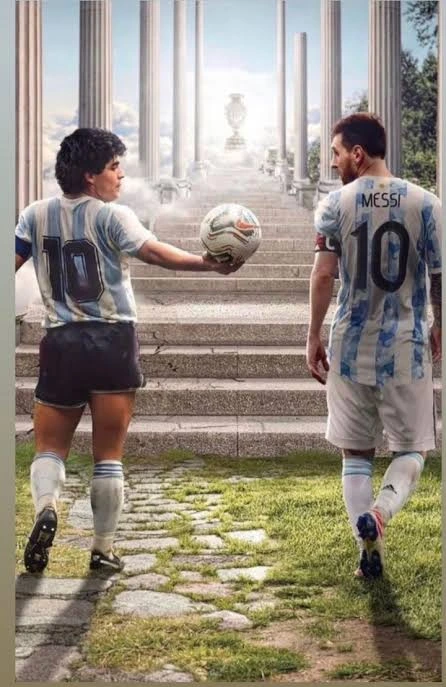
Messi vs Maradona: Goals, Trophies, World Cups and Legacy
For decades, Diego Maradona represented the ultimate image of Argentine football genius.
Then Lionel Messi arrived.
He was left-footed. Small, extraordinarily balanced and capable of running through defenders while appearing to keep the ball attached to his feet. He wore Argentina’s No. 10 shirt, moved from Argentina to Barcelona as a young player and eventually became the central figure in another World Cup-winning Argentine team.
The similarities made Messi vs Maradona inevitable.
But comparing them is more complicated than asking who scored more goals.
They played in different eras, under different rules, on different pitches and in very different club environments. Maradona’s greatest club achievement came from transforming Napoli into champions during an era dominated by powerful northern Italian clubs. Messi spent most of his career inside one of the strongest football systems ever assembled at Barcelona.
Their Argentina careers were also different.
Maradona’s reputation is inseparable from the 1986 World Cup, where he produced five goals, five assists and one of the most influential individual campaigns in tournament history.
Messi’s international story developed more slowly. He suffered defeat in the 2014 World Cup final and several Copa América finals before eventually leading Argentina to the 2021 Copa América, the 2022 World Cup and the 2024 Copa América. He then helped Argentina reach another World Cup final in 2026 before retiring from international football.
That means Messi vs Maradona is not simply statistics against nostalgia.
It is a comparison between two different forms of football greatness.
For Messi’s complete career background, start with The News Ink’s Lionel Messi Explained.
Messi vs Maradona at a Glance
| Category | Lionel Messi | Diego Maradona |
|---|---|---|
| Argentina senior appearances | 208 | 91 |
| Argentina senior goals | 126 | 34 |
| World Cups played | 6 | 4 |
| World Cup appearances | 34 | 21 |
| World Cup goals | 21 | 8 |
| World Cup titles | 1 | 1 |
| World Cup finals reached | 3 | 2 |
| World Cup Golden Balls | 2 | 1 |
| Copa América titles | 2 | 0 |
| Ballon d’Or wins | 8 | Not eligible during prime; honorary award later |
| Barcelona goals | 672 | 38 |
| Napoli goals | — | 115 |
| Major Napoli Serie A titles | — | 2 |
| Champions League titles | 4 | 0 |
| UEFA Cup titles | 0 | 1 |
| Primary foot | Left | Left |
| Iconic Argentina shirt | No. 10 | No. 10 |
The statistics clearly show Messi’s greater career volume.
But Messi vs Maradona becomes much more interesting once the context behind those numbers is examined.
1. Their Argentina Careers Began Very Differently
Maradona made his Argentina debut in 1977 while still a teenager.
He narrowly missed Argentina’s 1978 World Cup squad but quickly became one of the country’s central players. By the time the 1986 tournament arrived, he was captain and the unquestioned creative leader of Carlos Bilardo’s team.
Maradona ultimately finished with:
91 Argentina appearances
and
34 goals.
FIFA’s records also give him eight World Cup goals across 21 appearances.
Messi’s Argentina career lasted much longer.
He made his senior debut in 2005 and played his final international match against Benin on October 6, 2026.
FIFA’s final record gives Messi:
208 appearances
126 goals
and
70 assists.
FIFA — Lionel Messi Argentina Career
On pure international volume, the Messi vs Maradona comparison strongly favors Messi.
He played more than twice as many matches and scored almost four times as many international goals.
Yet Maradona’s international reputation rests less on volume than on what happened during one extraordinary tournament.
2. Maradona’s 1986 World Cup Is the Foundation of His Case
Mexico 1986 is central to every serious Messi vs Maradona debate.
Maradona played seven matches.
He scored five goals.
He created another five.
Argentina became world champion.
FIFA’s historical account credits Maradona with one of the tournament’s defining individual campaigns.
His quarter-final against England became perhaps the most famous single performance in World Cup history.
FIFA — Maradona Against England in 1986
The first goal became known as the Hand of God after Maradona used his hand to send the ball past goalkeeper Peter Shilton without the officials detecting the infringement.
Four minutes later came something completely different.
Maradona received the ball inside his own half, accelerated past multiple England players and finished past Shilton.
FIFA later celebrated it as the Goal of the Century.
One goal became one of football’s greatest controversies.
The other became one of its greatest demonstrations of individual skill.
That contrast captures much of Maradona’s extraordinary mythology.
3. Maradona Did Much More Than Score in 1986
The numbers alone do not fully explain his influence.
Maradona completed an extraordinary number of dribbles during the tournament. FIFA’s modern statistical reviews credit him with 53 successful take-ons in Mexico 1986, one of the greatest dribbling totals ever recorded at a World Cup.
He also created goals.
He controlled possession.
He drew defenders toward him.
And opponents often used physical challenges that would receive much greater punishment under modern officiating.
Argentina’s system was built around his ability to receive the ball under pressure and move it forward.
This is why Maradona’s 1986 tournament remains one of the strongest arguments made by those who prefer him in the Messi vs Maradona debate.
His supporters are not primarily pointing to career statistics.
They are pointing to the scale of his influence over one World Cup-winning side.
4. Messi’s World Cup Story Took Six Tournaments
Messi’s relationship with the World Cup was completely different.
He first appeared at the tournament in 2006.
Argentina reached the quarter-finals.
Another quarter-final followed in 2010.
Then came the 2014 tournament in Brazil.
Messi scored four goals during the group stage and helped Argentina reach the final, where Germany won 1-0 after extra time.
Messi received the World Cup Golden Ball as the tournament’s outstanding player.
Four years later, Argentina exited in the last 16.
Then everything changed in Qatar.
At the 2022 World Cup, Messi scored seven goals and helped create several more.
He scored in the group stage.
The round of 16.
The quarter-final.
The semi-final.
And the final.
Argentina eventually defeated France on penalties after a 3-3 draw.
Messi scored twice in the final and converted his shootout penalty.
For the full tournament breakdown, see The News Ink’s Lionel Messi World Cup Record.
5. Messi Then Extended His World Cup Career in 2026
For years, people assumed Qatar would be Messi’s final World Cup.
It was not.
He returned at age 39 for the expanded 2026 tournament.
Messi scored eight goals and provided four assists as Argentina reached another final.
Spain eventually defeated Argentina in the title match, but Messi finished his World Cup career with:
34 appearances
and
21 goals.
UEFA’s updated record summary also confirms his 34 World Cup appearances as the men’s record.
The Messi vs Maradona World Cup comparison therefore has two distinct arguments.
Maradona produced the more concentrated legendary tournament in 1986.
Messi built the larger complete World Cup career.
6. Messi Holds Two World Cup Golden Balls
Another remarkable difference is individual tournament recognition.
Maradona won the Golden Ball as the best player at the 1986 World Cup.
Messi won it twice:
2014
and
2022.
FIFA confirms Messi is the only man to win two World Cup Golden Balls.
FIFA — Messi World Cup Golden Balls
Maradona later received the Bronze Ball at the 1990 tournament as Argentina again reached the final.
This creates another fascinating difference in Messi vs Maradona.
Maradona’s single greatest tournament may have been more dominant.
Messi’s excellence remained significant across several World Cups.
7. Maradona Took Argentina Back to the Final in 1990
Maradona’s international story did not end in 1986.
Argentina entered the 1990 World Cup with problems.
Maradona was carrying injuries.
The team struggled during the group stage.
Yet Argentina still reached the final.
Maradona did not score at the tournament, but he remained central to the team’s attacking play.
One of the defining moments came against Brazil when he carried the ball forward and created Claudio Caniggia’s winning goal.
Argentina later eliminated Italy in Naples, the city where Maradona had become a club icon.
West Germany defeated Argentina 1-0 in the final.
That second World Cup final is important because it demonstrates that Maradona’s international legacy was not built entirely around one tournament.
Still, 1986 remains its defining chapter.
8. Messi’s Argentina Story Eventually Became Much Larger
For much of Messi’s career, critics repeatedly compared his national-team achievements with Maradona’s.
The argument was simple.
Maradona had won the World Cup.
Messi had not.
That criticism became much harder to sustain after 2021.
Argentina defeated Brazil in the Copa América final at the Maracanã.
Messi had finally won a major senior international title.
Then came:
2022 Finalissima
2022 FIFA World Cup
2024 Copa América.
Messi ended his Argentina career with four major senior team titles.
The News Ink’s Lionel Messi Argentina Career covers that transformation in detail.
By the time he retired internationally in October 2026, Messi had become Argentina’s record appearance-maker and record goalscorer.
9. Maradona’s Napoli Career Is Essential to His Legacy
If Maradona had only played for Argentina, he would still be a legend.
Napoli made his story much larger.
Maradona joined the Italian club in 1984.
At that time, Italian football’s biggest power traditionally came from clubs such as Juventus, Milan and Inter.
Napoli had never won Serie A.
Maradona changed that.
Napoli became Italian champion in:
1986-87
and
1989-90.
The club also won the Coppa Italia in 1987 and later captured the UEFA Cup in 1989.
UEFA describes Maradona as central to Napoli’s greatest period of success.
UEFA — Maradona and Napoli’s 1989 UEFA Cup
That club transformation remains one of Maradona’s strongest arguments in Messi vs Maradona.
10. Why Winning With Napoli Matters So Much
Winning trophies at Barcelona is difficult.
Winning Napoli’s first Serie A title carried a different historical meaning.
Maradona arrived in southern Italy at a club competing against powerful northern institutions with greater financial strength and deeper traditions of domestic success.
He became the central figure of the team.
Serie A’s official historical honors confirm Napoli’s championships in 1986-87 and 1989-90.
Maradona also scored 115 official goals in 259 appearances for Napoli under widely used career statistics.
The relationship between player and city became so strong that Napoli later retired the No. 10 shirt.
This is not simply a trophy argument.
It is an argument about transformation.
Maradona did not join an existing dynasty.
He became the symbol of Napoli becoming champions.
11. Messi’s Barcelona Career Was Far More Dominant Statistically
The club side of the Messi vs Maradona comparison looks completely different when the focus shifts to sustained numbers.
Messi scored:
672 official goals for Barcelona.
FC Barcelona’s own historical player database records the figure.
FC Barcelona — Lionel Messi Statistics
He also helped Barcelona win 35 trophies during his first-team career.
Those included:
10 La Liga titles;
7 Copa del Rey trophies;
4 Champions League titles;
multiple Spanish and European Super Cups;
Club World Cups.
Messi became La Liga’s record scorer and produced multiple seasons with more than 50 goals in all competitions.
Maradona’s club career never produced anything close to that statistical volume.
12. But Maradona Also Played for Barcelona
There is a direct historical connection between the two players.
Maradona joined Barcelona in 1982.
His time in Spain was brilliant but disrupted.
He suffered from hepatitis.
He later sustained a serious ankle injury.
His Barcelona period lasted only two seasons.
The club officially records:
58 competitive appearances
38 goals.
FC Barcelona — Diego Maradona Statistics
Maradona also won the Copa del Rey, Spanish League Cup and Spanish Super Cup during his time there.
But Barcelona did not become the defining club of his career.
Napoli did.
For Messi, Barcelona became almost inseparable from his football identity.
13. Messi Was the Greater Volume Goalscorer
This is one of the clearest statistical differences.
Messi scored hundreds more official goals than Maradona.
He finished his Argentina career with 126 alone.
His Barcelona total was 672.
Maradona scored 34 times for Argentina.
His most prolific European club total was 115 with Napoli.
That does not mean Maradona was a poor goalscorer.
Far from it.
He scored 38 times in only 58 competitive Barcelona appearances, an excellent rate for a player whose role also involved extensive playmaking.
But Maradona was not used primarily as a scoring machine.
Messi gradually became one.
That makes goal totals one of the categories where Messi vs Maradona produces a clear statistical separation.
14. Their Playing Styles Had Remarkable Similarities
Anyone watching footage of the two immediately sees why comparisons began.
Both were:
left-footed;
short;
powerfully balanced;
exceptional dribblers;
creative passers;
dangerous free-kick takers;
comfortable receiving the ball under pressure.
Both could change direction without losing control.
Both manipulated defenders with body movement rather than only raw pace.
And both could create an entire attack from an apparently harmless position.
There were also important differences.
Maradona often operated as a traditional attacking midfielder or free No. 10.
He frequently dropped deeper to organize possession and carry the ball toward goal.
Messi began as a winger before becoming a devastating false nine and later evolving into a deeper creator.
The similarities are real.
Treating them as identical players would still be inaccurate.
15. Maradona Played in a More Physical Era
One of the most difficult parts of Messi vs Maradona is comparing the environments in which they played.
Maradona competed during a period when defenders were generally permitted much more physical contact.
Video from the 1980s shows challenges that would frequently produce yellow or red cards today.
Pitches were also less consistent.
Protective equipment was less advanced.
Sports medicine was less sophisticated.
Maradona’s career was significantly affected by injuries, including the serious ankle injury he suffered while playing for Barcelona.
That context matters.
Modern football protects attacking players more effectively in certain situations.
But modern football creates different difficulties.
16. Messi Faced Faster and More Organized Modern Defenses
Messi played in an era of:
extensive video analysis;
data-driven scouting;
highly structured pressing;
extremely fit defensive units;
specialized tactical preparation.
Teams could study enormous amounts of footage before facing him.
Every tendency could be analyzed.
Where he received the ball.
Which direction he preferred to turn.
Where he passed when surrounded.
Yet defenders repeatedly failed to stop him.
So saying Maradona faced harder football simply because defenders tackled more aggressively would be incomplete.
The challenges changed.
Maradona faced more physical punishment.
Messi faced more sophisticated collective defensive organization.
There is no perfect formula for converting one era into another.
17. Messi Has the Stronger Ballon d’Or Record—but the Comparison Is Unfair
Messi has won:
eight Ballon d’Or awards.
That is the men’s record.
The News Ink’s Lionel Messi Ballon d’Or guide covers all eight victories.
Maradona won no competitive Ballon d’Or during his playing prime.
But simply writing:
Messi 8 — Maradona 0
would be historically misleading.
For most of Maradona’s career, the Ballon d’Or was restricted by eligibility rules that prevented South American players such as Maradona from winning.
UEFA’s Ballon d’Or history confirms that Maradona and Pelé later received honorary Ballon d’Or trophies because they had not been eligible during their eras.
So individual award totals cannot be compared directly without context.
18. Messi Has a Much Larger Trophy Collection
Messi’s overall trophy record is extraordinary.
The News Ink’s Lionel Messi Trophies page currently uses a broad official club-and-country methodology placing him at 47 team honours, including youth and Olympic titles.
Even under a senior-only methodology, his collection remains enormous.
Barcelona accounts for the majority.
Messi later added titles with Paris Saint-Germain, Inter Miami and Argentina.
Maradona’s trophy cabinet was smaller.
But once again, pure totals do not explain historical context.
Maradona’s two Serie A titles with Napoli may carry more individual transformational significance than several championships won inside already-dominant teams.
This is why Messi vs Maradona cannot be solved by counting cups alone.
19. Maradona’s Greatest Strength Was His Ability to Carry a Team’s Identity
The phrase “carried the team” is often exaggerated in football.
No player wins alone.
Maradona had excellent teammates with both Argentina and Napoli.
But the degree to which those teams were identified with him was unusual.
Argentina’s 1986 attack revolved around him.
Napoli’s greatest era revolved around him.
Opponents organized entire defensive plans around stopping him.
Supporters viewed him as more than the team’s best player.
He became its identity.
This cultural and emotional influence is difficult to measure statistically.
It is also one reason people who watched Maradona in his prime can reject purely numerical Messi vs Maradona arguments.
20. Messi’s Greatest Strength May Be Sustained Excellence
Maradona’s peak is central to his case.
Messi’s duration is central to his.
Messi became a Barcelona first-team player in the mid-2000s.
He was still producing at elite international level in 2026.
During that period, his role changed repeatedly.
Young Messi relied more heavily on acceleration and one-on-one dribbling.
Pep Guardiola’s Barcelona used him as a false nine.
Later he became a combination of goalscorer and playmaker.
In his final years, he increasingly controlled matches through passing, positioning and selective bursts rather than constant high-speed dribbling.
He adapted without losing influence.
The Messi vs Maradona debate therefore partly contrasts extraordinary peak impact with extraordinary sustained production.
21. Their World Cup Numbers Show This Difference Perfectly
The full World Cup record tells the story.
Lionel Messi
6 World Cups
34 appearances
21 goals
1 title
3 finals
2 Golden Balls
Diego Maradona
4 World Cups
21 appearances
8 goals
1 title
2 finals
1 Golden Ball
Messi’s numbers are much larger.
Maradona’s most famous single tournament remains uniquely influential.
This is perhaps the cleanest summary of Messi vs Maradona.
Messi accumulated more.
Maradona compressed enormous influence into a shorter peak.
22. Maradona’s Eight World Cup Goals Do Not Show His Full Value
Maradona scored eight World Cup goals.
Messi scored 21.
That looks like an enormous gap.
But Maradona was also a creator.
FIFA’s historical records give him eight World Cup assists across his four tournaments, including five in 1986.
FIFA — Diego Maradona World Cup Record
He frequently received the ball deeper than a traditional striker.
The correct comparison is therefore not:
21 goals vs 8 goals = Messi was almost three times better.
Football does not work that way.
Goals matter enormously.
Role and creative responsibility matter too.
23. Messi Became More Complete Internationally Late in His Career
One of the most interesting parts of Messi’s career is how dramatically the public perception of his Argentina legacy changed.
Before 2021, his international career contained:
a World Cup final defeat;
Copa América final defeats;
years of criticism.
After 2021, the trophy sequence changed everything.
Copa América.
Finalissima.
World Cup.
Another Copa América.
Then another World Cup final in 2026.
Messi did not suddenly become a better footballer at 34.
Argentina became a more balanced team around him, while Messi himself developed into an experienced captain and creator.
That late transformation is essential to the modern Messi vs Maradona debate.
24. Maradona Became a Cultural Symbol Beyond Football
Maradona’s legacy is not limited to what happened between the touchlines.
In Naples, his identity became connected with regional pride.
In Argentina, he represented a particular form of football mythology: rebellious, emotional and deeply connected to street football culture.
Murals, songs and tributes continue long after his death in 2020.
Napoli’s stadium now bears his name:
Stadio Diego Armando Maradona.
That level of cultural identification is difficult to compare with statistics.
Messi has enormous global popularity.
Maradona’s relationship with particular places—especially Naples and Argentina—had a different intensity.
25. Messi’s Influence Is More Global
Messi’s career developed during the era of global broadcasting, social media and digital football culture.
Barcelona matches were watched worldwide.
His rivalry with Cristiano Ronaldo helped make La Liga one of the central products in global sport.
His move to Inter Miami transformed attention around Major League Soccer.
His shirts, goals and records reached audiences far beyond Argentina and Spain.
That gives Messi a global footprint that belongs to a different media era from Maradona.
Maradona was globally famous too.
But football in the 1980s did not have the same continuous worldwide digital distribution.
Comparing fame directly is therefore almost as difficult as comparing tackling standards.
26. Who Was the Better Dribbler?
This is one of the closest technical categories.
FIFA’s World Cup statistics show the scale of both players’ dribbling ability.
Maradona completed 53 successful take-ons during the 1986 World Cup.
Messi became the player with the most completed dribbles across World Cup history through his much longer tournament career.
Both relied heavily on:
balance;
close control;
body feints;
rapid direction changes.
Maradona’s dribbling could look more aggressive because he frequently carried the ball across longer distances through midfield.
Messi often combined tiny touches with sudden acceleration near the penalty area.
Declaring one objectively superior is difficult.
Both belong among football’s greatest dribblers.
27. Who Was the Better Goalscorer?
This category is much easier.
Messi.
His career scoring output is far greater.
He scored 672 times for Barcelona alone.
Maradona’s entire club career produced a much lower total.
Messi also scored 126 international goals compared with Maradona’s 34.
He produced 91 goals for club and country during the 2012 calendar year.
Maradona’s game was never built around that level of scoring volume.
Therefore, in the Messi vs Maradona comparison, finishing and sustained goalscoring strongly favor Messi.
28. Who Was the Better Playmaker?
This is much closer.
Both were extraordinary creators.
Maradona’s deeper role meant that playmaking was fundamental to his identity.
Messi became one of football’s most productive creators while simultaneously producing striker-level scoring numbers.
Historical assist data from Maradona’s era is much less complete than modern records, making exact career comparisons unreliable.
That limitation matters.
Modern databases can track almost every Messi assist.
Maradona’s full creative record cannot be reconstructed with the same precision.
The fairest conclusion is that both were elite playmakers operating in somewhat different tactical roles.
29. Who Had the Better Club Career?
If this means:
goals;
trophies;
longevity;
Champions League success;
domestic league records,
Messi has the stronger career.
His Barcelona period lasted almost two decades and produced 672 goals and 35 trophies.
But if the question becomes:
Who transformed one club more dramatically?
Maradona’s Napoli case becomes extremely powerful.
That illustrates why wording matters in Messi vs Maradona.
“Better club career” and “greater transformational impact at one club” are not exactly the same question.
30. Who Had the Better International Career?
Again, the answer depends on the measurement.
Messi finished with:
126 goals;
208 appearances;
two Copa América titles;
one World Cup;
one Finalissima;
three World Cup finals;
two World Cup Golden Balls.
Maradona had:
34 goals;
91 appearances;
one World Cup;
two World Cup finals;
one World Cup Golden Ball.
The complete career record therefore strongly favors Messi statistically.
But Maradona’s 1986 peak remains one of football’s greatest individual tournament performances.
Both statements can coexist.
Messi vs Maradona: Category-by-Category Comparison
| Category | Main Edge | Why |
|---|---|---|
| Career goals | Messi | Much larger scoring total |
| Argentina goals | Messi | 126 vs 34 |
| Argentina appearances | Messi | 208 vs 91 |
| World Cup goals | Messi | 21 vs 8 |
| World Cup titles | Equal | One each |
| World Cup peak | Maradona has powerful case | 1986 remains exceptional |
| World Cup longevity | Messi | Six tournaments, 34 games |
| World Cup Golden Balls | Messi | Two vs one |
| Club trophies | Messi | Much larger total |
| Transforming one club | Maradona has unique case | Napoli’s historic rise |
| Ballon d’Or record | Messi statistically | Maradona was ineligible during prime |
| Dribbling | Extremely close | Both historic elite |
| Playmaking | Extremely close | Different roles and data eras |
| Longevity | Messi | Elite career stretched into late 30s |
| Cultural impact | Different forms | Maradona in Naples/Argentina; Messi globally |
The table does not produce a universal winner.
It shows why different supporters prioritize different evidence.
Frequently Asked Questions
Who was better, Messi or Maradona?
There is no objective formula that settles Messi vs Maradona. Messi has the stronger career statistics, larger trophy collection, more Argentina goals and much greater longevity. Maradona’s strongest case comes from the extraordinary influence of his 1986 World Cup and transformation of Napoli.
Did Messi score more goals than Maradona?
Yes. Messi scored vastly more official senior goals. He finished with 126 goals for Argentina alone, compared with Maradona’s 34.
How many times did Messi play for Argentina?
Messi finished his senior Argentina career with 208 appearances and 126 goals after his final match in October 2026.
How many games did Maradona play for Argentina?
Maradona played 91 senior internationals and scored 34 goals.
Who scored more World Cup goals, Messi or Maradona?
Messi scored 21 World Cup goals across six tournaments. Maradona scored eight across four.
Who won more World Cups?
They each won one. Maradona led Argentina to the 1986 title, while Messi captained Argentina to victory in 2022.
Who reached more World Cup finals?
Messi reached three: 2014, 2022 and 2026. Maradona reached two: 1986 and 1990.
Who won more World Cup Golden Balls?
Messi won two, in 2014 and 2022. Maradona won the award in 1986.
Did Maradona ever win the Ballon d’Or?
Maradona was not eligible for the competitive Ballon d’Or during most of his career because of the award’s old eligibility rules. He later received an honorary Ballon d’Or.
How many Ballon d’Or awards did Messi win?
Messi won a record eight.
Did both Messi and Maradona play for Barcelona?
Yes. Messi spent the majority of his elite club career at Barcelona. Maradona played there from 1982 to 1984, scoring 38 goals in 58 official matches.
How many goals did Maradona score for Napoli?
Maradona scored 115 official goals in 259 appearances for Napoli under widely used historical records.
What did Maradona win with Napoli?
His major achievements included two Serie A titles, the 1987 Coppa Italia, the 1989 UEFA Cup and the 1990 Italian Super Cup.
How many goals did Messi score for Barcelona?
Barcelona officially credits Messi with 672 goals.
Why are Messi and Maradona compared so often?
Both are Argentine left-footed No. 10s famous for extraordinary dribbling, creativity and World Cup success. Their similar physical profiles and central roles for Argentina made comparisons inevitable.
Messi vs Maradona Is Really a Debate About What We Value in Football
The simplest way to compare great players is to count.
Goals.
Trophies.
Appearances.
Awards.
If those are the primary measures, the Messi vs Maradona debate moves strongly toward Lionel Messi.
His career lasted longer at the highest level.
He scored far more goals.
He played more than twice as many internationals.
He won more club trophies.
He reached more World Cup finals.
He won two World Cup Golden Balls.
He won a record eight Ballon d’Or awards.
He eventually collected almost every major title that had once been used against him.
But football greatness is not measured only through accumulation.
That is where Maradona remains impossible to dismiss.
The 1986 World Cup is not remembered merely because Argentina won.
It is remembered because Maradona appeared to control the tournament.
Five goals.
Five assists.
The England quarter-final.
The dribbling.
The passes.
The constant pressure from defenders.
The leadership.
Then there was Napoli.
Maradona did not simply add trophies to a club already accustomed to winning them.
He helped change what supporters believed Napoli could become.
Two Serie A championships and a UEFA Cup turned him into something larger than an ordinary star in Naples.
That emotional legacy cannot be reduced to a spreadsheet.
Messi’s career tells a different story.
His greatness was repeated so consistently that extraordinary performances gradually became normal.
Forty goals.
Fifty goals.
Another Ballon d’Or.
Another league title.
Another Champions League run.
Another dribble through half a defense.
For years, that consistency may even have worked against him psychologically because supporters became accustomed to the impossible.
His Argentina story then completed the arc.
For much of his career, the comparison with Maradona produced the same criticism:
Maradona won the World Cup.
Messi did not.
Then Messi won Copa América.
Then the World Cup.
Then another Copa América.
He returned for one final World Cup in 2026 and helped Argentina reach another final before ending his international career with 208 caps and 126 goals.
By then, the Messi vs Maradona discussion had fundamentally changed.
The question was no longer whether Messi could achieve what Maradona had achieved.
It became how two completely different careers should be weighed against one another.
Maradona represents perhaps the strongest argument for peak influence.
Messi represents perhaps the strongest argument for sustained excellence.
Maradona’s most powerful image is Mexico 1986: the captain demanding the ball and driving Argentina toward the trophy.
Messi’s career cannot be reduced to one tournament or one club season because his case depends on the accumulation of almost two decades of elite football.
That is why this debate will probably never disappear.
People are not merely comparing two players.
They are choosing what they value most.
Peak or longevity.
Transformation or accumulation.
One extraordinary tournament or six World Cups of production.
Napoli’s historic rise or Barcelona’s sustained dominance.
The answer changes depending on the question.
But one conclusion is easy.
Argentina produced two footballers whose influence extends far beyond their statistics.
Maradona gave one generation its defining No. 10.
Messi gave the next generation another.
And instead of making one man’s greatness smaller, the Messi vs Maradona debate may ultimately demonstrate something more remarkable:
Argentina somehow produced both.
Follow The News Ink
For more research-driven explainers, science coverage and global stories, follow The News Ink on X, Instagram, Threads, Medium, Substack, Bluesky, Pinterest, TikTok, Quora and Mastodon.