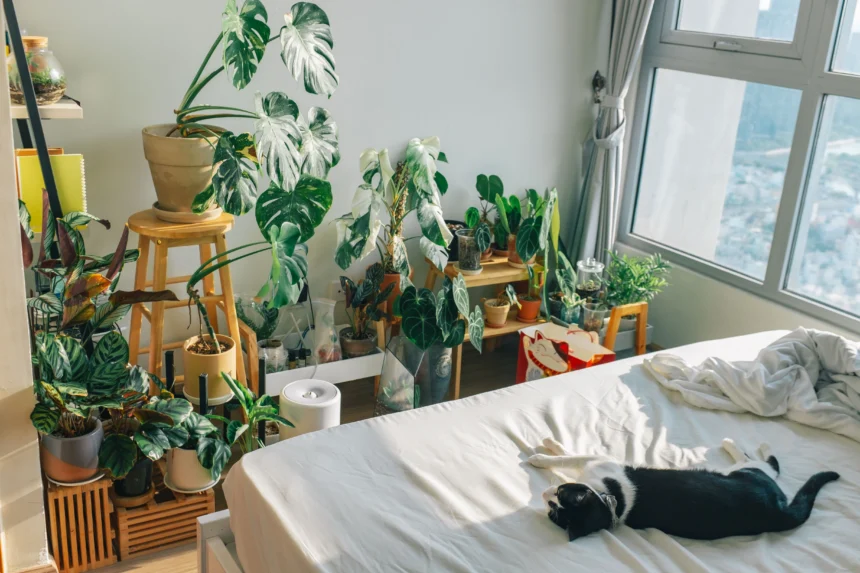
10 Bedroom Plants That Can Improve Your Room While You Sleep
You turn off the lights.
Close the curtains.
Put your phone down.
And beside the bed, a plant quietly remains alive through the night.
It sounds almost too simple, yet bedroom plants have become enormously popular among people trying to make their sleeping spaces calmer, fresher and more comfortable.
The internet often takes the idea much further.
You may have seen claims that a snake plant will “flood your bedroom with oxygen,” that a peace lily will remove dangerous toxins while you sleep or that putting a few houseplants around your bed can dramatically improve sleep quality.
The reality is more interesting—and much more nuanced.
Some bedroom plants really can make a room feel more relaxing. Plants transpire water, so several healthy plants can contribute modestly to indoor humidity. Greenery has also been associated with psychological benefits including lower perceived stress and improved mood.
Some plants use unusual nighttime metabolism.
Others have pleasant fragrances.
And simply creating a bedroom that feels comfortable and intentionally designed for rest may support a better wind-down routine.
But plants are not medical sleep treatments.
Nor can a handful of bedroom plants replace proper ventilation or a real air cleaner.
The Royal Horticultural Society says research suggests that some of the strongest benefits of indoor plants relate to psychological wellbeing, including improved mood and lower stress. It also cautions that substantial numbers of plants may be needed to create meaningful room-scale air-quality changes. RHS — Houseplants for Health and Wellbeing
So which plants actually make sense beside the bed?
And what can they realistically do while you sleep?
Bedroom Plants at a Glance
| Plant | Best Bedroom Benefit | Light | Watering | Pet Safety |
|---|---|---|---|---|
| Snake plant | Very easy care, nighttime CAM metabolism | Low to bright indirect | Low | Toxic to cats/dogs |
| Spider plant | Easy, compact, pet-friendly choice | Medium indirect | Moderate | Generally pet-safe |
| Aloe vera | CAM plant for sunny rooms | Bright light | Low | Toxic to cats/dogs |
| Peace lily | Lush greenery, humidity-loving | Medium indirect | Moderate | Toxic |
| Boston fern | High transpiration, lush appearance | Medium indirect | Frequent | Generally pet-safe |
| Areca palm | Large green visual impact | Bright indirect | Moderate | Generally pet-safe |
| Parlor palm | Compact palm for moderate light | Low to medium | Moderate | Generally pet-safe |
| Pothos | Easy trailing greenery | Low to bright indirect | Low/moderate | Toxic |
| ZZ plant | Extremely low-maintenance | Low to medium | Low | Toxic |
| Lavender | Fragrance and bedtime association | Very bright | Low/moderate | Use caution with pets |
The right bedroom plants depend on your light, available space, pets and willingness to care for them.
A healthy spider plant in the right location is better than a supposedly “perfect sleep plant” slowly dying in a dark corner.
Before the List: Do Bedroom Plants Really Purify the Air?
This is the biggest myth surrounding bedroom plants.
The story usually begins with NASA.
In 1989, NASA-supported research tested several plants for their ability to remove compounds such as benzene, formaldehyde and trichloroethylene from enclosed experimental chambers.
The results were real.
Several plants and their root-zone systems did remove pollutants under those conditions.
NASA — Interior Landscape Plants for Indoor Air Pollution Abatement
But an experimental chamber is not your bedroom.
Later researchers reviewed decades of plant studies and calculated that ordinary passive houseplants remove volatile organic compounds far too slowly to compete with the air exchange occurring naturally in real buildings.
The review estimated that matching typical building ventilation could require roughly 10 to 1,000 plants per square meter depending on conditions.
PubMed — Potted Plants Do Not Improve Indoor Air Quality: A Review
The U.S. Environmental Protection Agency is even clearer.
Its current indoor-air guidance states that there is no evidence that a reasonable number of houseplants removes significant quantities of pollutants in homes and offices. For indoor air problems, source control, ventilation and appropriate filtration matter far more. EPA — Improving Indoor Air Quality
That does not make bedroom plants useless.
It simply means we should appreciate their real benefits instead of inventing superpowers for them.
The News Ink’s detailed guide to plants for indoor air quality examines this myth in greater depth.
1. Snake Plant
If you want one of the easiest bedroom plants, the snake plant is difficult to beat.
Its upright leaves take up very little floor space.
It tolerates inconsistent watering.
It can survive lower-light rooms better than many houseplants.
And it has one genuinely unusual biological feature.
Snake plants use Crassulacean Acid Metabolism, commonly called CAM photosynthesis.
CAM plants can open their stomata during the night and take in carbon dioxide, storing it for photosynthesis later.
This is different from many ordinary plants.
That fact has produced a much larger internet claim:
“Snake plants produce so much oxygen at night that they improve your sleep.”
That is where the story becomes exaggerated.
A few houseplants simply do not move enough gases to significantly alter the oxygen concentration of a normal bedroom.
The RHS notes that nighttime gas exchange from ordinary houseplants is far too small to create a meaningful danger—or dramatic benefit—for people sharing the room.
So why choose a snake plant?
Because it is:
- attractive;
- vertical rather than sprawling;
- tolerant of neglect;
- suitable for many bedrooms;
- one of the easiest bedroom plants to keep alive.
That last point matters more than an exaggerated oxygen claim.
2. Spider Plant
The spider plant may be the best all-round choice for beginners.
Its long striped leaves arch outward, while mature plants develop small hanging plantlets.
It can sit:
on a shelf;
in a hanging basket;
on a dresser;
or near a window.
The RHS describes spider plants as easy to grow and capable of tolerating some neglect. They prefer bright indirect light but can tolerate relatively low light. RHS — How to Grow Spider Plants
Spider plants also have another major advantage over several popular bedroom plants:
they are commonly regarded as non-toxic to cats and dogs.
That can make them a much better choice for someone whose pet sleeps in the room.
Do not buy one because you expect it to scrub the bedroom air clean overnight.
Buy one because it is:
easy;
attractive;
adaptable;
and comparatively pet-friendly.
Those are much more defensible benefits.
3. Aloe Vera
Aloe vera belongs in a bright bedroom.
It is a succulent, so it likes considerably more light than a plant such as a ZZ plant.
Like snake plant, aloe uses CAM metabolism.
Its gas-exchange pattern therefore continues in an unusual way at night.
Again, this makes aloe interesting biology.
It does not mean one aloe plant beside your pillow will meaningfully raise the oxygen concentration of the room.
The bigger advantage is practicality.
Aloe:
needs relatively infrequent watering;
does not create a huge amount of foliage;
fits easily on a bright windowsill;
and can tolerate the dry conditions found in many bedrooms.
Among bedroom plants, aloe makes most sense where a sunny window is available.
It is not an appropriate choice for a dark room.
Pet owners should also be cautious because aloe can cause problems if cats or dogs chew it.
4. Peace Lily
Few bedroom plants look as immediately calming as a healthy peace lily.
Its dark green leaves create dense foliage and its white spathes can make a bedroom feel softer and more finished.
Peace lilies also prefer moderate humidity.
Because plants lose water through their leaves, actively growing plants can contribute some moisture to dry indoor air.
That effect should be kept in perspective.
One peace lily is not a humidifier.
But several transpiring plants may make a modest contribution in a small, dry room.
The RHS recommends bright indirect light for peace lilies and warns against prolonged overwatering. RHS — How to Grow Peace Lilies
Peace lilies are also poisonous if eaten.
That matters in bedrooms containing curious pets or young children.
Before choosing any plant, check its safety rather than assuming something sold as a houseplant is harmless.
ASPCA — Toxic and Non-Toxic Plant Database
5. Boston Fern
If your bedroom becomes extremely dry during heating season, Boston fern is one of the more interesting bedroom plants.
Its huge number of thin fronds creates a large leaf area.
Plants lose water through a process known as transpiration.
Consequently, healthy leafy plants can contribute moisture to the immediate indoor environment.
Research into indoor greenery has found measurable changes in humidity under certain controlled conditions, although the effect depends heavily on:
plant size;
number of plants;
room size;
temperature;
watering;
ventilation.
This should not turn into another exaggerated claim.
If your bedroom has seriously low humidity, a hygrometer and properly managed humidifier provide far more direct control.
But a Boston fern can combine lush visual greenery with natural transpiration.
It does require more care than a snake plant.
The compost should not repeatedly become bone dry, and the plant generally prefers indirect light and higher humidity.
6. Areca Palm
A small plant can soften a bedside table.
An areca palm can transform an entire corner.
That is why larger bedroom plants can have psychological value even when their air-cleaning effects are small.
A tall palm introduces:
height;
texture;
movement;
a stronger visual connection with nature.
Research into indoor plants has repeatedly explored effects on stress, mood and perceived wellbeing.
A systematic review and meta-analysis of indoor plant research reported measurable physiological and psychological effects across experimental studies, although study designs and environments varied.
Scientific Review — Physiological and Psychological Benefits of Indoor Plants
This may ultimately be more relevant to the bedroom than pollutant removal.
People generally sleep better in environments that feel safe, comfortable and relaxing.
The National Sleep Foundation emphasizes that a sleep-friendly bedroom should prioritize characteristics such as darkness, quiet and comfortable temperature. Plants can complement that environment, but they do not replace those fundamentals.
National Sleep Foundation — How to Make a Sleep-Friendly Bedroom
7. Parlor Palm
Not everyone has space for a large areca palm.
The parlor palm provides a more compact alternative.
It has been grown indoors for generations because it adapts relatively well to typical household conditions.
For a bedroom, that means you can obtain the visual softness of palm foliage without turning half the room into a greenhouse.
The best bedroom plants are not necessarily the plants with the most spectacular laboratory statistics.
They are the plants that:
fit your space;
survive your light conditions;
do not demand stressful maintenance;
and improve how the room feels to you.
The parlor palm performs well on those criteria.
It is also generally considered a more pet-friendly choice than pothos, peace lily or snake plant.
8. Pothos
Pothos is one of the classic indoor trailing plants.
Place it on a high shelf and its vines can gradually cascade downward.
That makes pothos one of the most flexible bedroom plants for people who lack floor space.
It also tolerates a range of indoor conditions.
Bright indirect light produces stronger growth, but pothos can survive in less ideal light where many flowering plants struggle.
Its main bedroom benefit is therefore not magical nighttime chemistry.
It is easy greenery.
A bare bedroom with hard surfaces can feel visually cold.
A trailing plant can soften shelves, wardrobes and corners without occupying the floor.
Pothos is, however, toxic if chewed by cats or dogs.
Keep it inaccessible if pets roam freely through the bedroom.
9. ZZ Plant
Some people want greenery.
They just do not want another responsibility.
For them, the ZZ plant may be one of the best bedroom plants available.
It stores water in underground rhizomes and tolerates long gaps between watering.
It also copes surprisingly well with lower-light interiors.
A ZZ plant therefore works well for:
busy people;
frequent travelers;
dark bedrooms;
forgetful waterers.
There is one important limitation.
“Low light tolerant” does not mean “requires no light.”
Plants ultimately need light for photosynthesis.
A permanently windowless room may require an appropriate grow light.
The ZZ plant is also not pet-safe if eaten.
10. Lavender
Lavender is different from most of the other bedroom plants on this list.
Its main interest is fragrance.
Lavender aroma has actually been studied in relation to sleep.
A randomized trial involving university students with self-reported sleep problems found that participants receiving lavender aromatherapy alongside sleep hygiene reported greater improvements in some sleep-quality measures than those following sleep hygiene alone. PubMed — Lavender and Sleep Hygiene Randomized Trial
That does not prove that putting a live lavender pot beside the bed treats insomnia.
The trial used lavender essential-oil inhalation, not simply a growing plant.
The distinction matters.
A living lavender plant may release a pleasant fragrance, but its aroma concentration and exposure are not equivalent to experimental aromatherapy.
There is another practical problem.
Lavender likes abundant light.
A dark bedroom is usually a poor long-term environment for it.
If you have a very bright windowsill, however, lavender can be an interesting addition to your bedroom plants collection.
Bedroom Plants Will Not Fix Bad Sleep
It is easy for wellness trends to turn a useful idea into a cure-all.
That should not happen here.
If you regularly sleep five hours, a snake plant cannot replace the missing three.
If traffic wakes you repeatedly, a peace lily will not remove the noise.
If your room is extremely hot, adding a fern does not solve the temperature problem.
If you have untreated sleep apnea, insomnia or another sleep disorder, bedroom plants are not treatment.
The News Ink’s guide to what actually happens while you sleep explains how deeply normal sleep affects the brain, cardiovascular system, hormones, memory and immune function.
For practical sleep improvement, the broader sleep quality guide examines temperature, light, noise, routine and other factors that matter much more than choosing one particular plant.
Plants should support the environment.
They should not become the entire sleep strategy.
Do Bedroom Plants Steal Your Oxygen at Night?
This myth goes in the opposite direction.
Some people worry that plants are dangerous in bedrooms because most plants consume some oxygen during cellular respiration.
Technically, plants do respire.
So do you.
But the amount of gas exchanged by a few bedroom plants is far too small to make sharing a normal ventilated bedroom with them dangerous.
The RHS specifically notes that nighttime carbon-dioxide emissions from houseplants are very low and unlikely to be a problem.
Having one person sleeping beside you affects room respiration far more than putting a small houseplant on the dresser.
You do not need to move your plants into another room every evening.
Can Bedroom Plants Increase Humidity?
Yes—but the size of the effect matters.
Plants absorb water through their roots.
Some of that water eventually leaves through tiny openings in the leaves.
This is transpiration.
Therefore bedroom plants can contribute water vapor to the room.
Leafy, actively growing plants generally contribute more than small slow-growing succulents.
But humidity depends on much more than plants.
It is affected by:
outdoor weather;
heating;
air conditioning;
ventilation;
room size;
showers;
cooking;
number of occupants.
Too much humidity is not desirable either.
Persistently damp bedrooms can encourage mold and dust mites.
The EPA warns that overwatered houseplant soil can also support microorganisms that may bother susceptible people.
So do not turn your bedroom into a tropical greenhouse trying to improve sleep.
How Many Bedroom Plants Should You Have?
There is no scientific rule saying:
one plant per 100 square feet
or
five plants per sleeper.
Those numbers are usually invented.
For most rooms, one to three bedroom plants can provide plenty of visual impact without creating excessive maintenance.
Start with one.
Choose it according to the room.
For example:
Dark bedroom: snake plant or ZZ plant.
Bright bedroom: aloe vera or lavender.
Bedroom with pets: spider plant or parlor palm.
Very dry room: Boston fern or a larger leafy palm.
Small room: pothos on a shelf.
Minimalist room: one architectural snake plant.
Do not choose ten plants simply because an article lists ten.
Keep Bedroom Plants Healthy—or They Can Make the Room Worse
A dying plant does not create a relaxing bedroom.
Neither does wet, moldy potting mix.
Common mistakes include:
- watering on a fixed daily schedule;
- leaving water standing inside decorative pots;
- putting low-light plants in complete darkness;
- placing tropical plants directly against cold windows;
- allowing dead leaves to accumulate;
- ignoring pests;
- buying toxic plants without considering pets.
Overwatering deserves special attention.
People sometimes assume more water means more humidity and therefore a healthier bedroom.
Instead, continuously saturated soil can encourage root rot, fungus gnats and microbial growth.
Healthy bedroom plants should smell like plants and soil—not dampness or decay.
Bedroom Plants Can Become Part of a Sleep Routine
There is another benefit that is difficult to reduce to chemistry.
Plants require small repetitive activities.
Check the leaves.
Touch the soil.
Water when necessary.
Remove a dead leaf.
Turn the pot toward the light.
These activities can become part of a quiet evening environment.
For someone whose bedtime routine otherwise consists of endless phone scrolling, even a small ritual that shifts attention away from a screen may make the room feel more intentional.
The News Ink’s article on cognitive shuffling explores a different example of using low-stimulation attention to help an overactive mind transition toward sleep.
And the broader Healthy Lifestyle guide explains why sleep works alongside movement, diet and stress management rather than as an isolated nightly event.
This is probably the healthiest way to think about bedroom plants.
Not as medicine.
As part of the environment.
Frequently Asked Questions
What are the best bedroom plants?
Some of the easiest bedroom plants include snake plant, spider plant, ZZ plant, pothos and parlor palm. The best choice depends on your available light, space, pets and watering habits.
Do bedroom plants help you sleep?
There is not strong evidence that simply placing ordinary bedroom plants beside your bed directly increases sleep duration or treats insomnia. Plants may improve perceived comfort, aesthetics, mood and relaxation, which can support a pleasant sleep environment.
Which bedroom plants produce oxygen at night?
CAM plants such as snake plant and aloe vera can take in carbon dioxide at night. However, the amount of gas exchanged by a few pots is far too small to significantly change bedroom oxygen levels.
Do bedroom plants clean the air?
Plants can remove some volatile compounds under laboratory conditions, but real-world research indicates that a practical number of passive houseplants does not clean indoor air quickly enough to replace ventilation or filtration.
Is snake plant good for a bedroom?
Yes. Snake plant is one of the easiest bedroom plants because it tolerates lower light and infrequent watering. Its CAM metabolism is interesting, but its main benefit is durability rather than dramatically increasing room oxygen.
Is peace lily good for bedrooms?
Peace lilies can provide attractive foliage and contribute some transpiration, but they need appropriate light and watering. They are also toxic if chewed by pets.
Which bedroom plants are safest for pets?
Spider plant and parlor palm are commonly considered safer options for homes with cats and dogs. Always verify an individual species in a reputable toxicity database before bringing it home.
Can too many bedroom plants be bad?
Potentially. Large numbers of overwatered plants can increase maintenance, humidity and the chance of mold or fungus gnats. More plants do not automatically mean healthier air.
Is lavender really good for sleep?
Lavender aroma has shown promising results in several sleep studies, but most research uses lavender essential oil or controlled aromatherapy rather than live potted lavender. A lavender plant should therefore not be presented as a proven insomnia treatment.
Should bedroom plants be removed at night?
No. Normal quantities of houseplants do not consume enough oxygen or release enough carbon dioxide overnight to represent a realistic danger in a normal bedroom.
Bedroom Plants Can Improve a Room Without Performing Miracles
The most interesting thing about bedroom plants is that they do not need to perform biological miracles to be worthwhile.
A snake plant does not need to flood your room with oxygen.
A peace lily does not need to function like an industrial air purifier.
A Boston fern does not need to replace a humidifier.
A lavender plant does not need to cure insomnia.
Plants can improve a bedroom in much simpler ways.
They add life to a space.
They introduce natural shapes and textures.
They can soften an otherwise sterile room.
Healthy foliage may contribute modestly to humidity.
Certain plants are extremely easy to maintain.
Some fragrances may be pleasant and relaxing.
And scientific research suggests that exposure to indoor greenery can support aspects of mood and psychological wellbeing.
That is enough.
The strongest reason to choose bedroom plants is therefore not a viral claim about “removing 87% of toxins overnight.”
It is that human beings spend a remarkable amount of life inside bedrooms.
A room that feels comfortable, calm and cared for can become a better environment for winding down at the end of the day.
Choose plants that fit the actual conditions.
If the room is dark, choose a tolerant plant.
If pets sleep beside you, choose a pet-safe species.
If the room is bright, consider aloe or lavender.
If the room is dry, a leafy fern or palm may contribute more transpiration than a succulent.
And if indoor air quality is genuinely poor, deal with the real source.
Ventilate appropriately.
Reduce pollution sources.
Control moisture.
Use suitable filtration where necessary.
Then let bedroom plants do what plants do best:
grow quietly;
bring nature indoors;
and make the room feel a little more alive while you sleep.
Follow The News Ink
For more research-driven explainers, science coverage and global stories, follow The News Ink on X, Instagram, Threads, Medium, Substack, Bluesky, Pinterest, TikTok, Quora and Mastodon.