




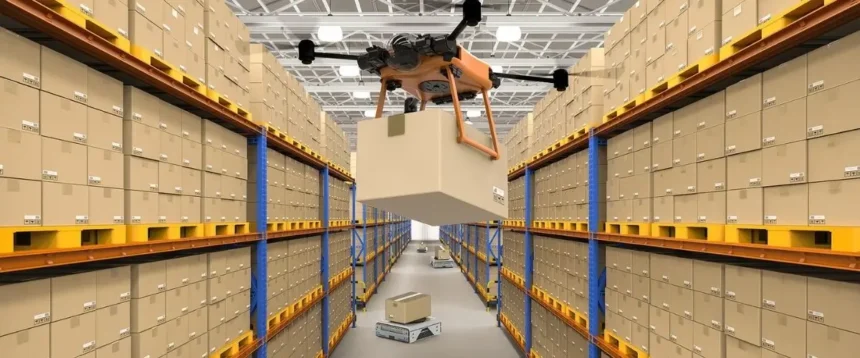
Warehouse Robotics Explained: How Robots Are Transforming Logistics and Fulfillment
Warehouse robotics is rapidly changing what happens between clicking “Buy Now” and seeing a package arrive at the door.
Modern warehouses have to receive thousands or even millions of products, identify where those products should be stored, locate them when orders arrive, transport them through the facility, pick individual items, package orders and move completed shipments toward delivery.
For decades, much of that work depended on people walking through enormous warehouse aisles, pushing carts, lifting containers and manually moving products between different stages.
Warehouse robotics is changing that model.
Autonomous mobile robots can transport goods without fixed tracks. Robotic arms can pick items from bins. Automated storage systems can bring inventory directly to workers. Machine-vision systems can inspect packages, while software can coordinate hundreds or even thousands of robots simultaneously.
The scale of logistics robotics is already significant.
According to the International Federation of Robotics, 102,900 professional service robots for transportation and logistics were sold in 2024, an increase of 14% from the previous year. Transportation and logistics represented more than half of professional service-robot sales reported in the IFR supplier sample that year.
That makes logistics one of the clearest real-world examples of robotics moving beyond traditional factory production lines.
For the wider technology behind autonomous machines, industrial automation, humanoids and intelligent robots, see The News Ink’s Robotics Explained: Complete Guide.
What Is Warehouse Robotics?
Warehouse robotics refers to robots and automated systems used to move, store, retrieve, identify, sort, pick, pack or inspect goods inside warehouses and fulfillment centers.
The term covers much more than one type of machine.
A warehouse robotics system may include:
- autonomous mobile robots;
- automated guided vehicles;
- robotic picking arms;
- palletizing robots;
- depalletizing robots;
- automated storage and retrieval systems;
- conveyor automation;
- sorting robots;
- inventory drones;
- robotic unloaders;
- collaborative robots;
- AI-powered warehouse-management software.
Some warehouse robots remain fixed in one location.
Others move throughout a facility.
Some manipulate individual products, while others transport shelves, pallets, carts or entire containers.
The most advanced warehouses combine several forms of warehouse robotics into a single connected system.
Why Warehouse Robotics Is Growing
The growth of e-commerce has fundamentally changed logistics.
Traditional retail supply chains often moved large quantities of products between manufacturers, warehouses and stores.
E-commerce creates a different challenge.
A fulfillment center may receive thousands of individual consumer orders containing completely different combinations of products.
That creates intense pressure around:
- picking speed;
- inventory accuracy;
- labor availability;
- same-day shipping;
- next-day delivery;
- seasonal demand;
- warehouse space;
- workplace ergonomics.
Warehouse robotics helps companies automate the physical movement behind these processes.
The IFR reported nearly 200,000 professional service robots sold in 2024, with transportation and logistics remaining the largest application category at 102,900 units.
The same IFR research showed Robot-as-a-Service deployments in transportation and logistics grew 42% during 2024.
That business model could make warehouse robotics accessible to companies that do not want to purchase large fleets upfront.
Main Types of Warehouse Robots
Warehouse robotics can be divided into several major categories.
| Warehouse Robot | Main Function | Typical Application |
|---|---|---|
| Autonomous Mobile Robots | Navigate independently | Transport, picking support |
| Automated Guided Vehicles | Follow predefined routes | Pallet and material movement |
| Robotic Picking Arms | Pick individual products | Order fulfillment |
| AS/RS Systems | Store and retrieve inventory | High-density storage |
| Sorting Robots | Route parcels and products | Distribution centers |
| Palletizing Robots | Stack goods | End-of-line logistics |
| Depalletizing Robots | Unload stacked goods | Receiving |
| Inventory Drones | Scan warehouse inventory | Stock monitoring |
| Robotic Unloaders | Remove boxes from trailers | Inbound logistics |
Each technology solves a different warehouse problem.
A company does not necessarily need every type.
The best warehouse robotics strategy starts by identifying where workers spend the most time, where delays occur and which processes are repetitive enough to automate effectively.
Autonomous Mobile Robots
Autonomous mobile robots, or AMRs, have become one of the most important technologies in warehouse robotics.
Unlike older automated systems that depend heavily on fixed routes, AMRs can navigate dynamically through indoor environments.
They typically use combinations of:
- LiDAR;
- cameras;
- depth sensors;
- wheel encoders;
- inertial sensors;
- onboard computers;
- mapping software.
An autonomous mobile robot can determine where it is, calculate a route toward a destination and adjust when workers, forklifts or other robots block its path.
DHL describes AMRs as robots capable of real-time path planning rather than following the fixed physical or digital paths normally associated with older automated guided vehicles.
This makes AMRs particularly useful in warehouses because these environments constantly change.
Workers move.
Pallets appear.
Carts block aisles.
Products are replenished.
A useful warehouse robot therefore has to navigate rather than simply repeat one route.
AMRs vs AGVs
Autonomous mobile robots and automated guided vehicles are often confused.
The difference is important.
| AMRs | AGVs |
|---|---|
| Navigate dynamically | Usually follow predefined routes |
| Can reroute around obstacles | Often stop when routes are blocked |
| Use mapping and sensors | May use tape, markers or fixed guidance |
| Flexible deployment | More structured deployment |
| Useful in changing warehouses | Useful for predictable transport |
AGVs remain valuable for highly structured material movement.
If a pallet always travels between the same two locations, sophisticated autonomous navigation may be unnecessary.
AMRs become more attractive when routes and workloads constantly change.
Warehouse robotics is therefore not about selecting the most advanced technology. It is about selecting the appropriate technology for each process.
Goods-to-Person Robotics
One of the biggest transformations in warehouse operations is the shift from person-to-goods toward goods-to-person fulfillment.
In a traditional warehouse, a worker receives an order and walks through aisles collecting products.
In a goods-to-person system, warehouse robots bring inventory to the worker.
The difference can be enormous.
Instead of walking several kilometers during a shift, the employee remains at an ergonomic workstation while inventory continuously arrives.
Robots then return containers or shelves to storage.
Amazon helped popularize this approach after acquiring Kiva Systems in 2012.
By June 2025, Amazon reported that it had deployed its one millionth robot, with its global robotics network spanning more than 300 facilities.
That scale demonstrates how warehouse robotics can become infrastructure rather than simply an experimental technology.
Robotic Picking
Moving inventory is only part of the challenge.
Eventually, a specific product has to be picked.
Humans perform this seemingly simple task remarkably well.
We can look inside a cluttered bin, identify the correct object, estimate how it should be grasped and adjust instantly if it slips.
Robots find this much harder.
Products vary enormously in:
- shape;
- size;
- weight;
- texture;
- packaging;
- orientation.
Modern robotic picking combines several technologies.
A typical system may use:
Camera → Object Recognition → Grasp Planning → Robot Arm → Gripper → Verification
Machine vision identifies the item.
Software estimates where the object is located.
A robotic arm calculates a path.
The gripper picks the product.
Sensors or cameras then verify whether the operation succeeded.
This combination of industrial robotics and artificial intelligence is making automated picking significantly more capable.
For a broader explanation of how AI enables perception and decision-making, see The News Ink’s Artificial Intelligence Explained: Complete Guide.
Amazon’s Warehouse Robotics Ecosystem
Amazon provides one of the clearest examples of warehouse robotics operating at enormous scale.
Its robotic systems now include machines designed for different parts of fulfillment.
Amazon’s Hercules robots can move heavy inventory pods.
Pegasus systems transport packages.
Proteus was developed as the company’s first fully autonomous mobile robot capable of navigating open areas around employees.
Robotic arms perform sorting and manipulation tasks.
Amazon’s Sequoia system combines mobile robots, gantry systems, robotic arms and redesigned workstations to move inventory through fulfillment centers. Amazon says Sequoia can identify and store incoming inventory up to 75% faster and reduce order-processing time through a fulfillment center by up to 25% compared with its previous approach.
These figures are company-reported results rather than industry-wide benchmarks, but they show why large logistics operators continue investing heavily in warehouse robotics.
Artificial Intelligence and Warehouse Robotics
Warehouse robotics is increasingly becoming an AI problem as much as a mechanical engineering problem.
When hundreds of robots operate inside the same facility, simply calculating each robot’s individual route is not enough.
The entire fleet needs coordination.
Robots can compete for the same aisle.
Traffic can form near workstations.
One delayed robot can affect several downstream processes.
Artificial intelligence can help optimize:
- fleet routing;
- task assignment;
- picking;
- inventory placement;
- congestion management;
- predictive maintenance;
- demand forecasting;
- visual inspection.
Amazon introduced an AI foundation model called DeepFleet in 2025 to coordinate movement across its mobile robotics network. The company says the system is designed to improve robot travel efficiency by approximately 10%.
This points toward an important future for warehouse robotics.
The intelligence may increasingly sit above individual machines.
Instead of every robot acting independently, software will treat an entire warehouse as one coordinated robotic system.
Automated Storage and Retrieval Systems
Automated storage and retrieval systems, commonly known as AS/RS, automate the movement of inventory into and out of storage locations.
These systems can use:
- cranes;
- shuttles;
- lifts;
- mobile robots;
- vertical storage modules;
- conveyors.
One major advantage is storage density.
Human workers need aisles wide enough to walk or drive equipment through.
Robotic systems can sometimes use narrower aisles and taller storage configurations.
This can allow warehouses to hold more inventory within the same building footprint.
AS/RS technology is particularly valuable when companies need:
- fast retrieval;
- high inventory accuracy;
- dense storage;
- predictable workflows.
However, these systems can also require substantial capital investment and careful integration.
Sorting Robots
Once products have been picked and packed, they still need to reach the correct destination.
Sorting automation routes parcels according to information such as:
- destination;
- carrier;
- delivery route;
- order type;
- package size.
High-volume distribution centers can process enormous numbers of parcels.
Robotic sortation systems can reduce manual handling while improving consistency.
Some systems use mobile robots that carry parcels to designated chutes.
Others combine conveyor systems, scanners and automated diverters.
The underlying principle is the same: turn digital order information into physical movement.
Palletizing and Depalletizing
Palletizing is one of the oldest warehouse robotics applications.
Robotic arms can stack cartons, bags or other products onto pallets according to programmed patterns.
The opposite operation—depalletizing—can be more difficult.
When goods arrive, boxes may have shifted during transport. Packaging may be damaged. Products may vary in size.
Machine vision increasingly helps warehouse robots recognize and remove these less predictable items.
Automating pallet work can also reduce repetitive lifting for human employees.
That makes palletizing an important area where productivity and ergonomics can align.
Robotic Trailer Unloading
Unloading trucks and trailers is another physically demanding logistics task.
Workers may repeatedly lift boxes inside enclosed trailers where temperatures can become uncomfortable.
Robotic systems are beginning to automate this process.
DHL, for example, has been deploying Boston Dynamics’ Stretch robot for truck unloading and exploring broader box-handling applications. DHL reported in 2025 that it had invested more than €1 billion in automation across its contract-logistics operations over the previous three years, with more than 7,500 robots operating in its network.
Large deployments like these show warehouse robotics spreading across the entire logistics process rather than remaining limited to picking.
Flying Robots Inside Warehouses
Not every warehouse robot moves across the floor.
Autonomous drones are emerging as an inventory-management tool.
In June 2026, the International Federation of Robotics awarded its IERA robotics innovation award to Verity for an autonomous indoor drone system used in logistics and retail environments.
The drones navigate warehouse aisles without GPS, scan barcodes and send inventory information into warehouse-management systems.
IFR reported that Verity’s technology had been deployed in approximately 200 warehouses, with deployed systems capturing around 500,000 images per day.
Inventory drones illustrate an important principle.
Warehouse robotics does not always need to manipulate goods.
Sometimes the greatest value comes from understanding exactly where inventory is located.
Warehouse Management Systems and Robots
Robots cannot transform logistics effectively if they operate separately from warehouse software.
Modern automation often connects with:
- Warehouse Management Systems (WMS);
- Warehouse Control Systems (WCS);
- Warehouse Execution Systems (WES);
- Enterprise Resource Planning systems;
- inventory databases;
- order-management software.
Suppose an online customer purchases a pair of headphones.
The digital order enters the fulfillment system.
Software identifies where the headphones are stored.
A warehouse robot receives a task.
Inventory is transported toward a picking station.
The item is picked and verified.
The order moves toward packaging.
Another automated system may route the completed parcel toward shipping.
The physical robots are only one layer.
Warehouse robotics works best when software and machines behave as parts of one integrated process.
Benefits of Warehouse Robotics
Companies invest in warehouse robotics for several reasons.
Faster Movement
Robots can reduce the time workers spend walking between locations.
DHL notes that workers in some non-automated warehouse environments may walk up to 15 kilometers per day.
Removing unnecessary walking can increase the amount of time workers spend on productive picking or problem-solving.
Higher Throughput
Automation can allow warehouses to process more goods without increasing floorspace or labor at the same rate.
This becomes especially important during seasonal peaks.
Improved Inventory Accuracy
Robotic scanning and connected inventory systems can help continuously update the location of goods.
Reduced Physical Strain
Warehouse employees may perform thousands of repetitive lifts, reaches and movements.
Robots can handle some of these tasks.
24-Hour Operations
Robots can support continuous operations, although charging, maintenance and human supervision remain necessary.
Scalability
Mobile warehouse robots can sometimes be added incrementally as demand increases.
This can be easier than rebuilding an entire fixed automation system.
Warehouse Robotics and Worker Safety
Warehouse robotics can reduce some workplace hazards while creating others.
Robots may reduce:
- repetitive lifting;
- long walking distances;
- heavy cart movement;
- work in difficult environments.
However, workers may now operate around autonomous machines, robotic arms and automated conveyors.
OSHA warns that warehouse automation can create struck-by, caught-between and other hazards when equipment is not properly integrated. The agency specifically notes that warehouses may contain both collaborative and non-collaborative industrial robots.
NIOSH similarly notes that robots can improve worker safety but that new forms of human-robot interaction create safety questions that need continued research.
Warehouse robot safety therefore requires:
- risk assessment;
- emergency stopping systems;
- speed controls;
- safe operating zones;
- sensors;
- worker training;
- traffic planning;
- maintenance procedures.
Automation should redesign unsafe work rather than simply introduce new moving machines into an already complicated warehouse.
Warehouse Robotics and Jobs
Warehouse automation naturally raises concerns about employment.
Some tasks are clearly becoming more automated.
Robots can already perform parts of:
- transport;
- picking;
- sorting;
- palletizing;
- scanning;
- unloading.
That may reduce labor requirements for particular activities.
But complete warehouse automation remains difficult.
Humans continue to outperform robots in many situations involving:
- unusual products;
- damaged packaging;
- unpredictable problems;
- judgment;
- customer exceptions;
- maintenance;
- system recovery.
Automation can also increase demand for technical jobs involving:
- robotics maintenance;
- controls engineering;
- software;
- fleet management;
- automation integration.
Amazon reported that its next-generation fulfillment facility in Shreveport required 30% more employees in reliability, maintenance and engineering roles because of advanced robotics. That does not prove automation always creates more jobs overall, but it shows that robotics changes the type of labor required.
For the wider employment debate, read The News Ink’s AI Jobs Are Changing Faster Than Expected.
Cybersecurity Risks in Automated Warehouses
As warehouse robotics becomes connected, cybersecurity becomes increasingly important.
Robots may connect with:
- wireless networks;
- warehouse-management systems;
- cloud software;
- remote support platforms;
- cameras;
- inventory databases.
A cyberattack does not need to physically take control of a robot to create disruption.
Attackers could target the systems that assign tasks, track inventory or coordinate automation.
This creates potential risks involving:
- operational shutdowns;
- data theft;
- manipulated inventory records;
- unauthorized access;
- ransomware.
A highly automated warehouse therefore needs cybersecurity designed into its operational technology.
For a broader foundation, see The News Ink’s Cybersecurity Explained: Complete Guide.
The Cost of Warehouse Robotics
There is no single price for warehouse robotics.
Costs vary dramatically depending on whether a company deploys several mobile robots or redesigns an entire fulfillment center.
Expenses can include:
- robots;
- charging infrastructure;
- sensors;
- robotic arms;
- grippers;
- software;
- integration;
- safety systems;
- employee training;
- maintenance.
Companies should calculate return on investment using factors such as:
Automation ROI = Labor Savings + Productivity Gains + Accuracy Gains − Total Automation Cost
The calculation should also consider flexibility.
A large fixed automation system may produce excellent efficiency when volumes remain predictable but become expensive to modify when operations change.
AMRs and Robot-as-a-Service models can provide a more flexible alternative.
IFR reported that RaaS activity within transportation and logistics increased 42% in 2024, showing how rental and subscription models are becoming part of the warehouse robotics market.
Limitations of Warehouse Robotics
Warehouse robots are not suitable for every operation.
Integration Can Be Difficult
Older warehouses were built around people and forklifts rather than autonomous machines.
Introducing robotics may require changes to workflows, software and facility layouts.
Irregular Products Are Hard
Robots prefer predictable objects.
Transparent packaging, deformable items and cluttered bins can make automated picking difficult.
Downtime Can Spread
When an automated warehouse relies heavily on connected systems, one failure can affect multiple processes.
High Initial Costs
Large-scale automation can require substantial investment.
Human Work Does Not Disappear
Someone still has to handle exceptions, maintain equipment and manage unexpected events.
The strongest warehouse robotics systems therefore combine automation with human decision-making rather than assuming every physical activity should be robotic.
The Future of Warehouse Robotics
Warehouse robotics is moving toward greater autonomy.
Several technologies are likely to shape the next phase.
Smarter AMRs
Mobile robots will improve their ability to navigate crowded environments and coordinate with large fleets.
AI-Powered Picking
Better vision-language and manipulation systems could allow robots to handle a wider variety of unfamiliar products.
Mobile Manipulators
Combining an autonomous mobile base with a robotic arm could create machines that travel to a location and perform physical work there.
Automated Inventory
Drones and scanning robots may allow warehouses to monitor inventory continuously rather than performing periodic manual counts.
Robot-as-a-Service
Subscription models could allow smaller businesses to adopt warehouse robotics without enormous upfront investments.
Humanoid Robots
Humanoid robots are also being tested for logistics because warehouses are fundamentally designed around human movement.
A human-shaped robot could theoretically move through existing facilities without requiring the warehouse to be redesigned around specialized machines.
However, humanoids must compete with specialized warehouse robots that are already highly efficient.
The News Ink has explored this emerging field in Humanoid Robots Are No Longer Science Fiction and Humanoid Robots Could Have Their ChatGPT Moment.
Frequently Asked Questions About Warehouse Robotics
What is warehouse robotics?
Warehouse robotics refers to robotic and automated systems used to move, pick, store, sort, inspect and manage products inside warehouses and fulfillment centers.
What robots are commonly used in warehouses?
Common warehouse robots include autonomous mobile robots, AGVs, robotic picking arms, palletizing robots, sorting robots, automated storage systems and inventory drones.
What is an AMR in a warehouse?
An autonomous mobile robot is a self-navigating robot capable of moving around a warehouse using sensors, mapping and software rather than relying entirely on fixed tracks or predefined physical guides.
What is the difference between AMRs and AGVs?
AGVs usually follow predefined routes, while AMRs can calculate routes dynamically and navigate around obstacles.
How big is logistics robotics?
The IFR reported 102,900 professional transportation and logistics service robots sold in 2024, up 14%. The figures are based on IFR’s supplier sample rather than a complete census of every robot sold globally.
Does Amazon use warehouse robots?
Yes. Amazon announced in 2025 that it had deployed its one millionth robot, with robotic systems operating across more than 300 facilities globally.
Will warehouse robots replace workers?
Warehouse robotics can automate specific tasks and may reduce labor demand in some activities. However, people remain necessary for maintenance, troubleshooting, irregular products, supervision and other complex tasks.
Is warehouse robotics safe?
Robotics can reduce heavy lifting and repetitive movement, but autonomous machines can introduce new hazards. Proper risk assessment, traffic management, sensors, training and emergency procedures remain necessary.
Conclusion: Warehouse Robotics Is Becoming the Infrastructure Behind Modern Logistics
Warehouse robotics is no longer limited to experimental machines moving around futuristic fulfillment centers.
It is becoming part of the infrastructure behind modern commerce.
The IFR’s latest data show that transportation and logistics is already the largest professional service-robot application category within its supplier sample, with 102,900 robots sold in 2024.
The reason is straightforward.
Modern warehouses face a difficult combination of enormous product variety, faster delivery expectations, labor pressures and constantly changing order volumes.
Robots are particularly effective at moving goods through these environments.
AMRs can transport inventory.
Robotic arms can pick and palletize.
Automated storage systems can improve warehouse density.
Drones can monitor inventory.
Artificial intelligence can coordinate entire fleets.
Yet the future is unlikely to be a warehouse containing robots and no people.
Humans remain far better at improvising when products are damaged, orders are unusual or situations fall outside what the automation system expects.
The more realistic future is a warehouse in which software, warehouse robotics and human workers operate together.
Machines handle increasing amounts of repetitive physical movement.
People handle judgment, maintenance, exceptions and higher-level decisions.
As AI improves perception, planning and robotic manipulation, warehouse robotics will become capable of handling a broader range of tasks.
That makes warehouses one of the most important environments for understanding how robotics is moving from controlled industrial cells into complex spaces shared with people.
For the broader technology connecting warehouse robots with industrial automation, AI, autonomous machines and humanoids, continue with The News Ink’s Robotics Explained: Complete Guide.
Follow The News Ink
X
Pinterest
Medium
Quora
TikTok
Instagram
Substack
Threads
Bluesky
Mastodon


