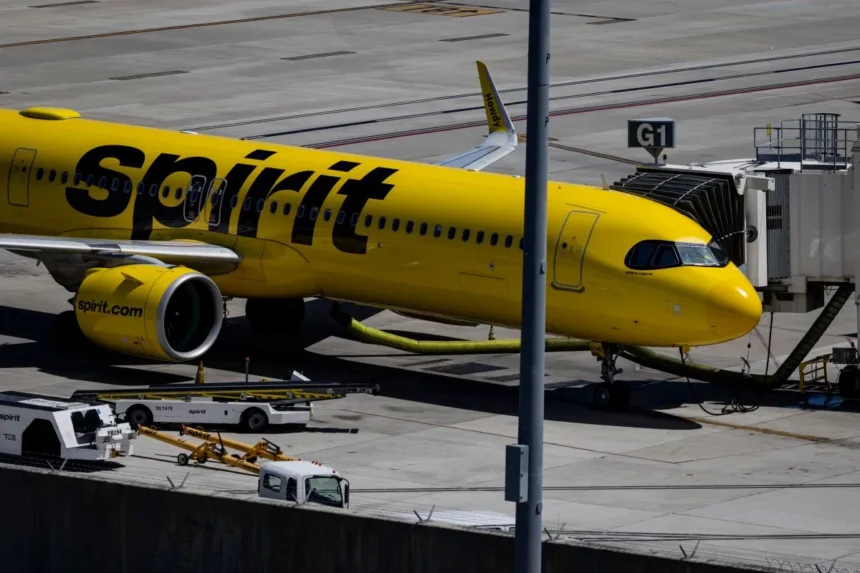
Spirit Airlines shuts down after rescue talks collapse
Spirit Airlines shuts down after rescue talks collapsed, marking a major shock in the US aviation industry. The budget carrier has officially entered an immediate wind-down process following failed bailout negotiations, rising fuel costs, and deep financial instability.
The sudden announcement means Spirit Airlines shuts down operations across all routes, cancelling flights and leaving thousands of passengers stranded. What was once one of America’s most recognizable ultra-low-cost airlines is now facing complete operational closure under bankruptcy supervision.
Below are the 5 key reasons why Spirit Airlines shuts down, explained in detail.
1. Failed bailout and collapsed rescue negotiations
The most direct reason Spirit Airlines shuts down is the failure to secure a $500 million rescue package. The airline had been negotiating with government stakeholders for emergency financial support to stabilize operations.
However, talks collapsed due to political resistance and disagreement over bailout conditions. Some proposals reportedly included partial government involvement in ownership, which was heavily criticized.
Without this financial lifeline, Spirit Airlines shuts down became unavoidable as liquidity dried up.
2. Soaring jet fuel prices after global tensions
Another major factor behind why Spirit Airlines shuts down is the sharp rise in jet fuel costs. Fuel typically accounts for up to 40% of airline operating expenses, making it a critical cost driver.
Geopolitical tensions and supply chain disruptions pushed fuel prices sharply higher, doubling in some markets.
| Cost Factor | Impact |
|---|---|
| Jet fuel prices | Nearly doubled |
| Operating costs | Significantly increased |
| Profit margins | Turned negative |
These rising costs made it impossible for Spirit to maintain its ultra-low-cost pricing model, accelerating the outcome where Spirit Airlines shuts down.
3. Long-term financial losses and failed restructuring
Spirit had already entered bankruptcy protection before its final collapse. The airline attempted restructuring by reducing flights, cutting aircraft usage, and lowering operational costs.
Despite these efforts, losses continued to grow. The business model relied heavily on volume-based revenue, which became unsustainable under rising costs.
Even during restructuring phases, analysts warned that Spirit Airlines shuts down was a realistic risk if financial stability was not restored.
4. Weak ultra-low-cost business model under pressure
A structural weakness in Spirit’s business model is another key reason why Spirit Airlines shuts down. The airline depended on low base fares and charged extra for services like baggage, seat selection, and onboard amenities.
While this model worked in earlier years, competition changed the market:
- Traditional airlines matched low fares
- New budget carriers entered aggressively
- Customer dissatisfaction increased
As competition intensified, Spirit lost its pricing advantage, contributing significantly to why Spirit Airlines shuts down.
5. Liquidity crisis and operational breakdown
The final trigger behind Spirit Airlines shuts down was a severe liquidity crisis. With cash reserves running low, the airline could no longer sustain daily operations, pay suppliers, or manage debt obligations.
This led to an immediate halt of flights and an “orderly wind-down” process under bankruptcy court supervision.
Passengers reported confusion at airports as cancellations arrived with little warning. Refunds are being processed for direct bookings, but indirect costs remain uncertain.
Passenger impact and travel disruption
The shutdown has caused widespread disruption across the United States. Thousands of passengers were left stranded or forced to find alternative flights at short notice.
Refunds for credit and debit card bookings are being processed automatically. However, travelers using vouchers, travel agents, or reward points may face delays.
For ongoing aviation updates and travel industry insights, readers can follow detailed coverage on The News Ink.
Industry reaction and wider aviation concerns
The collapse of Spirit highlights growing stress in the airline industry. Experts warn that Spirit Airlines shuts down is not an isolated case, as other low-cost carriers face similar challenges.
Rising fuel prices, inflation, and operational costs are squeezing margins across the aviation sector. Analysts believe more consolidation or failures could follow if conditions do not improve.
For global trade and economic context, the situation also reflects wider aviation pressures discussed in reports by International Air Transport Association, which tracks airline industry stability and fuel cost impacts.
Government response and failed intervention
The US government reportedly considered a bailout but ultimately rejected the final rescue plan. Concerns included long-term financial risk and potential misuse of taxpayer funds.
Officials argued that intervention would not guarantee recovery, reinforcing the decision that led to Spirit Airlines shuts down despite last-minute negotiations.
What happens next for Spirit Airlines
Spirit Airlines will now undergo bankruptcy court supervision. This includes:
- Sale of airline assets
- Debt settlement
- Processing passenger claims
- Employee layoffs
Thousands of jobs are now at risk, while competitors are expected to absorb routes previously served by Spirit.
Final outlook
The collapse shows how quickly financial pressure can escalate in the aviation industry. Spirit Airlines shuts down due to a combination of failed rescue talks, rising fuel costs, weak business structure, and liquidity failure.
It marks one of the most significant airline shutdowns in recent US history and highlights the fragility of ultra-low-cost airline models in unstable global conditions.