Universal Flu Vaccine: Stunning 2026 Breakthrough Offers New Hope
Universal flu vaccine research is moving closer to one of medicine’s most important goals: a flu shot that protects against many influenza strains for longer than one season.
That goal matters because influenza remains one of the world’s most persistent infectious threats. The World Health Organization estimates that seasonal flu causes around one billion infections each year, including 3 million to 5 million severe cases and 290,000 to 650,000 respiratory deaths. Most people recover after several days of fever, cough, aches and fatigue, but flu can be deadly for older adults, young children, pregnant people and those with underlying health conditions.
Current flu vaccines save lives, but they have a built-in weakness. They must be redesigned every year because influenza changes constantly. When the vaccine is well matched to circulating strains, protection is useful. When the virus mutates in the wrong direction after vaccine decisions are made, effectiveness can fall sharply.
That is why scientists are looking for a better answer. A universal flu vaccine would not need to guess one season’s likely winner. Instead, it would target stable parts of the virus that change more slowly. These weak spots could allow the immune system to recognise many versions of influenza, even after the virus mutates.
The promise is huge. A better vaccine could reduce illness, deaths, hospital pressure, antibiotic misuse and the yearly uncertainty of flu-season planning. But the science is difficult, and no fully universal flu vaccine has yet replaced the annual flu shot.
For readers interested in everyday prevention and stronger immunity habits, The News Ink’s healthy lifestyle guide is a useful internal read alongside vaccine coverage.
Why flu vaccines have to change every year
Universal flu vaccine research begins with a simple problem: influenza is a moving target.
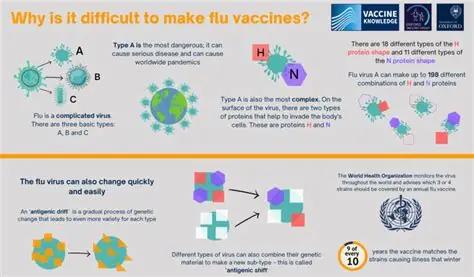
The flu virus carries surface proteins that help it infect human cells and spread from cell to cell. The two best-known proteins are haemagglutinin, usually shortened to HA, and neuraminidase, shortened to NA. These proteins give flu subtypes their names. H1N1 has one type of HA and one type of NA. H3N2 has another combination.
The immune system learns to recognise these proteins after infection or vaccination. But influenza mutates as it spreads. Over time, small genetic changes build up in HA and NA, allowing the virus to escape some existing immunity. Scientists call this antigenic drift.
That drift forces vaccine experts to update seasonal flu vaccines. The WHO vaccine-composition process happens twice a year, once for the Northern Hemisphere and once for the Southern Hemisphere. Experts review global surveillance data and recommend which strains vaccine manufacturers should target.
This system is impressive, but it is not perfect. It requires prediction months before a flu season peaks. If a new variant expands after the decision is made, the vaccine can be less protective.
The H3N2 subclade K lesson
The 2025-26 flu season showed why a universal flu vaccine remains such an urgent goal.
A new A(H3N2) variant, classified as J.2.4.1 and often called subclade K, emerged in August 2025 and spread rapidly across the world. WHO later said it accounted for the majority of influenza viruses reported across regions and contributed to earlier-than-usual flu activity in many countries.
That timing created a familiar problem. The 2025-26 vaccine had already been selected before subclade K became dominant. In the United States, AP reported that vaccine effectiveness was only about 25% to 30% for adults seeking medical care and about 40% for children, one of the weaker performances in recent years. The vaccine still mattered because flu shots reduce severe illness and death, but the mismatch showed the limits of seasonal prediction.
The 2026-27 vaccine recommendations were updated to include newer H3N2-like viruses. That is how the current system responds. It catches up. A universal flu vaccine aims to do something better: reduce the need to catch up every year.
What scientists mean by “universal”
The phrase universal flu vaccine can sound as if one injection would protect everyone against every flu virus forever. That is not the realistic short-term meaning.
In practice, researchers use “universal” to describe vaccines that provide broader and longer-lasting protection than today’s seasonal flu shots. Some candidates may protect against many influenza A strains. Others may reduce severe disease across both seasonal and pandemic threats. Some may last several years rather than one season. A perfect one-shot vaccine for all flu viruses remains a very high bar.
The more realistic goal is a step-change in protection:
| Current seasonal flu shots | Universal flu vaccine goal |
|---|---|
| Updated every year | Broader protection across multiple years |
| Targets expected circulating strains | Targets stable viral weak spots |
| Protection varies by season | Less vulnerable to strain mismatch |
| Mainly strain-specific antibodies | Broader antibodies and T-cell responses |
| Strong public-health value but imperfect | Better pandemic preparedness and fewer severe outcomes |
This is why scientists describe the field carefully. A universal flu vaccine would not make influenza disappear overnight. But it could make flu less unpredictable, less deadly and less disruptive.
The weak spot: haemagglutinin’s stem
One of the most promising targets is the stem, or stalk, of haemagglutinin.
HA looks a little like a lollipop. The head sits on top and changes frequently. The stem holds it up and tends to change more slowly because it performs essential functions the virus cannot easily redesign. Traditional flu vaccines often produce antibodies focused on the changing HA head. Universal flu vaccine strategies try to redirect the immune system toward more conserved regions such as the HA stem.
That is the logic behind work from Nicholas Heaton and colleagues at Duke University. Duke reported that researchers created a vaccine approach that encourages the immune system to target a less variable part of the influenza surface. In experiments with mice and ferrets, the strategy produced broader protection and suggested a path toward less reliance on yearly strain-matched shots.
This does not mean the Duke approach is ready for routine use. Animal success is not the same as human approval. But it shows why the field is advancing: scientists are learning how to make the immune system look at the virus differently.
NIAID’s mRNA universal vaccine trial
The National Institutes of Health has also pushed this field forward.
In 2023, NIH announced a Phase 1 clinical trial of an experimental universal flu vaccine candidate called H1ssF-3928 mRNA-LNP. The vaccine uses an mRNA platform and is designed around the HA stem. The trial, conducted through NIAID’s Collaborative Influenza Vaccine Innovation Centers programme, was created to test safety and immune response in healthy adults.
This matters for two reasons.
First, mRNA technology can be adapted quickly, as seen during the COVID-19 pandemic. Second, pairing mRNA with conserved flu targets may help researchers test universal flu vaccine concepts faster than older production systems.
However, early-phase trials are only the beginning. Phase 1 studies mainly assess safety and immune response. They do not prove population-level protection. Any universal flu vaccine candidate must still pass larger trials before public-health agencies can recommend it.
Beyond HA: other targets matter too
The HA stem gets much of the attention, but universal flu vaccine research is broader than one target.
Scientists are also studying neuraminidase, the NA protein that helps new virus particles leave infected cells. NA changes too, but some parts may be useful for broader immune responses. Other teams are looking at M2e, a small conserved region of the M2 ion channel, as well as internal proteins such as nucleoprotein and matrix protein 1. These internal targets may be especially useful for T-cell responses, which can help reduce severe disease even when antibodies do not fully block infection.
Some vaccine candidates use nanoparticles to display multiple flu proteins. Others use viral vectors, mRNA, recombinant proteins, whole-virus approaches, or intranasal vaccines designed to strengthen mucosal immunity in the nose and throat.
This variety is healthy. Influenza is too complex for one idea to dominate too early. The best universal flu vaccine may eventually combine several strategies: broad antibodies, T-cell immunity, mucosal protection and fast manufacturing.
The clinical pipeline is growing
The field is no longer purely theoretical. WHO reported in February 2026 that 46 next-generation influenza vaccines were in clinical development using diverse technology platforms. CIDRAP’s Universal Influenza Vaccine Technology Landscape tracks candidates designed to provide broader and more durable protection than current strain-specific vaccines.
That does not mean 46 vaccines are close to approval. Clinical development includes different stages, from early safety testing to more advanced trials. Many candidates will fail. Some may work only for specific groups or specific influenza types. Others may be safe but not strong enough to replace annual shots.
Still, the pipeline shows progress. A decade ago, universal flu vaccine research often felt like a distant promise. Now, multiple platforms are being tested in humans, and public-health agencies are planning how improved vaccines could be introduced.
The News Ink’s AI trends in 2026 coverage is relevant because artificial intelligence and genomic modelling are increasingly being used to track viral evolution, predict strain fitness and improve vaccine design.
Why this is hard
A universal flu vaccine is difficult because influenza is not one enemy.
There are seasonal influenza A and B viruses. There are animal flu viruses that occasionally infect humans. There are many HA and NA combinations. There are different age groups with different immune histories. Someone exposed first to H1N1 may respond differently from someone first exposed to H3N2. Older adults often have weaker vaccine responses. Children may need different immune priming.
This immune history can shape how people respond to future vaccines. Scientists sometimes call this imprinting. The immune system remembers early flu exposures, which can help or hinder later responses.
There is also the challenge of measuring success. A seasonal vaccine can be tested against one year’s circulating strains. A universal flu vaccine must prove breadth, durability and protection against severe disease. That requires careful trial design, long follow-up and global data.
This is why Julie Ostrowsky and other vaccine-roadmap experts warn that progress will take time. The goal is promising, but the scientific and regulatory pathway is complex.
Why better flu vaccines could save millions
The potential benefit is enormous.
WHO’s 2026 assessment found that if improved, next-generation or universal influenza vaccines were widely used between 2025 and 2050, they could prevent up to 18 billion flu cases and save up to 6.2 million lives globally. The same assessment said these vaccines could avert up to 1.3 billion defined daily doses of antibiotics, because fewer flu infections would mean fewer unnecessary antibiotic prescriptions for viral illness or secondary complications.
This is an important point. Better flu vaccines would not only prevent coughs and fever. They could reduce hospital pressure, protect older adults, lower school and workplace disruption, support pandemic preparedness and reduce antimicrobial resistance.
That is why universal flu vaccine research should be viewed as global health infrastructure, not just a scientific curiosity.
The News Ink’s sleep quality guide connects naturally here because flu prevention is not only about vaccines; sleep, recovery and general health also influence how people cope with respiratory infections.
Annual flu shots still matter
A universal flu vaccine is not available for routine public use yet, so annual flu vaccination remains important.
This is the most important public-health message. The weakness of seasonal vaccines should not be confused with uselessness. Even in mismatched years, flu vaccination can reduce severe disease, hospitalisation and death. AP reported that experts still recommended vaccination during the subclade K season because protection against severe outcomes remained valuable.
People at higher risk should follow local health guidance and speak with a healthcare professional about vaccination and antivirals. In many countries, flu shots are especially important for older adults, young children, pregnant people, healthcare workers and those with chronic conditions.
Universal flu vaccine research is about improving the future. It is not a reason to skip protection now.
What would success look like?
Success may arrive in stages.
The first improved vaccines may not be fully universal. They may protect better against H3N2, last longer in older adults, reduce hospitalisation more reliably, or protect against several influenza A groups. Later vaccines may combine broader HA and NA targets with T-cell components and mucosal delivery.
A realistic first win could be a vaccine that does not need to be updated every year and still protects well against severe disease. Another win could be a vaccine that can be deployed quickly against pandemic influenza threats because it targets conserved features shared across many strains.
A perfect universal flu vaccine would be wonderful. A significantly better flu vaccine would still save many lives.
What to watch next
Several developments will show whether the field is moving from promise to practice.
First, watch clinical trial results from HA-stem, mRNA, nanoparticle and intranasal vaccine candidates. Safety is the first hurdle. Durable immune response is the next. Real-world protection is the hardest.
Second, watch whether vaccine candidates protect older adults, not just healthy young volunteers. Flu kills heavily in older populations, so a vaccine that works only in younger adults would have limited public-health value.
Third, watch manufacturing. A universal flu vaccine must be scalable, affordable and usable in low- and middle-income countries. WHO has stressed that future vaccines should be suitable for wider global access, not only wealthy markets.
Fourth, watch surveillance. Even with better vaccines, the world still needs strong influenza tracking to detect pandemic threats, animal spillovers and new variants.
Finally, watch public trust. Vaccine science can succeed in the lab and still fail in society if misinformation, access barriers and political confusion reduce uptake.
The final judgment
Universal flu vaccine research is closer than it once was, but the breakthrough should be understood carefully.
Scientists are not promising that annual flu shots will disappear tomorrow. They are building vaccine candidates that target stable viral weak spots, especially conserved regions of haemagglutinin, neuraminidase and other influenza proteins. These approaches could offer broader, longer-lasting protection and reduce the risk that one late-emerging variant will undermine a whole season’s vaccine.
The 2025-26 subclade K season showed why this matters. The world’s current vaccine system is impressive, but it still depends on prediction. Influenza can change after those predictions are made. A universal flu vaccine would make protection less dependent on guessing the future perfectly.
The science is challenging, but the direction is encouraging. WHO says dozens of next-generation influenza vaccines are in clinical development. NIH, Duke, CIDRAP and many other research groups are pushing different strategies. If even some of them succeed, the global burden of flu could fall dramatically.
For now, annual flu vaccination remains the practical tool. But the future may look different: fewer updates, broader protection, stronger pandemic readiness and less fear that one viral twist will leave the world exposed.
For more health and science analysis from The News Ink, follow The News Ink on X.