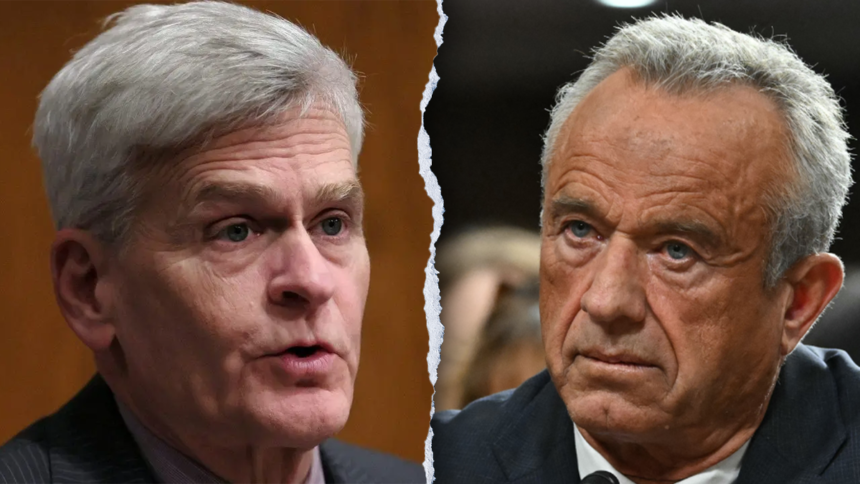
When Health Policy Becomes a Political Battleground
A fierce political battle is heating up in Louisiana — and it has moved far beyond the traditional lines of Republican versus Democrat.
Health Secretary Robert F. Kennedy Jr. and his Make America Healthy Again movement are actively working to defeat one of their own party’s sitting senators: Republican Sen. Bill Cassidy of Louisiana. The May 16, 2026, primary race has transformed into a high-stakes proxy war between two competing visions of American health policy — and the gloves are officially off.
One person familiar with Kennedy’s thinking put it plainly: “The gloves are off.”
Who Is Bill Cassidy — and Why Does Kennedy View Him as the Enemy?
To understand this conflict, you need to understand who Cassidy is and why the MAHA movement views him as their biggest obstacle.
Cassidy chairs the Senate HELP Committee and has been openly skeptical of Kennedy’s bid to reform health policy. After providing a pivotal vote to confirm Kennedy as Health Secretary, Cassidy pushed back on Kennedy’s efforts to scale back vaccine recommendations and reshape the Centers for Disease Control and Prevention. Axios
Cassidy is a physician by training — a gastroenterologist — which makes his pushback on Kennedy’s health agenda carry significant weight. For Kennedy and his supporters, that is precisely the problem. They view Cassidy not as an honest critic, but as a defender of the very medical establishment the MAHA movement seeks to overhaul.
Kennedy and his supporters view the physician-turned-senator as an avatar for the medical establishment they are determined to upend. Cassidy has also challenged Kennedy’s claims that environmental toxins are a major driver of chronic disease. Axios
The Breaking Point: Casey Means and the Surgeon General Battle
The feud reached a boiling point over the nomination of Dr. Casey Means for U.S. Surgeon General.
Means, a 38-year-old Stanford-educated physician, became disillusioned with traditional medicine and did not finish her surgical residency program. She faced scrutiny over her lack of experience and her stance on vaccines — declining to commit to advising Americans to vaccinate against the flu and measles during outbreaks. PBS
Despite that controversy, Kennedy championed Means as the perfect person to lead the nation’s health agenda. She is a close personal ally, a prominent MAHA movement figure, and the sister of Calley Means — a top Kennedy adviser.
Cassidy, leading the Senate committee responsible for reviewing Means’ nomination, declined to bring her nomination to a committee vote, effectively killing her path to confirmation. Kennedy publicly accused Cassidy of sabotaging the nomination. Statnews
Calley Means responded by blaming Cassidy in a social media post, accusing him of “constant delay tactics” that sank the nomination because he refused to bring it to a committee vote. NPR
President Trump then pulled the nomination entirely and replaced it with radiologist Dr. Nicole Saphier, publicly blaming Cassidy for blocking his original pick. Statnews
The fallout was immediate and severe.
Kennedy Mobilizes — The Sharpest Attack Yet
After Means’ nomination collapsed, Kennedy launched his most direct political offensive against Cassidy to date.
Kennedy issued his sharpest public criticism yet, saying the senator “once again did the dirty work for entrenched interests seeking to stall the MAHA movement and protect the very status quo that has made America the sickest nation on earth.”
The attack from Kennedy’s inner circle went further.
Calley Means predicted to his 312,000-plus followers on social media that Cassidy would “lose his re-election and immediately work for the pharmaceutical industry who funded his political career.” Tony Lyons, the president of the Kennedy-aligned MAHA PAC, called Cassidy an “existential threat to every child in America” who “must be stopped.” Axios
These are not quiet, behind-the-scenes criticisms. These are public, coordinated political attacks — and they signal that the MAHA movement intends to make Cassidy’s defeat a top national priority.
The Louisiana Primary: Who Is Running Against Cassidy?
Cassidy enters the May 16 primary already carrying significant political baggage — and not just because of his feud with Kennedy.
Cassidy was one of seven Senate Republicans who voted to convict President Trump at his second impeachment trial following the events of January 6, 2021. That vote destroyed his standing with the majority of Louisiana’s Republican base long before the MAHA conflict emerged. rollcall
Now Cassidy faces two primary challengers: Rep. Julia Letlow and former Rep. John Fleming.
Kennedy ally Tony Lyons pledged $1 million through the MAHA PAC to help defeat Cassidy before Letlow even entered the race, and the group has already spent over $200,000 in support of her campaign. NBC News
Both Trump and the MAHA PAC endorsed Letlow in January, giving her a powerful dual endorsement that Cassidy cannot easily overcome in a deep-red state like Louisiana.
The Three Primary Candidates at a Glance:
- Sen. Bill Cassidy — Incumbent, physician, chairs Senate HELP Committee; faces backlash over both the Trump impeachment vote and his opposition to the MAHA agenda
- Rep. Julia Letlow — Trump-endorsed, MAHA-endorsed, attacked Cassidy for blocking Casey Means’ nomination; represents the establishment’s pro-Trump alternative
- Former Rep. John Fleming — Adds further competition, splitting the anti-Cassidy vote in the primary
The Polling Numbers: Cassidy Is in Trouble
The numbers tell a difficult story for the incumbent senator.
A recent Emerson College survey showed Fleming narrowly leading with 28%, Letlow close behind at 27%, and Cassidy sitting at just 21%. If no candidate receives a majority of the vote, the nomination will be decided in a June 27 runoff between the top two finishers. Axios
That scenario — a runoff from which Cassidy is excluded — is now a very real possibility. Finishing third in a Republican primary in Louisiana would represent a stunning collapse for a sitting senator.
Louisiana Has Already Moved Toward MAHA Policies
Despite Cassidy’s campaign insisting that MAHA’s influence in Louisiana is limited, the state’s own legislative record tells a different story.
Louisiana legislators have taken steps over the past year to adopt a number of MAHA-related policies, including banning artificial additives and ultra-processed foods in school meals. Axios
That legislative shift suggests MAHA-aligned thinking has already taken root at the state level — making the movement’s national profile in Louisiana more credible than Cassidy’s campaign acknowledges.
Letlow aligned herself with MAHA early, attacking Cassidy in March for “stonewalling” Casey Means’ surgeon general nomination — a framing that directly echoes Kennedy’s own language. Axios
Cassidy Fights Back — But Is It Enough?
Cassidy has not gone down without a fight. His campaign dismisses the MAHA threat as an exaggerated internet phenomenon.
A person close to Cassidy’s campaign pushed back on the narrative, saying: “It’s a totally irrelevant factor. We polled all sorts of MAHA issues and it’s entirely an internet phenomenon.”
Cassidy largely downplayed his differences with the MAHA movement during campaign events, highlighting the areas where he and Kennedy actually agree. He also argued that on the topic of vaccines, more voters may now be on his side after seeing the consequences of low vaccination rates during recent disease outbreaks. NBC News
But that argument faces a steep hill. Cassidy’s past votes — both on the Trump impeachment and his more recent clashes with Kennedy — have created an image among Louisiana Republican primary voters of a senator who repeatedly breaks with the conservative base. In a closed primary system with a smaller, more conservative electorate, that image is politically deadly.
What Happens Next: Will Kennedy Come to Louisiana?
Republican operatives are watching closely to see whether Kennedy further escalates his involvement in the race with a personal visit to Louisiana ahead of the May 16 primary. Axios
A Kennedy appearance in the state would supercharge media attention on the race and send a clear signal that Health Secretary of the United States considers defeating a sitting Republican senator a personal priority.
It would also mark a genuinely unprecedented moment in modern American politics — a cabinet secretary actively campaigning to remove a senator from their own party because of policy disagreements.
The feud ignited publicly after Cassidy blocked Casey Means’ surgeon general nomination from reaching a committee vote
- Kennedy and MAHA PAC are backing Rep. Julia Letlow against Cassidy in the May 16 Louisiana primary
- Trump also endorsed Letlow — leaving Cassidy battling the White House, the MAHA movement, and his own impeachment legacy simultaneously
- Polling shows Cassidy at just 21% — trailing both Letlow and Fleming in a three-way race
- A June 27 runoff is possible if no candidate clears 50% — and Cassidy could miss the runoff entirely
- MAHA-aligned policies have already passed in Louisiana — including bans on artificial additives in school meals — suggesting the movement carries real state-level influence
- Kennedy’s team says the gloves are off — raising the possibility of a personal Kennedy campaign visit to Louisiana before election day
Why This Race Matters Beyond Louisiana
This primary is about far more than one Senate seat in one Southern state. It represents a test of whether the MAHA movement can translate internet enthusiasm and White House backing into real electoral power. If Kennedy and Trump succeed in defeating Cassidy, it sends a chilling message to every Republican senator who might otherwise push back on the administration’s health agenda.
If Cassidy survives, it signals that even in a state as conservative as Louisiana, voters will not simply follow the White House’s orders when a sitting senator makes his case for experience, medical expertise, and independence.
Either way, May 16 shapes up as one of the most consequential Senate primary nights of the 2026 election cycle.