NASA Planetary Defense Explained: Asteroids, DART and Protecting Earth
NASA planetary defense sounds like something from a science-fiction film.
The real program is far more scientific.
NASA is not operating a secret weapon waiting for an asteroid to appear.
Instead, planetary defense begins with telescopes, observations, orbital mathematics and years, preferably decades, of warning.
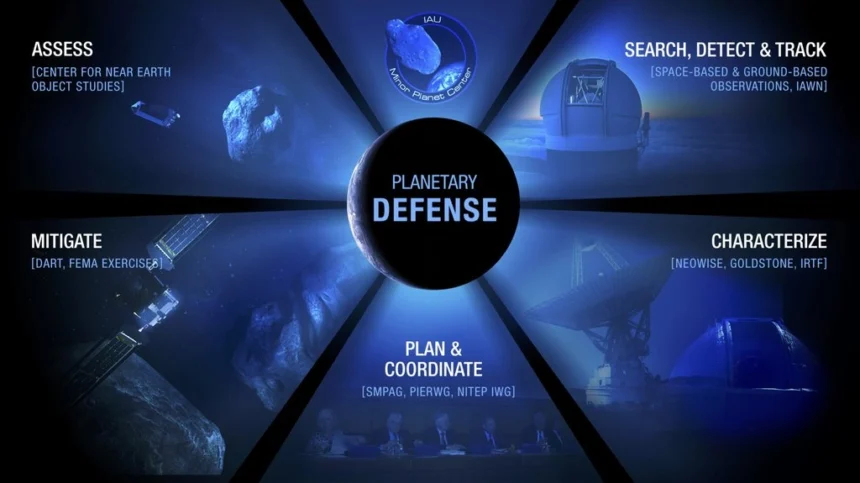
The basic strategy is:
find the object
→ track it
→ understand it
→ calculate whether it can hit Earth
→ warn governments if necessary
→ develop an appropriate response.
NASA formalized this work in 2016 by establishing its Planetary Defense Coordination Office, or PDCO, to coordinate efforts involving near-Earth asteroids and comets that could present an impact hazard.
The agency already has one historic technology demonstration behind it.
In September 2022, NASA’s Double Asteroid Redirection Test, better known as DART, deliberately crashed into the asteroid moonlet Dimorphos.
The collision changed Dimorphos’ orbit.
For the first time, humanity intentionally altered the motion of a celestial object in a demonstration specifically designed for planetary defense.
NASA is now building another major piece of the system.
NEO Surveyor will be the first space telescope created specifically to search for potentially hazardous asteroids and comets. Its infrared instruments should make it particularly useful for finding dark objects that are difficult for visible-light surveys to detect.
But the most important current fact may be the least dramatic:
NASA says scientists at its Center for Near-Earth Object Studies consider it highly unlikely that an asteroid large enough to cause widespread damage will impact Earth during the next 100 years or more based on the objects currently known.
NASA planetary defense therefore is not evidence that a giant asteroid is currently heading toward Earth.
It exists because asteroid impacts are rare natural hazards whose consequences can be severe, and because this is one natural disaster that humanity may eventually be capable of preventing if enough warning is available.
NASA Planetary Defense at a Glance
| Area | What NASA Does |
|---|---|
| Lead office | Planetary Defense Coordination Office |
| Established | 2016 |
| Main targets | Near-Earth asteroids and comets |
| Detection | Ground and space telescopes |
| Orbit calculations | Center for Near-Earth Object Studies |
| Automated impact monitoring | Sentry |
| Short-term impact assessment | Scout and related systems |
| First deflection demonstration | DART |
| DART impact | September 2022 |
| Future dedicated survey mission | NEO Surveyor |
| NEO Surveyor role | Infrared discovery and characterization |
| Major future close approach | Apophis, April 13, 2029 |
| Apophis threat to Earth | No impact danger in 2029 or for 100+ years |
What Is NASA Planetary Defense?
NASA planetary defense is the collection of scientific, technical and emergency-preparedness activities used to identify and respond to asteroids or comets capable of striking Earth.
NASA describes the work as applied planetary science.
It includes:
- finding near-Earth objects;
- tracking their positions;
- calculating their future orbits;
- estimating their sizes;
- studying their physical properties;
- determining whether they present an impact risk;
- providing warnings when appropriate;
- researching technologies capable of changing an object’s trajectory;
- coordinating with U.S. and international organizations.
The objective is not to eliminate asteroids.
Asteroids are natural members of the solar system and are scientifically valuable.
The objective is to identify the very small fraction whose future trajectories might matter for Earth.
What Is a Near-Earth Object?
A near-Earth object, commonly abbreviated NEO, is an asteroid or comet whose orbit brings it into Earth’s region of the solar system.
NASA describes NEOs as objects whose orbits can come within roughly 30 million miles, or 48 million kilometers, of Earth’s orbit. Most known NEOs are asteroids.
That definition is frequently misunderstood.
A near-Earth object does not necessarily come close to hitting Earth.
It simply belongs to an orbital population that comes relatively near Earth’s region of the solar system.
Most identified NEOs pose no significant threat.
Near-Earth Asteroid vs Potentially Hazardous Asteroid
The terms are not interchangeable.
A near-Earth asteroid can pass through Earth’s broad orbital neighborhood without qualifying as potentially hazardous.
NASA generally classifies a potentially hazardous asteroid, or PHA, using two main factors:
- it is roughly 140 meters or larger;
- its orbit can approach within about 4.6 million miles, or 7.5 million kilometers, of Earth’s orbit.
Again, the word potentially is crucial.
Being placed in the PHA category does not mean an impact is predicted.
It means the asteroid is large enough and its orbit comes sufficiently close that continued monitoring is worthwhile.
This distinction should be preserved carefully in every NASA planetary defense news article.
Why Asteroid Size Matters
An asteroid only a few meters wide generally behaves very differently from one hundreds of meters across.
NASA’s planetary-defense estimates illustrate the scale:
| Approximate Size | Estimated Average Impact Frequency | Possible Consequence |
|---|---|---|
| 10 m | About once per decade | Fireball, sonic boom, possible broken windows |
| 50 m | About once per 1,000 years | Local devastation |
| 140 m | About once per 20,000 years | Severe regional consequences |
| 1 km | About once per 700,000 years | Global devastation possible |
| 10 km | About once per 100 million years | Mass-extinction-scale consequences |
These figures represent broad statistical estimates rather than a schedule of future impacts.
Most small incoming objects burn up or fragment in the atmosphere.
The largest asteroids are much rarer.
The difficult planetary-defense problem involves objects large enough to cause significant damage but small and dark enough that many remain undiscovered.
The Planetary Defense Coordination Office
NASA created the Planetary Defense Coordination Office in 2016.
Its role is to bring different pieces of NASA planetary defense together.
The office coordinates NASA-funded observations, impact-risk assessments, mission development and communication with organizations that may need to respond if a genuine threat is discovered.
Its responsibilities broadly follow four stages.
Find
Discover asteroids and comets that enter Earth’s neighborhood.
Track
Gather enough observations to calculate increasingly precise orbits.
Characterize
Estimate size, shape, rotation, composition and other properties.
Prepare
If a real impact threat is confirmed, provide information needed to evaluate deflection or disaster-mitigation options.
Planetary defense is therefore much more than one spacecraft.
DART is only one component of a much larger system.
Ground Telescopes Are Earth’s First Line of Detection
The first step in NASA planetary defense happens mostly through astronomical surveys.
Telescopes repeatedly photograph regions of the sky.
Computer software compares images.
Stars remain in approximately the same pattern.
Asteroids move.
Once a moving object is detected, follow-up observations help determine its path.
NASA funds multiple observing efforts through its Near-Earth Object Observations Program.
One example is the Asteroid Terrestrial-impact Last Alert System, or ATLAS, managed by the University of Hawaii.
ATLAS played a major role in discovering asteroid 2024 YR4, which later became an important real-world test of how planetary-defense risk assessment works.
Why Finding an Asteroid Is Only the Beginning
A new asteroid may initially have only a short observational arc.
Astronomers know where it appeared.
They know roughly how it is moving.
But they may not yet know its future orbit with enough precision to rule out every possible Earth encounter decades later.
This creates an uncertainty region.
As more observations arrive, the orbit becomes more precise.
Sometimes that causes the calculated impact probability to rise temporarily.
Later observations may then shrink the uncertainty further until Earth is completely outside the possible trajectory.
That process can look alarming when reduced to a headline.
In reality, it is normal orbital science.
The 2024 YR4 case demonstrates this particularly well.
NASA’s Center for Near-Earth Object Studies
The Center for Near-Earth Object Studies, or CNEOS, operates at NASA’s Jet Propulsion Laboratory.
CNEOS calculates high-precision orbits for near-Earth objects and evaluates potential Earth encounters.
It takes astronomical observations from multiple sources and uses them to answer questions such as:
Where will this asteroid be tomorrow?
Where will it be in 10 years?
How uncertain is that prediction?
How close could it approach Earth?
Could any future trajectory intersect Earth?
This is one of the most important pieces of NASA planetary defense because an asteroid cannot be meaningfully defended against until its orbit is understood.
What Is NASA’s Sentry System?
NASA uses an automated monitoring system known as Sentry to evaluate known near-Earth asteroids for possible future impacts.
When an object’s orbit still contains uncertainty, Sentry explores possible trajectories and identifies whether any could intersect Earth.
Being listed by Sentry does not automatically mean an asteroid is dangerous.
Many objects initially appear with extremely small probabilities and are later removed from concern as additional observations improve their orbital solutions.
Asteroid 2024 YR4 became a particularly visible demonstration of that process.
Asteroid 2024 YR4: Planetary Defense in Real Life
Asteroid 2024 YR4 was first reported in December 2024 after being detected by the NASA-funded ATLAS survey in Chile.
Early calculations indicated a small possibility that the asteroid could hit Earth on December 22, 2032.
As astronomers collected more data, its calculated probability temporarily increased.
At its peak, the estimated Earth-impact probability reached approximately 3.1%.
That attracted substantial global attention.
Then more observations arrived.
The uncertainty narrowed.
By February 24, 2025, NASA reduced the Earth-impact probability to approximately:
0.004%
and concluded that 2024 YR4 presented no significant Earth impact threat for the foreseeable future.
Later observations also eliminated a previously considered possibility of a 2032 lunar impact. NASA’s 2026 facts page now states that the asteroid poses no significant impact risk to Earth and no 2032 impact risk to the Moon.
What 2024 YR4 Teaches Us
The lesson is not that NASA “changed its mind.”
The lesson is that orbital probabilities become better as measurements improve.
Imagine knowing that a car will pass somewhere along a road hundreds of kilometers long.
Earth may initially lie inside that large uncertainty area.
Additional measurements shorten the possible section.
For a while, Earth could represent a larger percentage of the remaining uncertainty.
Then still more data may show that the entire path misses Earth.
That is why The News Ink should avoid sensational headlines such as:
NASA Says Asteroid Will Hit Earth
when the actual statement is:
NASA calculates a small probability while observations continue.
For NASA planetary defense, probability is not certainty.
NASA’s DART Mission
DART became the most famous practical experiment in NASA planetary defense.
The spacecraft launched in November 2021.
Its target was the binary asteroid system Didymos.
The larger body, Didymos, is approximately 780 meters across.
Its small moon, Dimorphos, is roughly 160 meters across.
Neither object threatened Earth.
NASA deliberately selected a safe system where a deflection experiment could be measured without creating an Earth hazard.
DART’s mission was intentionally simple in concept:
hit the asteroid.
DART’s Collision With Dimorphos
On September 26–27, 2022, depending on time zone, DART collided with Dimorphos at high speed.
The spacecraft was destroyed.
That was the plan.
Scientists then used telescopes to measure how the impact changed Dimorphos’ orbit around Didymos.
Before the collision, Dimorphos took approximately:
11 hours 55 minutes
to orbit Didymos.
After DART, NASA’s updated analysis measured the orbit at about:
11 hours 23 minutes.
That was a change of approximately:
32 minutes.
NASA concluded that the mission successfully demonstrated asteroid deflection using a kinetic impactor.
How Can Crashing a Small Spacecraft Move an Asteroid?
Momentum.
A fast-moving spacecraft carries momentum.
When it strikes an asteroid, that momentum is transferred.
But DART produced another useful effect.
The collision blasted asteroid material into space.
That ejecta moved outward in one direction and produced an additional recoil effect on Dimorphos.
NASA found that the escaping debris significantly strengthened the orbital change created by the spacecraft itself.
This matters because asteroid composition influences how effective a kinetic impactor will be.
A dense solid body may respond differently from a loose rubble pile.
Future planetary-defense planning therefore requires more than knowing where an asteroid is.
NASA also needs to understand what it is made of.
Could DART Stop an Asteroid Heading Toward Earth?
Possibly, under the right conditions.
But DART was a demonstration, not a universal solution.
The effectiveness of a kinetic impactor depends on factors including:
- asteroid size;
- mass;
- composition;
- structure;
- rotation;
- speed;
- orbit;
- how much warning time exists.
A small change applied many years before a predicted collision could eventually move an asteroid far enough that it misses Earth.
A similar change only days before impact would be far less useful.
This leads to one of the most important principles of NASA planetary defense:
Early detection is the real superpower.
Why Warning Time Matters More Than Movie-Style Explosions
Hollywood often imagines waiting until an asteroid is almost at Earth.
Real planetary defense tries to do the opposite.
If an object is found decades before a predicted impact, scientists may need to alter its velocity by only a very small amount.
That tiny change compounds over years.
Eventually, the asteroid reaches Earth’s orbital crossing point earlier or later than Earth does.
No last-minute destruction is required.
This is why NASA is investing heavily in discovery systems rather than treating deflection alone as planetary defense.
NEO Surveyor: Finding the Asteroids We Cannot See Easily
NEO Surveyor could become the next major leap in NASA planetary defense.
It will be the first space telescope designed specifically for discovering and characterizing potentially hazardous asteroids and comets.
The observatory will use a roughly 50-centimeter infrared telescope operating in two heat-sensitive wavelength bands.
Infrared is particularly important.
Visible-light telescopes rely heavily on reflected sunlight.
Dark asteroids can reflect very little light and therefore appear deceptively faint.
But they still absorb solar energy and emit heat.
An infrared telescope can detect that thermal emission.
Where Will NEO Surveyor Operate?
NASA plans for NEO Surveyor to operate around the Sun-Earth L1 region, roughly one million miles in the Sunward direction from Earth.
From there, the spacecraft can observe regions of the sky that are difficult for many ground telescopes, including directions relatively close to the Sun.
That matters because some asteroids approach from inside Earth’s orbit and may spend much of their observable time near the Sun from our perspective.
Ground-based optical surveys cannot simply stare close to the Sun continuously.
NEO Surveyor is designed partly to reduce this observational blind spot.
When Will NEO Surveyor Launch?
NASA’s current public mission page lists launch as:
No earlier than September 2027.
At the same time, NASA’s fiscal-year 2027 budget documentation maintains a formal launch-readiness commitment of:
No later than June 2028.
The safest way to report the current schedule is therefore that NEO Surveyor is targeted within the late-2027 to mid-2028 readiness window, with the exact launch date still subject to mission progress.
As of May 2026, the spacecraft was undergoing integration and testing.
What NEO Surveyor Is Expected to Find
NASA says NEO Surveyor’s five-year baseline survey is designed to discover at least two-thirds of the near-Earth objects larger than about 140 meters that have not yet been found, while making major progress toward the congressional goal of identifying more than 90% of objects in this size range.
Objects around 140 meters are important because an impact could cause serious regional damage.
The largest kilometer-scale NEO population is already much more completely catalogued.
The challenge becomes increasingly difficult as researchers move toward smaller objects.
NASA’s planetary-defense strategy estimates that roughly 25,000 NEOs larger than about 140 meters may exist. Historical strategy estimates indicated that fewer than half had been detected when that analysis was produced.
Apophis: The Famous Asteroid That Will Not Hit Earth in 2029
Few asteroids have generated as much public attention as 99942 Apophis.
After its discovery in 2004, early observations temporarily suggested possible future impact scenarios.
Further observations dramatically improved its orbit.
NASA now says Apophis poses no impact danger to Earth for at least 100 years.
Yet the asteroid will make a spectacular close approach on:
April 13, 2029.
It will pass only about 20,000 miles, or roughly 32,000–36,000 kilometers, from Earth’s surface, depending on how distance is rounded in NASA material.
That is closer than the orbital altitude of some satellites.
It is still a safe flyby.
Why Apophis Is Valuable to NASA Planetary Defense
A close approach creates a scientific opportunity.
Earth’s gravity will alter Apophis’ orbit and may affect aspects of its surface and rotation.
NASA redirected the former OSIRIS-REx spacecraft toward Apophis and renamed the extended mission:
OSIRIS-APEX.
The spacecraft is expected to study the asteroid around its 2029 Earth encounter.
Apophis is especially valuable because many potentially hazardous asteroids are broadly similar rocky bodies.
Learning how one asteroid responds to a very close gravitational encounter can improve models used throughout NASA planetary defense.
Can NASA Destroy an Asteroid?
“Destroy” is usually the wrong objective.
Breaking a dangerous asteroid into many pieces could create a more complicated threat.
Planetary defense generally focuses first on changing the trajectory enough to avoid Earth.
DART demonstrated the kinetic-impact approach.
NASA and other researchers also study broader mitigation concepts, but the correct response would depend heavily on warning time and the characteristics of the specific object. NASA’s national strategy explicitly includes research into deflection, disruption and civil-protection options rather than relying on one universal method.
The important idea is:
There is no single “asteroid defense button.”
Every threat would be a unique physics problem.
What Happens If Deflection Is Impossible?
Planetary defense also includes disaster preparedness.
Suppose a smaller asteroid were discovered only shortly before impact.
There might not be enough time to launch a spacecraft.
But if scientists could accurately determine:
when it would arrive,
where it would enter,
and what damage it could cause,
governments could potentially evacuate or protect people in the threatened region.
This is why NASA planetary defense combines astronomy with emergency-response planning.
Preventing an impact is ideal.
Reducing loss of life is still valuable when prevention is impossible.
International Cooperation Is Essential
Asteroids do not respect national borders.
A possible impact trajectory can cross continents as orbital uncertainty changes.
NASA therefore works with international scientific organizations and observatories.
Two important international structures are:
International Asteroid Warning Network
and
Space Mission Planning Advisory Group.
The broader planetary-defense strategy emphasizes sharing observations, coordinating warnings and developing international planning capabilities.
This matters because no single telescope or country can observe every part of the sky continuously.
Planetary defense works best as a global network.
Planetary Defense Exercises
NASA and partner organizations also conduct hypothetical impact exercises.
These simulations use fictional asteroids to test how scientists, emergency managers and governments might respond as an impact scenario develops.
Participants may have to decide:
whether the orbit is reliable,
what additional observations are required,
what regions are at risk,
whether a spacecraft mission is feasible,
and how uncertainty should be communicated.
CNEOS has supported multiple Planetary Defense Conference exercises built around intentionally fictional asteroids.
The purpose is similar to an emergency drill.
It is better to discover weaknesses in a simulation than during a real impact warning.
Could a Comet Threaten Earth?
Yes.
Planetary defense is not limited to asteroids.
Near-Earth objects include both asteroids and comets, although asteroids greatly outnumber near-Earth comets.
Long-period comets can present a particularly difficult theoretical challenge because some may be discovered with much less warning time than typical asteroids.
This is one reason NASA planetary defense is designed around broader near-Earth-object detection rather than asteroid detection alone.
Is Every Close Asteroid Flyby Dangerous?
No.
This is another major source of misleading headlines.
An asteroid may pass “close” to Earth in astronomical terms while remaining millions of kilometers away.
Even classification as a potentially hazardous asteroid does not mean a collision is predicted.
The meaningful questions are:
What is the object’s predicted closest distance?
How uncertain is the orbit?
What is the impact probability?
How large is the object?
How far into the future is the encounter?
Without those numbers, the phrase close asteroid has little value for assessing danger.
What Would Happen if a Large Asteroid Hit Earth?
The answer depends enormously on size, composition, speed, entry angle and impact location.
A small object might disintegrate in the atmosphere.
A tens-of-meters object could create an airburst capable of regional damage.
An approximately 140-meter asteroid could produce severe damage across a large region.
A kilometer-scale object could generate global consequences.
A roughly 10-kilometer-class impact belongs to the mass-extinction category.
Fortunately, larger impactors are far less common than small ones.
NASA estimates that approximately 95% of the kilometer-class near-Earth population has already been discovered, with no known object in that category currently posing an impact threat.
Why Planetary Defense Is Different From Other Natural Disasters
Humans cannot prevent:
earthquakes,
hurricanes,
volcanic eruptions
or tsunamis from beginning.
We can forecast some of them and reduce their consequences.
Asteroid impacts are unusual.
With enough warning, humanity may be able to prevent the event itself.
DART proved that the trajectory of an asteroid can intentionally be changed.
NEO Surveyor is designed to improve our ability to find potentially dangerous objects early enough for that knowledge to matter.
That makes NASA planetary defense one of the rare fields where astronomical science can potentially prevent a natural catastrophe before it occurs.
NASA Planetary Defense Timeline
| Year | Milestone |
|---|---|
| 1990s onward | NASA expands systematic NEO search programs |
| 2004 | Apophis discovered |
| 2016 | Planetary Defense Coordination Office established |
| 2021 | DART launches |
| Sept. 2022 | DART strikes Dimorphos |
| 2022 | DART confirms kinetic-impact deflection concept |
| Dec. 2024 | 2024 YR4 discovered |
| Feb. 2025 | Earth impact risk from 2024 YR4 ruled insignificant |
| 2026 | NEO Surveyor in integration and testing |
| Sept. 2027 or later | Earliest current NEO Surveyor launch date |
| June 2028 | Current formal launch-readiness commitment |
| April 13, 2029 | Apophis safely passes close to Earth |
Frequently Asked Questions About NASA Planetary Defense
What is NASA planetary defense?
NASA planetary defense is NASA’s program for discovering, tracking and characterizing asteroids and comets that could threaten Earth, calculating potential impact risks and developing methods to prevent or reduce the effects of an impact.
Is an asteroid currently heading toward Earth?
NASA says it is highly unlikely that any currently known asteroid large enough to cause widespread damage will strike Earth during the next 100 years or more.
What is a near-Earth object?
A near-Earth object is an asteroid or comet whose orbit brings it into Earth’s broad neighborhood, generally within roughly 30 million miles of Earth’s orbit.
What is a potentially hazardous asteroid?
A potentially hazardous asteroid is generally at least about 140 meters across and follows an orbit capable of approaching within roughly 4.6 million miles of Earth’s orbit. The classification does not mean it will hit Earth.
What is NASA’s DART mission?
DART was the world’s first asteroid-deflection technology demonstration. NASA intentionally crashed the spacecraft into Dimorphos in 2022 and shortened its orbit around Didymos by about 32 minutes.
Can NASA change an asteroid’s orbit?
Yes. DART demonstrated that a kinetic spacecraft impact can measurably change an asteroid’s motion. Whether the same technique would work for a real threat depends on the asteroid and available warning time.
What is NEO Surveyor?
NEO Surveyor is NASA’s first space telescope designed specifically for planetary defense. It will use infrared observations to discover and characterize potentially hazardous asteroids and comets.
When will NEO Surveyor launch?
NASA’s mission page currently says no earlier than September 2027, while agency budget documentation maintains launch readiness no later than June 2028.
Will Apophis hit Earth in 2029?
No. NASA has ruled out an Apophis impact in 2029 and says the asteroid presents no impact hazard for at least 100 years.
Will asteroid 2024 YR4 hit Earth in 2032?
No significant Earth-impact risk remains. NASA concluded in 2025 that the asteroid does not present a meaningful 2032 Earth-impact threat, and later observations also eliminated the possible 2032 lunar impact.
Would NASA blow up a dangerous asteroid?
Not necessarily. Planetary defense generally aims to change an object’s trajectory rather than simply destroy it. The correct technique would depend on its size, structure, orbit and available warning time.
Why is early asteroid detection so important?
Because a very small change in an asteroid’s motion made years before a predicted encounter can grow into a large miss distance by the time the asteroid reaches Earth’s orbit.
Conclusion: NASA Planetary Defense Is About Finding Danger Early
NASA planetary defense is not primarily about destroying asteroids.
It is about time.
The earlier humanity discovers a dangerous object, the more options become available.
That begins with telescopes.
Ground surveys repeatedly photograph the sky.
New objects are reported.
Follow-up telescopes refine their positions.
CNEOS calculates their orbits.
Automated systems evaluate whether Earth lies anywhere inside the range of future possibilities.
Most objects are ruled harmless.
That is the normal outcome.
The 2024 YR4 episode demonstrated the process clearly.
Early observations produced a measurable 2032 impact probability.
More data temporarily raised that probability.
Then still more observations dramatically narrowed the orbit.
NASA ultimately determined that the asteroid presented no significant Earth-impact threat.
That is planetary defense working correctly.
Not panic.
Measurement.
Revision.
Better measurement.
Conclusion.
DART answered another question.
Suppose astronomers eventually identify an asteroid that really is heading toward Earth.
Can humans do anything about it?
In 2022, DART crashed into Dimorphos.
The impact changed the moonlet’s orbit around Didymos by approximately 32 minutes.
Humanity had intentionally altered the motion of a celestial object for the first time.
It did not prove every dangerous asteroid can be redirected.
It proved one essential concept:
asteroid deflection is physically possible.
The next challenge is discovery.
Many large near-Earth asteroids are already known.
Smaller regional-damage-class objects remain harder to find.
That is why NEO Surveyor matters.
Its infrared telescope is designed to identify objects that visible-light observations can miss, including dark asteroids and objects approaching from challenging directions near the Sun.
As of 2026, the spacecraft is being assembled and tested.
NASA’s public mission schedule lists launch no earlier than September 2027, while its formal program baseline maintains readiness no later than June 2028.
Then comes Apophis.
In April 2029, the roughly 340-meter asteroid will pass extraordinarily close to Earth.
It will attract enormous public attention.
But it will not hit us.
NASA has ruled out an Apophis collision for at least a century.
Instead, scientists will use the flyby as an opportunity.
OSIRIS-APEX will study how Earth’s gravity changes the asteroid.
Ground observatories will gather data.
Researchers will improve their understanding of objects that belong to the same broad population planetary defenders monitor every day.
That is the larger value of NASA planetary defense.
The risk is real but extremely low on human timescales.
The solution is not fear.
It is preparation.
Discover the objects before they discover us.
Understand their trajectories.
Develop technologies while there is no emergency.
Practice international response procedures.
Communicate probabilities accurately.
And preserve enough warning time that a threatening asteroid can become an engineering problem instead of an unavoidable disaster.
For the complete agency overview, read NASA Explained.
For the history behind NASA’s scientific and exploration programs, read NASA History Explained.
NASA’s upcoming NEO Surveyor is also a space observatory, so readers can explore the broader technology in NASA Space Telescopes Explained.
For robotic exploration of another planetary environment, continue with NASA Mars Missions Explained.
Authoritative Sources Used
NASA Planetary Defense Coordination Office and planetary-defense overview
NASA DART mission and final deflection measurements
NASA/JPL NEO Surveyor mission information
NASA Center for Near-Earth Object Studies definitions and risk framework
NASA Apophis research
NASA 2024 YR4 analysis
Follow The News Ink
Stay connected with The News Ink for science, technology, space exploration and global coverage:
X
Pinterest
Medium
Quora
TikTok
Instagram
Substack
Threads
Bluesky
Mastodon