



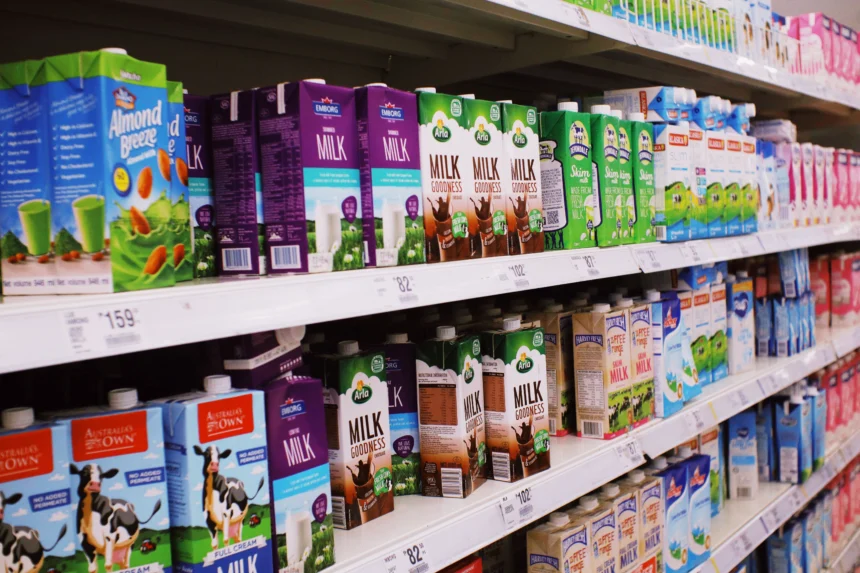
Why Do Supermarkets Put Milk at the Back of the Store?
You walk into a supermarket because you need one thing: milk.
It sounds like a two-minute shopping trip. You enter the building, find the milk, pay and leave.
Instead, you walk past vegetables, cereal, bread, snacks, drinks and several promotional displays before finally reaching the dairy refrigerators. By the time you arrive at the checkout, the carton of milk may no longer be the only item in your basket.
That experience is familiar because many supermarkets place milk at the back of the store or somewhere along the rear or outer perimeter.
There is a popular explanation for this: supermarkets deliberately hide milk as far from the entrance as possible so customers are forced to walk past hundreds of other products and buy things they never intended to purchase.
There is some truth behind that idea, but the full answer is more interesting.
Academic research on supermarket behavior has specifically identified milk as an example of a frequently purchased product that can be positioned deeper inside a store to encourage shoppers to travel farther. Greater exposure to products gives retailers more opportunities to generate unplanned purchases.
At the same time, milk at the back of the store also makes sense for practical reasons. Dairy needs continuous refrigeration. Large refrigerated cases are often built along perimeter walls. Milk sells quickly and must be replenished frequently, so stores also care about efficient access between sales floors, storage areas and delivery operations.
The placement is therefore not simply a psychological trick.
It is where retail psychology and supermarket operations meet.
Milk at the Back of the Store: The Main Reasons
| Reason | Why It Matters |
|---|---|
| Milk is a staple product | Customers are willing to walk farther to find something they already planned to buy |
| More product exposure | A longer route puts more merchandise in front of shoppers |
| Impulse purchases | Additional exposure can create unplanned purchases |
| Refrigeration | Milk requires continuous cold storage |
| Perimeter design | Large refrigerated departments are commonly placed around outer walls |
| Frequent restocking | High-volume dairy products need constant replenishment |
| Traffic distribution | Destination departments can pull customers deeper into the building |
| Basket growth | A shopper entering for one item may leave with several |
| Category grouping | Milk naturally sits beside other refrigerated dairy products |
| Store economics | Increasing the total basket can matter more than maximizing profit on milk itself |
Not every supermarket follows exactly the same plan, but these factors explain why the pattern is so common.
1. Milk Is a Product People Intentionally Enter the Store to Buy
Retailers distinguish between products shoppers actively seek out and products they discover while shopping.
Milk is one of the classic planned purchases.
People frequently enter a supermarket already knowing they need it. The same can be true for bread, eggs, meat and other household staples.
That makes milk at the back of the store strategically useful.
If someone specifically came to buy milk, moving the dairy case another 30 or 50 meters away is unlikely to make them abandon the purchase. They still need milk.
A less important product would behave differently. If a store made customers walk across the entire building for an unfamiliar snack, many shoppers might simply decide they did not want it badly enough.
Milk therefore works as what retailers sometimes describe as a destination category: a product or department that shoppers are willing to seek out.
Academic research reviewing consumer behavior in supermarkets notes that shoppers can only purchase products they actually encounter. It specifically discusses popular perishables such as milk being placed at the back so customers travel through more of the store.
National Library of Medicine — Contextual Influences on Consumer Shopping
The supermarket is not necessarily trying to convince you to buy the milk.
You already decided that.
It is trying to decide what else you will see before reaching it.
2. Walking Farther Means Seeing More Products
A supermarket contains tens of thousands of individual products.
According to current figures from FMI — The Food Industry Association, an average U.S. supermarket carried more than 33,000 items in 2025.
You obviously cannot examine all 33,000 products during one shopping trip.
Your route determines what gets your attention.
That is where milk at the back of the store becomes commercially valuable.
Suppose the milk refrigerator were positioned two meters inside the entrance. A customer could enter, grab milk and leave without seeing almost anything else.
Put the same milk deeper in the building and the customer may pass several product categories.
They might see coffee and remember they are almost out. They notice cereal on promotion. They see bananas. A display reminds them that guests are visiting tomorrow, so they add snacks.
None of those purchases necessarily required aggressive sales tactics.
The products simply became visible at the right moment.
Store layout research shows that product placement and shopper movement can influence purchasing behavior because exposure is one of the basic requirements for an impulse purchase.
A data-driven grocery-layout study published in Computers & Industrial Engineering specifically modeled store layout partly around increasing revenue from impulse purchases.
ScienceDirect — A Data-Driven Approach to Grocery Store Layout
The basic logic is straightforward: you cannot spontaneously buy something you never see.
3. Supermarkets Care About Your Entire Basket, Not Just the Milk
A carton of milk is not necessarily an enormously profitable item.
In fact, staples such as milk often face strong price competition because shoppers have a reasonable idea of what they should cost.
The supermarket therefore cares about something bigger than the margin on the milk itself.
It cares about your total basket.
Suppose you intended to spend $4 on milk but leave with:
milk;
bread;
cereal;
coffee;
cookies;
fruit.
The original trip has changed completely.
This is especially important because supermarkets typically operate on thin net profit margins. FMI reported average food-retail net profit of only 2.1% in 2025.
FMI — 2026 Food Retail Benchmarking
The News Ink’s detailed explanation of how supermarkets make money on tiny profit margins shows why retailers care so much about sales volume, basket size, inventory turnover and repeat visits.
A supermarket does not need to make a fortune from one carton.
It benefits when the carton brings someone into a much larger shopping environment.
4. Impulse Buying Is Real, but It Is Not Mind Control
The phrase impulse buying can make supermarket design sound almost sinister.
In reality, the mechanism is often simple.
You see something you were not thinking about before entering the store, and you decide you want it.
That might be:
a discounted chocolate bar;
fresh bakery bread;
a seasonal drink;
a new flavor of chips;
flowers;
a promotional bundle.
Placing milk at the back of the store creates more opportunities for those encounters.
Research on supermarket choice architecture has specifically discussed milk placement as a way of making customers travel farther through the store and increasing opportunities for additional purchases.
National Library of Medicine — Supermarket Choice Architecture
But supermarket layouts do not remove your ability to choose.
A display cannot force you to buy cereal.
It can make cereal more visible.
This distinction matters.
Retail psychology usually works by influencing:
attention;
convenience;
visibility;
timing;
comparison.
The shopper still makes the final decision.
5. Product Placement Can Measurably Change What People Buy
The importance of store layout is not just a marketing theory.
Researchers have tested what happens when products are physically moved.
One large supermarket study moved fruit and vegetables from less prominent locations to areas near store entrances. Researchers observed changes in sales and purchasing patterns.
PLoS Medicine — Supermarket Product Placement Study
More recent evaluation of similar supermarket placement strategies also found higher fruit-and-vegetable sales when produce was positioned prominently near entrances rather than farther toward the back.
NCBI — Supermarket Placement Strategy Evaluation
This evidence matters to the question of milk at the back of the store because it demonstrates the broader principle: where products are located can affect what shoppers buy.
If placement can increase purchases of vegetables, it can also influence purchasing opportunities for snacks, drinks and other categories.
The shelf itself is therefore part of the marketing system.
6. The Checkout Area Uses the Same Principle More Aggressively
Milk is not the only product whose location is carefully considered.
Look at the checkout.
You frequently find:
gum;
chocolate;
small drinks;
batteries;
magazines;
small convenience items.
Why?
Because you are standing there.
Research on checkout displays has found that strategically placed food near payment areas can encourage unplanned purchases.
National Library of Medicine — Checkout Food Placement
The psychology is similar to milk at the back of the store, but the timing is different.
Milk creates a journey.
Checkout products take advantage of a pause.
You have already finished shopping. You are waiting. The product is directly beside you. The cost is often low enough that little deliberation is required.
Retailers use different parts of the store for different behavioral opportunities.
7. Refrigeration Is a Major Practical Reason
There is also a much less exciting explanation for milk at the back of the store.
Milk must stay cold.
Refrigerated dairy departments require substantial infrastructure. The store needs refrigeration equipment, electrical connections, drainage considerations, maintenance access and a reliable cold chain.
USDA food-safety guidance recommends refrigerator temperatures of 40°F (4.4°C) or below for safe cold storage.
USDA — Refrigeration and Food Safety
Supermarket refrigeration systems are obviously much larger and more sophisticated than household refrigerators, but the underlying requirement remains: milk cannot simply sit on an ordinary shelf wherever the retailer finds a convenient empty space.
That is one reason refrigerated categories are frequently grouped around the store perimeter.
Milk.
Yogurt.
Cheese.
Cream.
Juice.
Frozen foods may occupy another refrigerated run.
Once a supermarket has invested in that infrastructure, product placement is partly constrained by the building itself.
So claiming that milk at the back of the store exists only because retailers want you to buy cookies misses an important operational reality.
8. Dairy Cases Fit Naturally Along Perimeter Walls
Walk through a conventional supermarket and you may notice a pattern.
Fresh produce is often near the entrance. Meat, seafood and dairy frequently appear around the perimeter. Shelf-stable packaged products occupy many of the central aisles.
There are exceptions, especially in compact stores, discount formats and modern urban supermarkets.
But perimeter departments offer several operational advantages.
Large refrigeration systems can be concentrated in dedicated areas. Perishable departments can be positioned closer to preparation rooms, cold storage or service areas. Employees can replenish high-volume goods without moving them through every dry-grocery aisle.
This means milk at the back of the store can satisfy both merchandising and logistics at the same time.
From the marketing side, it pulls shoppers deeper.
From the operating side, it can sit inside an efficient refrigerated department.
The strongest store layouts often accomplish several goals simultaneously.
9. Milk Needs Frequent Restocking
Milk sells quickly.
That creates another logistical issue.
A popular brand and size may need to be replenished repeatedly during a busy day.
Imagine stocking hundreds of milk containers by carrying them individually from a distant back room through crowded customer aisles.
That is inefficient.
Many supermarket designs therefore place high-volume refrigerated departments in locations that make replenishment easier.
Some dairy cases can even be restocked from service or storage areas behind the display, depending on the store design.
Again, this means the famous psychological explanation for milk at the back of the store is incomplete.
Retailers are not designing a video game where the milk is the prize at the final level.
They are designing a working food-distribution facility.
Employees must receive products, refrigerate them, move them, rotate stock and replace what customers purchase.
A good store layout has to serve employees as well as customers.
10. Milk Can Pull Customer Traffic Through Quiet Areas
Retailers also think about traffic distribution.
If every essential item were located beside the front door, shoppers could crowd one small section while much of the store remained lightly visited.
Placing destination categories around different areas can distribute customer movement.
Produce might sit near the entrance.
Meat may occupy another perimeter section.
Dairy appears elsewhere.
Frozen foods are somewhere different.
A shopper completing a weekly grocery trip naturally travels through several zones.
A 2024 academic study on supermarket space planning explicitly describes the challenge as balancing customer convenience with opportunities for impulse buying.
European Journal of Operational Research — Store-Wide Space Planning
That balance is important.
A supermarket that makes every product deliberately difficult to find would frustrate shoppers.
A supermarket that makes every staple accessible within ten steps of the entrance could reduce product exposure.
The retailer has to find a middle ground.
11. Supermarkets Do Not Want the Store to Feel Like an Obstacle Course
If forcing customers to walk farther increases sales, why not make the layout deliberately confusing?
Because shoppers also value convenience.
People do not enjoy wasting time searching for basic products.
An excessively confusing supermarket can encourage customers to choose a competitor.
This is why milk at the back of the store is different from deliberately hiding milk.
Most supermarkets clearly mark their dairy department.
The objective is often to create a logical route, not to make customers wander indefinitely.
Modern retailers increasingly have to compete with:
online grocery delivery;
pickup services;
discount stores;
convenience stores;
warehouse clubs.
If shopping becomes too frustrating, customers have alternatives.
FMI’s industry research shows that modern food retailers continue investing in customer experience and convenience even while operating on very thin margins.
FMI — Food Retailing Industry Speaks 2026
Retail design is therefore a compromise between exposure and efficiency.
12. Costco Demonstrates a Different Version of the Same Idea
Not every grocery retailer uses the traditional supermarket layout.
Costco is a good example.
Its warehouse stores have a limited assortment compared with conventional supermarkets, merchandise is often displayed on pallets, and shoppers may encounter changing product locations.
Yet Costco still benefits when customers walk through a large building and encounter products they did not originally intend to purchase.
The News Ink’s analysis of the Costco business model explains how high transaction values, enormous product volumes and membership economics allow the company to operate differently from conventional supermarkets.
A Costco shopper might enter for milk and paper towels and leave with:
food;
clothing;
batteries;
household goods;
perhaps even a television.
The exact floor plan changes, but the retail principle remains familiar.
More useful product exposure can mean a larger basket.
13. Milk May Function as a Traffic Builder Even With a Low Margin
Milk has another attractive feature for supermarkets: people buy it repeatedly.
A television retailer might see the same customer once every several years.
A supermarket can see the same household every week.
Staples create frequency.
A family finishes its milk and needs another carton.
That trip brings the customer back inside the store.
Once there, the shopper may purchase several additional products.
This makes milk at the back of the store valuable even if milk itself does not generate spectacular profit.
The News Ink’s supermarket-margin analysis explains that products such as milk, bread, eggs and bananas can also influence customers’ perception of whether a store is expensive.
Retailers may therefore compete aggressively on the price of visible staples while making money across the whole basket.
Milk is valuable not merely as merchandise.
It can be part of the reason the customer returns.
14. Why Is Produce Usually Near the Front Instead?
If staple products can draw shoppers deeper, why put fresh fruit and vegetables near the entrance?
Because different departments perform different jobs.
Produce is:
colorful;
fresh-looking;
visually attractive;
associated with quality.
A strong produce department can create a positive first impression.
It can make the supermarket feel fresh and abundant before shoppers encounter boxes, cans and packaged goods.
Research has also shown that moving fruit and vegetables toward store entrances can increase their sales.
A recent real-world supermarket evaluation reported increased fresh fruit and vegetable sales when an expanded produce section was moved near entrances.
PLoS Medicine — Fruit and Vegetable Placement Study
The difference illustrates how supermarkets think about space.
The front can establish an impression.
The back can create a destination.
The checkout can capture last-minute purchases.
Each area has a different commercial function.
15. Why Are Bread and Bakery Smells So Powerful?
Another supermarket experience is the smell of freshly baked bread.
A bakery can contribute more than direct sales.
Aroma changes the atmosphere of the store and can increase appetite.
This does not mean every supermarket deliberately pumps artificial bread smell into the building. Many stores genuinely bake or finish products on site.
But sensory cues matter in food environments.
The News Ink’s article on why restaurant food tastes better explains how aroma, presentation, context and expectation influence the way people experience food.
Supermarkets operate in the same sensory world.
A supermarket is not simply a warehouse containing food.
Modern stores increasingly try to create an environment where food looks, smells and feels appealing.
16. Why Are End-of-Aisle Displays So Valuable?
The ends of aisles—often called endcaps—are some of the most visible pieces of retail space.
Shoppers walking along the main path can see them without entering the aisle.
That makes them useful for:
promotions;
seasonal products;
new products;
large displays;
high-priority merchandise.
Research on retail layout repeatedly treats high-visibility locations as valuable because positioning changes exposure.
That explains why brands and supermarkets care intensely about where individual products appear.
The supermarket has limited shelf space.
Every meter must produce value through:
sales;
margin;
traffic;
customer satisfaction;
or strategic importance.
The News Ink’s article on how supermarkets make money explores how shelf placement, supplier relationships, promotions and category economics fit into this larger business model.
17. Why Are Expensive or Popular Products Often at Eye Level?
Shelf height creates another form of placement strategy.
A product placed directly in a shopper’s normal field of vision is easier to notice than something near the floor.
Retailers and brands therefore care about:
eye-level placement;
number of product facings;
adjacent products;
display size.
Research interventions have demonstrated that changing shelf position and the number of visible product facings can change the prominence of food items.
The broader lesson is the same as with milk at the back of the store.
Physical visibility affects commercial opportunity.
Shelf space is not neutral.
18. Why Are Chocolates Near the Checkout?
The checkout represents the opposite strategy from dairy.
You do not need to travel to find checkout chocolate.
It comes to you.
By the time you reach the register, your main shopping decisions are finished. You may then spend several minutes waiting beside inexpensive products designed for quick decisions.
This can be especially effective for low-cost items because the financial risk feels small.
Adding a $1 or $2 product to a $70 grocery basket does not feel like a major purchase.
Studies of supermarket checkout environments have therefore paid particular attention to impulse-oriented products displayed there.
In other words, supermarkets use different locations for different types of purchase.
Milk is something you seek.
Checkout candy is something you notice.
19. Store Layout Also Shapes How Long You Stay
Retailers care about how customers move through the store because movement affects exposure.
But more time is not automatically better.
A shopper who spends 40 productive minutes buying groceries can be valuable.
A shopper who spends 40 frustrating minutes searching for three products may never return.
Research comparing supermarket layouts has therefore examined metrics such as:
trip duration;
basket size;
spending;
use of endcap displays.
Store design affects all of them.
This is another reason simplistic explanations of milk at the back of the store miss the complexity.
Supermarkets are trying to optimize an entire journey rather than maximize walking distance for its own sake.
20. Online Grocery Shopping Changes the Psychology Completely
Now consider buying milk through an app.
There is no physical back of the store.
You search:
milk
and the product appears instantly.
Retailers therefore have to recreate product exposure digitally.
Online grocery sites may use:
recommended products;
sponsored search results;
“customers also bought” suggestions;
personalized offers;
digital coupons;
featured categories.
The physical store uses space.
The online store uses screens and algorithms.
The goal can be remarkably similar: help customers find what they need while creating opportunities to discover additional products.
This also shows that the underlying principle behind milk at the back of the store is broader than milk.
Retailers are managing attention.
21. Supermarkets Compete With Restaurants for Your Food Budget
Modern grocery stores increasingly contain:
coffee counters;
hot meals;
sushi;
pizza;
sandwiches;
salad bars;
rotisserie chicken.
These are not accidental additions.
Supermarkets want a share of money that might otherwise go to restaurants or delivery services.
Prepared food can also create another reason to walk through more of the store.
The News Ink’s article on why restaurant food tastes better explains how convenience and sensory appeal influence food choices.
Grocery retailers increasingly compete on those same dimensions.
The supermarket is becoming less like a building filled only with shelves and more like a combination of retailer, food service business and digital marketplace.
22. Location Changes What People Are Willing to Pay
Retail placement matters outside supermarkets too.
Think about an airport.
Food and drinks can cost significantly more partly because consumers have fewer convenient alternatives once they are inside the terminal.
The News Ink’s explanation of why airport food is so expensive shows how location, rent, security, logistics and captive demand affect retail economics.
A supermarket uses location differently.
It usually cannot charge dramatically more for milk simply because the dairy case is 50 meters away.
Competition prevents that.
Instead, the value comes from what the customer encounters during the trip.
This is why supermarket layout is often more about basket composition than dramatically increasing the price of one staple.
23. Consumer Psychology Is About More Than Manipulation
People often describe supermarket psychology as if retailers possess secret techniques that override rational thinking.
Human behavior is more ordinary than that.
People forget things.
They become hungry.
They respond to convenience.
They notice attractive products.
They remember needs when products appear.
They compare prices.
They become curious about promotions.
The News Ink’s article on why humans develop emotional attachments to objects explores another side of consumer psychology: people do not evaluate products through price and physical usefulness alone. Memory, identity, presentation and emotion influence value.
Supermarkets operate within those normal human tendencies.
Placing milk at the back of the store does not remove your free choice.
It gives the store more opportunities to influence what enters that choice.
24. Not Every Supermarket Puts Milk at the Back
This point is essential.
There is no universal law requiring milk at the back of the store.
Some supermarkets place dairy along a side wall.
Convenience stores may put milk close to the entrance because fast shopping is part of their value proposition.
Small urban supermarkets may have limited choices because of building shape.
Discount chains can use completely different layouts.
FMI research from years ago even found consumers expressing interest in quick-stop areas near store entrances containing staples such as milk and bread.
Different formats optimize different things.
A supermarket may want customers to browse.
A convenience store may promise speed.
A warehouse club may deliberately encourage exploration.
The correct question is therefore not:
“Do all supermarkets hide milk at the back?”
They do not.
The better question is:
“Why is deep or perimeter placement so useful when a store chooses it?”
That has a much stronger answer.
25. Is Putting Milk at the Back Actually Effective?
The broad principle is well supported: store layout changes product exposure, and product placement can affect purchasing.
Research has shown changes in sales when supermarket categories are moved to more or less prominent locations.
Studies of choice architecture also specifically cite milk as an example of a planned purchase that can draw shoppers farther through a store.
However, it would be too strong to claim that putting milk at the back automatically causes every customer to spend a predictable additional amount.
Shopping behavior depends on:
shopping lists;
income;
time pressure;
store familiarity;
family size;
promotions;
product preferences;
whether the shopper uses a basket or cart.
A disciplined shopper can walk straight to dairy, take one carton and leave.
The supermarket cannot stop them.
It can only change what they encounter along the route.
How to Avoid Buying More Than You Planned
If you regularly enter a supermarket for five items and leave with fifteen, a few simple habits can help.
Use a shopping list. A specific list reduces the number of decisions you have to make inside the store.
Do not shop extremely hungry. Hunger can make food displays much more tempting.
Know the store layout. Familiarity lets you move efficiently between the sections you actually need.
Compare unit prices. Large promotional signs do not always mean the product is the cheapest option.
Pause before adding an unplanned item. Ask whether you genuinely need it or simply noticed it because of the display.
Consider a basket for small trips. A huge empty cart can make a small purchase feel visually incomplete.
You do not have to treat the supermarket like an enemy.
You simply need to recognize that the environment was designed commercially rather than randomly.
Frequently Asked Questions
Why do supermarkets put milk at the back of the store?
Supermarkets often place milk at the back of the store because milk is a frequently purchased staple that shoppers are willing to seek out. The longer route can expose customers to more merchandise, while rear or perimeter placement can also suit refrigeration, dairy grouping and restocking requirements.
Is milk placed at the back just to make you buy more?
Not entirely. Increased product exposure and potential impulse purchases are part of the retail logic, but refrigeration infrastructure, department layout, delivery access and frequent restocking also influence milk placement.
Does every supermarket put milk at the back?
No. Milk may appear at the back, along a side perimeter wall or closer to the front depending on the store’s size, format and design.
Does store layout really affect buying behavior?
Yes. Research has found that changing the placement and prominence of supermarket products can influence sales and purchasing patterns.
Why is produce usually near the front?
Produce is visually attractive and can create a strong impression of freshness. Studies also show that prominent entrance placement can increase fruit and vegetable sales.
Why are chocolates placed near supermarket checkouts?
Checkout areas create opportunities for low-cost impulse purchases because shoppers are already waiting beside the merchandise after completing most of their planned shopping.
Why are supermarkets so large?
Large stores can carry tens of thousands of products and separate fresh, refrigerated, frozen, household and packaged categories. Larger spaces also give retailers more opportunities to organize categories and customer flow.
Why are dairy products usually together?
Milk, cheese, yogurt and related products require refrigerated storage and are logically grouped for customer convenience and operational efficiency.
Do supermarkets intentionally make customers walk farther?
Many retailers use destination categories and store layouts to influence customer movement and product exposure. However, they must balance that objective with convenience because excessively frustrating layouts can drive shoppers away.
Are supermarket layouts designed scientifically?
Major retailers use sales data, shopper research, planograms, traffic analysis and merchandising systems to make layout decisions. Academic research also uses optimization models to study supermarket floor plans.
Does putting staples farther away increase impulse buying?
It can increase opportunities for impulse buying because shoppers encounter more products. The effect on an individual shopper varies substantially.
Why do supermarkets move products around?
Products can move because of promotions, seasonal displays, assortment changes, supplier arrangements, renovations or attempts to improve category performance and customer flow.
Milk at the Back of the Store Is Part Psychology and Part Practical Engineering
The next time you enter a supermarket for one carton of milk, pay attention to the journey.
Notice what you pass.
Produce near the entrance may create an impression of freshness. Endcaps advertise products before you enter an aisle. Shelf positions determine which brands catch your eye first. The bakery may add aroma and visual appeal. Small products wait beside the checkout.
Then, somewhere deeper inside the building, you find the dairy department.
That journey is not completely accidental.
Placing milk at the back of the store can take advantage of a simple fact: people often arrive already committed to buying milk. Making them travel farther increases their exposure to other merchandise, and research on supermarket behavior shows that product exposure and placement can influence purchasing.
But the popular explanation should not be exaggerated.
The dairy section is also a refrigerated industrial system. Milk has to remain cold. It sells quickly. Employees need to replenish it frequently. Refrigerators, storage rooms, delivery systems and store architecture all affect where the department can sensibly go.
The smartest supermarket layout is therefore not simply the layout that makes customers walk the farthest.
It is one that balances several goals at once: customers can find what they need, employees can stock products efficiently, perishable goods remain properly refrigerated, high-value displays receive enough attention and shoppers encounter enough merchandise to make additional purchases possible.
That is why milk at the back of the store has become such a memorable example of retail strategy.
One carton can perform several jobs.
It satisfies an everyday household need. It brings customers back to the supermarket regularly. It helps draw traffic toward a particular part of the building. And on the journey there, it gives thousands of other products a chance to be noticed.
The store does not have to force you to buy anything.
It only needs to put the right products in your path.
And when millions of customers make thousands of small purchasing decisions every week, those few extra items can become a very large part of supermarket economics.