




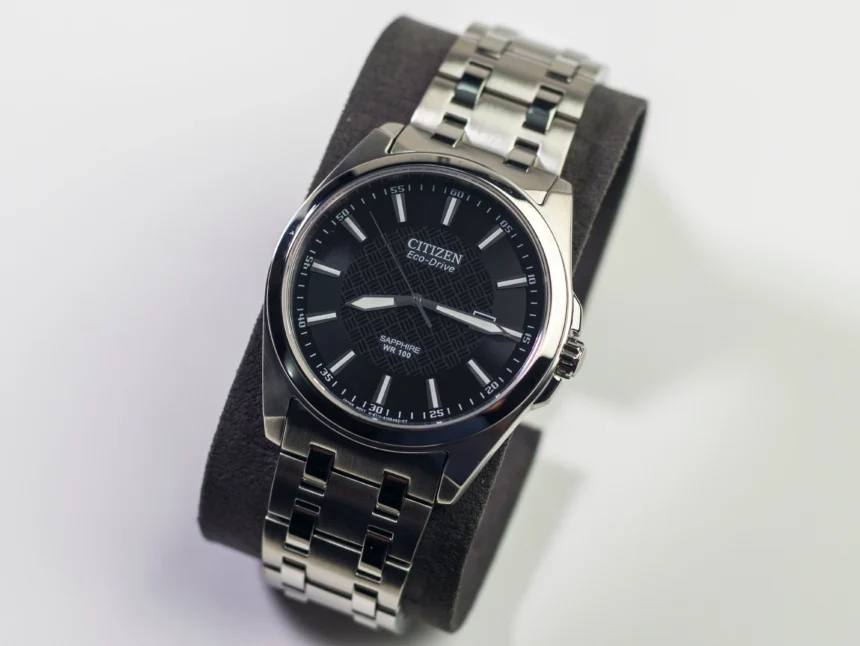
What Makes a $100,000 Luxury Watch Different From a $100 Watch?
Place two watches on a table.
One costs $100.
The other costs $100,000.
Both have hands.
Both display the time.
Both fit on your wrist.
And here is the strange part:
The $100 watch may actually keep better time.
That sounds ridiculous until you understand what people are really buying when they enter the world of luxury watches.
At $100, a watch is usually being sold primarily as a useful product.
At $100,000, it may be part timekeeper, part miniature machine, part handmade object, part jewelry, part collectible and part social signal.
The price difference is therefore not comparable to buying a $20 bicycle and a $20,000 motorcycle, where the expensive machine delivers dramatically more speed and engineering capability.
A $100,000 mechanical watch does not tell time one thousand times better.
In fact, a relatively inexpensive quartz movement can outperform many mechanical movements for pure timekeeping accuracy.
Seiko, for example, currently sells quartz watches specifying accuracy of about ±15 seconds per month. Seiko’s quartz specifications provide a useful benchmark for what relatively affordable electronic watchmaking can achieve.
A mechanical watch can vary by several seconds per day and still be considered an excellent mechanical timekeeper.
So if accuracy cannot explain the extraordinary price of luxury watches, what can?
The answer starts inside the case—but it does not end there.
$100 Watch vs $100,000 Luxury Watch
| Feature | Around $100 Watch | Around $100,000 Luxury Watch |
|---|---|---|
| Primary purpose | Reliable timekeeping | Timekeeping + craft + collecting + luxury |
| Movement | Often quartz | Frequently mechanical |
| Accuracy | Often excellent | Excellent for mechanical technology, but not necessarily better than quartz |
| Assembly | Highly automated | Can involve extensive hand assembly |
| Finishing | Functional | Polished, beveled and decorated down to tiny components |
| Complications | Basic | Calendars, chronographs, repeaters, world time, tourbillons |
| Materials | Steel, mineral glass, resin | Precious metals, sapphire, ceramic, specialized alloys |
| Production | Large scale | Often much smaller volumes |
| Testing | Product-dependent | Can involve extensive chronometric and durability testing |
| Brand premium | Relatively small | Can be enormous |
| Collectibility | Usually limited | Potentially substantial |
| Resale value | Usually declines | Highly variable; some rare references appreciate |
The crucial word is potentially.
Not every expensive watch is a masterpiece.
Not every luxury watch holds value.
And a high price does not automatically mean every component costs dramatically more to manufacture.
As with luxury handbag prices, the final retail price contains both genuine craftsmanship and substantial intangible value.
1. The $100 Watch May Win the Accuracy Contest
Before praising high-end watchmaking, we should make one fact very clear.
Quartz changed everything.
A quartz watch uses an electronic oscillator regulated by a quartz crystal. Because that crystal vibrates at a very stable frequency, inexpensive quartz movements can keep remarkably accurate time with very little adjustment.
A current Seiko quartz model priced in the hundreds of dollars specifies ±15 seconds per month.
Citizen also publishes the same ±15-second monthly specification for many of its Eco-Drive quartz movements. Citizen’s Eco-Drive specifications show how precise modern mass-produced quartz timekeeping can be.
That means an affordable quartz watch might gain or lose only a few minutes across an entire year.
Mechanical luxury watches solve the same problem in an entirely different way.
There is no battery-driven quartz oscillator.
Instead, they may contain:
a wound mainspring;
gear trains;
dozens or hundreds of components;
jewels reducing friction;
a balance wheel;
an escapement;
and numerous microscopic mechanical interactions.
The wonder is not that this complicated machine beats quartz.
Usually it does not.
The wonder is that a tiny mechanical system can run continuously on your wrist at all.
Mechanical Watchmaking Is Like Choosing a Fountain Pen Over a Printer
Imagine writing your name.
A computer printer can reproduce text faster and more consistently than a fountain pen.
Yet beautiful fountain pens still exist.
People value:
mechanical design;
materials;
craftsmanship;
history;
tactile experience;
and the pleasure of using something built differently.
Mechanical luxury watches operate in a similar world.
Their value is increasingly disconnected from the cheapest way of accomplishing the basic task.
A phone already tells perfect network-synchronized time.
Nobody genuinely needs a $100,000 wristwatch to know whether it is 3:47 p.m.
That means the expensive watch must justify itself through something else.
2. The Movement Can Contain Hundreds of Components
Consider a simple quartz watch.
Its movement can be compact, cheap to manufacture at scale and highly reliable.
Now look inside an elaborate mechanical watch.
A high complication may contain hundreds of individually manufactured pieces.
Patek Philippe’s 2026 Ref. 7147G perpetual calendar, for example, contains a self-winding caliber composed of 275 parts despite measuring only 27.5 millimeters across. The watch is priced at more than $137,000 in its limited 2026 edition. Patek Philippe’s specifications show just how much mechanism can fit into a small wristwatch.
More elaborate watches can go considerably further.
A mechanical movement has to translate stored spring energy into controlled motion while simultaneously minimizing:
friction;
wear;
power loss;
positional error;
temperature effects;
and shock.
Add a complication and the problem becomes more difficult.
Then add several complications together.
This is where high-end luxury watches begin to resemble miniature mechanical computers.
3. Expensive Watches Can Do Things That Are Mechanically Absurd
In watchmaking, a complication means a mechanical function beyond basic time display.
Common complications include:
date;
chronograph;
moon phase;
second time zone;
annual calendar.
More difficult examples include:
perpetual calendar;
split-seconds chronograph;
minute repeater;
tourbillon;
world-time mechanism;
grande sonnerie.
A perpetual calendar is a wonderful example.
It mechanically understands which months have:
31 days;
30 days;
28 days;
and when February receives a 29th day.
Patek Philippe explains that a conventional perpetual calendar can correctly account for leap years without calendar correction until 2100, when the Gregorian calendar skips what would otherwise appear to be a leap year. Patek Philippe’s Grand Complications guide describes these mechanisms as among watchmaking’s most demanding creations.
Of course, your phone handles this calculation effortlessly.
That is not the point.
The extraordinary part is doing it entirely through gears, springs, cams and levers in something smaller than your palm.
A Minute Repeater Is Even More Extreme
Push a lever on a minute repeater and the watch mechanically determines the time and strikes tiny gongs to communicate it acoustically.
No speaker.
No digital audio.
No computer.
A mechanical sequence interprets the position of the timekeeping system and converts it into sound.
At this level, luxury watches are no longer competing with ordinary watches on utility.
They are demonstrating what mechanical engineering can achieve under extreme size constraints.
It is closer to mechanical art.
4. You Are Paying for Finishing Nobody Else May Ever See
Take the back off an ordinary affordable watch and the movement is primarily designed to function.
That is perfectly reasonable.
Open a high-end mechanical watch and the situation can look completely different.
Tiny movement parts may have:
polished screw heads;
beveled edges;
mirror-polished steel;
decorative striping;
perlage;
straight graining;
black polishing;
hand-finished internal angles.
Patek Philippe says many of its finishing techniques are performed manually and notes that some components are so small specialists need binocular microscopes. Its guide to hand finishing explains that finishing can also remove microscopic machining traces and smooth surfaces that interact mechanically.
Audemars Piguet goes even further in describing the economics of this work.
The company says the decoration and finishing of a movement can represent at least 30% of its value. Audemars Piguet’s finishing guide shows craftspeople chamfering and polishing movement components individually.
Much of this work is invisible while the watch is being worn.
That sounds economically irrational.
To a collector, that is exactly why it matters.
The Invisible Work Is Part of the Luxury
Imagine a cabinet maker hand-finishing the back of a drawer that almost nobody will inspect.
From a pure utility perspective, it is unnecessary.
From a craftsmanship perspective, it demonstrates a standard.
The same philosophy exists in high-end luxury watches.
Collectors may use magnification to examine:
the sharpness of an interior angle;
the consistency of polished bevels;
whether screw heads are properly finished;
the transitions between brushed and polished surfaces.
At that point, tiny details become evidence of labor.
The object is being judged not only by what it does but by how completely it was made.
5. Even the Case Can Require Specialist Handwork
The difference is visible outside the watch too.
A cheap stainless-steel case can be stamped, machined and polished efficiently.
A luxury case may contain complex surfaces where:
brushed areas meet mirror-polished sections;
edges need to remain perfectly sharp;
curved surfaces must remain symmetrical;
and polishing cannot distort the geometry.
Grand Seiko provides a useful example with its Zaratsu polishing.
The company describes it as a technically difficult process used to create distortion-free mirror surfaces while preserving sharp ridge lines. Skilled specialists control pressure and movement manually during polishing. Grand Seiko’s explanation of Zaratsu emphasizes that the result depends heavily on craft experience.
Audemars Piguet similarly hand-finishes even difficult materials such as ceramic after components are formed and sintered at temperatures exceeding 1,000°C. Audemars Piguet’s materials guide describes the additional work needed to achieve its alternating polished and satin finishes.
Again, the raw material itself explains only part of luxury watch prices.
The difficulty of turning that material into a particular finish matters too.
6. Precious Metal Adds Cost—but Cannot Explain $100,000
Gold is expensive.
Platinum is expensive.
High-quality diamonds are expensive.
Exotic case materials can be difficult to manufacture.
A gold watch should obviously cost more than an otherwise identical steel watch.
But gold alone does not explain why one watch costs $100,000.
A wristwatch simply does not contain anywhere near $100,000 worth of ordinary gold.
That is the same mistake people make when analyzing luxury handbags by looking only at leather costs.
The News Ink’s analysis of why luxury handbags are so expensive reaches the same conclusion: premium materials are real costs, but luxury pricing cannot be reverse-engineered from raw materials alone.
With luxury watches, materials provide a base.
Watchmaking, finishing, distribution, scarcity and branding build on top of it.
7. Extreme Testing Costs Money Too
Some expensive watches undergo unusually extensive testing.
Rolex provides a good example.
In 2026, Rolex expanded its Superlative Chronometer certification beyond its existing finished-watch tests covering precision, waterproofness, self-winding and power reserve, adding criteria related to magnetic resistance, reliability and durability. Rolex’s 2026 certification overview describes the strengthened program.
Independent certification can add another layer.
Switzerland’s Federal Institute of Metrology, METAS, runs the Master Chronometer certification for qualifying watches. Testing covers areas including:
chronometric performance;
water resistance;
magnetic-field resistance;
power reserve.
The certification applies to the complete watch rather than simply an uncased movement. METAS’s official certification page explains the program.
This still does not mean an expensive mechanical watch beats cheap quartz in absolute accuracy.
It means the mechanical watch achieves impressive performance despite operating through miniature physical machinery.
That distinction is important.
8. Production Scale Changes Everything
A $100 watch might be produced in enormous quantities.
Tooling, engineering and design costs can therefore be spread across tens or hundreds of thousands of units.
High-end luxury watches may be produced in dramatically smaller quantities.
Patek Philippe says many of its references are produced in small series ranging from around ten to several hundred pieces. Patek Philippe’s manufacturing values explicitly identifies rarity as part of its production philosophy.
Small production runs change economics.
Imagine a company spends years developing a movement.
It needs:
engineers;
prototypes;
specialized tools;
testing equipment;
watchmakers;
training;
quality control.
If 500,000 watches use that movement, development cost per watch can become relatively small.
If only 500 watches use it, each one effectively has to absorb a much larger share of the development effort.
Low-volume manufacturing is expensive in almost every industry.
In haute horlogerie, it is central to the business model.
9. Rarity Can Become More Valuable Than Manufacturing Cost
Now we leave manufacturing and enter economics.
Suppose a particular watch costs $40,000 to produce, distribute and support.
That does not mean its retail price must be $45,000.
If thousands of collectors want it and only a few hundred exist, the market may accept dramatically higher prices.
This becomes even more obvious on the secondary market.
Sotheby’s identifies factors including:
reference rarity;
original dial;
case preservation;
complications;
provenance;
historical importance
as major drivers of high collectible-watch values. Its 2026 analysis of valuable Patek Philippe watches shows how two watches from the same brand can have radically different values because one has the rarer combination of configuration, originality and history.
At that point, the manufacturing cost of the watch is almost irrelevant.
Collectors are competing for scarcity. luxury watch prices can move far beyond
The mechanism resembles other collectibles:
art;
classic cars;
rare coins;
first-edition books.
Provenance Can Add Millions Without Changing the Watch
Imagine two mechanically identical vintage watches.
One belonged to an unknown owner.
The other belonged to a globally famous actor.
Physically, they may be nearly identical.
Economically, they can be completely different.
Why?
Provenance.
The history itself becomes part of the object.
That makes high-end collecting closely related to the psychology discussed in The News Ink’s article on emotional attachment to objects.
Humans do not assign value only according to physical material.
We value stories.
Ownership.
History.
Association.
Rarity.
That is why collectors can pay huge premiums for a watch that appears technically similar to another one.
10. Branding Is a Real Part of the $100,000 Price
Now we reach the uncomfortable part.
Yes, branding matters enormously.
Take an exquisitely finished mechanical watch made by an unknown independent manufacturer.
Now imagine an otherwise comparable watch bearing the name:
Patek Philippe;
Rolex;
Audemars Piguet;
Vacheron Constantin.
Will customers necessarily pay the same amount?
No.
Brand reputation changes willingness to pay.
This is partly rational.
An established manufacturer may provide:
service infrastructure;
documented history;
proven technical ability;
parts support;
strong quality control;
authentication;
and established resale demand.
But part of the premium is unquestionably symbolic.
A luxury brand tells other enthusiasts what the object represents.
This is exactly the pattern explored in The News Ink’s luxury handbag analysis.
The product may be excellently made.
The brand still adds another layer of value on top of the manufacturing quality.
There Is No Honest Formula Saying “70% Is Branding”
Just as with designer bags, claims such as:
“This $100,000 watch costs only $5,000 to manufacture, so $95,000 is branding”
should be treated carefully.
Most private luxury watchmakers do not publish model-level:
labor costs;
movement-development expense;
tooling;
rejection rates;
distribution cost;
boutique expenses;
marketing spend;
service liabilities;
manufacturing overhead;
or exact gross margin.
Without those numbers, precise viral estimates are mostly speculation.
Brand premium is real.
Assigning it one universal percentage is not.
The Swiss Watch Industry Shows How Powerful the High End Is
The broader market makes this particularly clear.
The Federation of the Swiss Watch Industry reported CHF 24.4 billion in wristwatch exports during 2025, despite only 14.6 million watches being exported.
The industry’s highest-priced segment—watches above CHF 3,000 at export value—has an outsized influence on total industry value. The Federation’s 2025 statistics show how Switzerland competes primarily through value rather than enormous production volume.
By comparison, countries manufacturing vast quantities of inexpensive watches may ship far more individual units while generating much lower value per piece.
That is the economics of luxury watches in one statistic.
High prices are not an accident at the edges of the Swiss industry.
They are central to its business model.
Why Can a Cheap Quartz Watch Be More Accurate Yet Less Valuable?
Because price measures demand, scarcity and production economics—not one technical metric.
A family sedan can be more reliable than a vintage Ferrari.
That does not make the Ferrari cheaper.
A printed photograph can reproduce an image more perfectly than an original painting.
That does not make the painting worthless.
A digital clock can keep time more accurately than an antique mechanical clock.
Collectors may still value the antique enormously.
The same applies to luxury watches.
Accuracy is one type of performance.
Collectors are buying a different package of qualities.
What Does the Extra $99,900 Actually Buy?
Not literally in these proportions, but conceptually the premium can include:
Better Materials
Precious metals, sapphire crystals, ceramics and specialized alloys.
Mechanical Complexity
Movements containing hundreds of precisely interacting components.
Development
Years of engineering for new movements or complications.
Manual Labor
Assembly, adjustment, polishing and finishing by skilled specialists.
Lower Production
Fixed costs distributed over fewer units.
Testing
More extensive precision, pressure, magnetism and reliability checks.
Finishing
Decorative work on parts almost nobody will see.
Heritage
The accumulated reputation of a manufacture.
Scarcity
Limited availability relative to demand.
Distribution
Expensive boutiques and global service infrastructure.
Branding
The emotional and social value attached to a prestigious name.
Collectibility
Potential interest from enthusiasts and secondary-market buyers.
Together, those factors produce luxury watch prices.
No single one explains the entire difference.
A $100,000 Watch Is Not Necessarily 1,000 Times Harder to Make
This is another important distinction.
Luxury pricing is not linear.
Suppose increasing basic quality from a $20 watch to a $100 watch creates a huge improvement.
You may gain:
better water resistance;
better case quality;
better strap or bracelet;
stronger crystal;
much better longevity.
Moving from $100 to $1,000 can add more.
But moving from $10,000 to $100,000 increasingly involves qualities such as:
rarity;
hand finishing;
mechanical complication;
brand prestige;
collectibility.
You reach diminishing functional returns.
The $100,000 watch may be meaningfully better made.
It is not necessarily one thousand times more useful.
That is how luxury markets work. luxury watch prices can move far beyond
Are $100,000 Watches Better Investments?
Sometimes.
Often not.
This is where watch enthusiasm can turn into dangerous financial simplification.
Certain rare references from brands such as Patek Philippe and Rolex have produced extraordinary auction results.
Sotheby’s shows how rarity, condition and provenance can push individual pieces to exceptional values.
But that does not mean buying an expensive watch automatically creates an appreciating asset.
Secondary-market prices can fall.
Fashion changes.
A particular reference can lose popularity.
Service history matters.
Condition matters.
Authentication matters.
Transaction costs can be substantial.
Buying a luxury watch because you love it is different from buying one because you assume it will outperform financial investments.
The News Ink’s article on car depreciation illustrates the same broader lesson: a high purchase price does not guarantee strong resale value.
Some Collectors Actually Prefer Steel Over Gold
Another strange luxury-watch phenomenon is that material value does not always determine collector value.
Gold costs more than steel.
Yet particular vintage steel watches can be vastly more valuable than equivalent gold models.
Why?
Rarity.
Perhaps almost everyone ordering the model decades ago chose gold because it was the prestigious option.
Only a handful were made in steel.
Decades later, collectors compete for the scarce configuration.
The cheap material becomes the expensive watch.
That would make no sense if luxury watches were priced according to metal value alone.
But it makes perfect sense in a collectible market.
Why Does Hand Finishing Matter When Machines Are More Precise?
Machines can produce astonishing precision.
In many tasks they outperform humans.
That makes hand craftsmanship seem inefficient.
It is.
And that inefficiency is partly why collectors value it.
A handmade internal bevel requiring substantial artisan time is expensive precisely because an automated process could accomplish a basic functional result much faster.
The luxury product deliberately preserves labor that mass production eliminated.
The same phenomenon appears in:
handmade furniture;
bespoke tailoring;
hand-stitched leather goods;
traditional musical instruments.
The craftsmanship is not simply a route to functionality.
It becomes part of the product itself.
The Watch Can Also Be an Heirloom
Expensive mechanical watches are often designed and marketed around longevity.
A movement can be serviced.
Worn components can be replaced.
Cases can be refinished carefully.
A watch can pass between generations.
This creates another dimension to luxury watches that inexpensive disposable products often lack.
Not every expensive watch will survive forever.
But high-end mechanical watchmaking frequently treats repairability and longevity as part of the object’s identity.
This overlaps again with emotional attachment to objects.
A watch inherited from a parent is no longer merely a machine.
Its personal history may eventually matter more than its market price. luxury watch prices can move far beyond
Mechanical Watchmaking Is Ancient Technology Refined to an Extreme
The basic goal—measuring time mechanically—is centuries old.
Modern watchmakers have added:
advanced materials;
computer-aided design;
precision manufacturing;
silicon components;
modern lubricants;
high-tech testing.
But the fundamental idea remains mechanical energy controlled through a regulating system.
That gives fine watchmaking an unusual position.
It is simultaneously obsolete and advanced.
Digital technology can accomplish the primary task better.
Yet mechanical engineering has become progressively more sophisticated.
This mirrors the broader story in The News Ink’s ancient inventions we still use today: old technologies do not necessarily disappear when newer ones arrive. Sometimes they evolve into different roles.
Mechanical watches stopped being necessary.
That freed them to become something else.
Frequently Asked Questions
Why do luxury watches cost $100,000?
Luxury watches can reach $100,000 because of complicated mechanical movements, hand finishing, low-volume production, precious materials, lengthy development, testing, brand reputation and scarcity.
Does a $100,000 watch keep better time than a $100 watch?
Not necessarily. A relatively inexpensive quartz watch can be more accurate than an expensive mechanical watch. The expensive watch’s value lies primarily in mechanical construction, craftsmanship, materials and collectibility rather than absolute accuracy.
Why are mechanical watches expensive?
High-end mechanical movements can contain hundreds of components requiring manufacturing, assembly, adjustment and finishing. Complicated movements demand additional engineering and specialist labor.
What is a watch complication?
A complication is a mechanical function beyond basic timekeeping. Examples include chronographs, perpetual calendars, minute repeaters, world-time displays and moon phases.
What is hand finishing in watchmaking?
Hand finishing includes processes such as polishing, beveling, graining and decorating movement components and cases. At the highest level, artisans may finish even parts hidden inside the movement.
Is gold the main reason luxury watches are expensive?
No. Precious metals add material cost, but a watch selling for $100,000 typically derives much of its value from movement complexity, craftsmanship, rarity and brand value.
Why are Rolex watches expensive?
Rolex combines vertically integrated manufacturing, strong testing standards, precision, durable materials, global brand recognition and high demand. Scarcity for particular references can also affect secondary-market pricing.
Why is Patek Philippe so expensive?
Patek Philippe produces complicated mechanical watches in relatively small volumes and uses extensive finishing and traditional craftsmanship. Brand heritage, rarity and collector demand add substantial value.
Are all expensive watches handmade?
No. Luxury watch production typically combines advanced machines with manual assembly and finishing. The amount of handwork varies significantly between manufacturers and models. luxury watch prices can move far beyond
Are luxury watches good investments?
Some rare references have appreciated, but most watches should not automatically be treated as investments. Condition, scarcity, demand, provenance and market cycles can substantially affect resale prices.
Why would anyone buy a mechanical watch when a phone tells better time?
For many buyers, luxury watches are appreciated as mechanical objects, craftsmanship, design, jewelry, collectibles and personal symbols rather than simply instruments for obtaining the time.
The $100 Watch and the $100,000 Watch Are Almost Different Products
This is ultimately the easiest way to understand luxury watches.
The $100 watch asks:
How reliably can we tell the time at an affordable price?
The $100,000 watch asks a completely different question:
How far can we push mechanical watchmaking, craftsmanship, design, scarcity and prestige inside an object small enough to wear on a wrist?
Those goals produce very different products.
The affordable quartz watch can be brilliantly engineered.
It may be more accurate.
It may survive years of everyday use.
It may provide better practical value for almost everyone.
There is nothing inferior about that.
The luxury mechanical watch simply competes in another category.
Inside the case may be hundreds of components interacting mechanically.
Surfaces invisible to the owner may have been polished by hand.
Steel edges may be beveled until they catch light perfectly.
A calendar mechanism may mechanically remember month lengths and leap years.
A repeater may transform the time into sound using tiny hammers and gongs.
A case may have been polished by a specialist whose skill took years to develop.
The manufacturer may produce only hundreds of examples.
Then economics adds another layer.
Collectors value rarity.
Brands accumulate heritage.
Famous references develop cultural status.
Provenance turns ordinary examples into historical objects.
Limited supply collides with global demand.
At that stage, luxury watch prices can move far beyond any reasonable estimate of raw manufacturing cost.
And yes, branding can become extremely important.
Remove the prestigious name from a $100,000 watch and the market may value the same physical level of craftsmanship very differently.
That does not make the craftsmanship fake.
It means luxury value is created from both the physical object and the story surrounding it.
So is a $100,000 watch one thousand times better than a $100 watch?
For telling time?
Absolutely not.
For mechanical complexity, hand craftsmanship, scarcity and collectibility?
It can belong to a completely different world.
That is the real difference.
The $100 watch tells you what time it is.
The finest luxury watches try to make you care about the machine doing the telling.
Follow The News Ink
Follow The News Ink for research-driven explainers covering business, luxury, technology, consumer economics and everyday questions on X, Instagram, Threads, Medium, Substack, Pinterest, TikTok, Quora, Bluesky and Mastodon.


