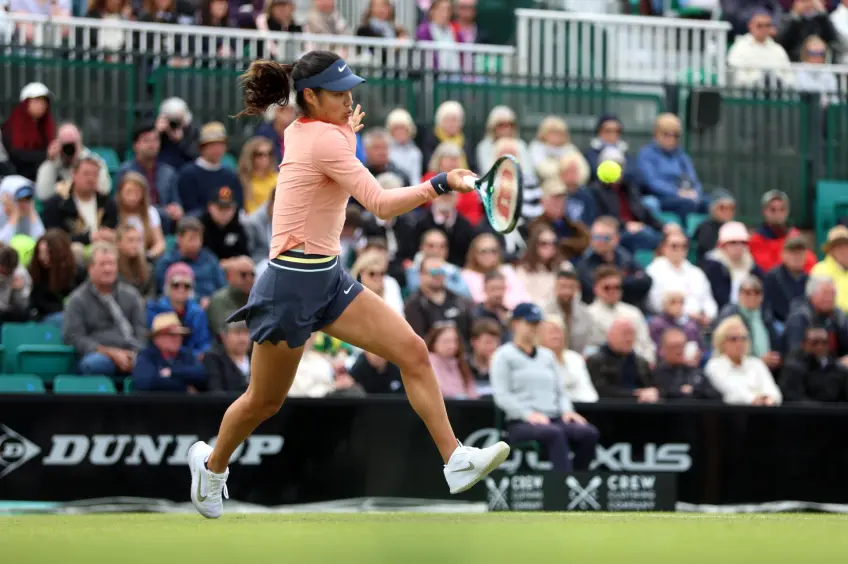
Emma Raducanu: Powerful 2026 Rebuild Sparks Fresh Hope
Emma Raducanu is trying to rebuild her tennis around something that sounds simple but has proved difficult since her US Open breakthrough: trusting the way she naturally wants to play.
The British No.1 began 2026 searching for clarity after another coaching change, a difficult Australian Open exit and a growing feeling that too many outside voices had pulled her away from her own instincts. After splitting with Francisco Roig, the former coach of Rafael Nadal, Raducanu said she wanted to rediscover the aggressive, early-striking style that once made her game feel free, sharp and dangerous.
That reset did not produce a straight line. It brought a strong response at Indian Wells, a first tour-level final since her 2021 US Open title at the Transylvania Open, another final at Queen’s Club, renewed support from Mark Petchey and then a painful Wimbledon withdrawal because of a stress fracture in her lower right leg.
That is why the Emma Raducanu story is still so compelling. It is not only about rankings, coaches or one tournament. It is about whether a player who became famous almost too quickly can build a long-term game that belongs to her again.
For wider context on how modern athletes use data, training blocks and support teams, The News Ink’s sports training technology guide explains why elite performance now depends on more than raw talent.
Why Emma Raducanu wanted a reset
Emma Raducanu has never lacked ability. Her problem since New York has been continuity. Injuries, illness, coaching changes, physical rebuilds and public scrutiny have repeatedly interrupted the natural growth most young players receive away from the spotlight.
The split with Roig came after her second-round defeat to Anastasia Potapova at the Australian Open. Raducanu said the way she was playing did not feel aligned with how she saw her own game. Reports around the split described a disagreement over style, with Raducanu wanting to return to a more instinctive, attacking approach rather than feeling boxed in by technical instruction.
That matters because tennis is not played by committee. Coaches can improve patterns, sharpen technique and build tactics, but the player must still feel ownership of the ball. If a player hesitates between instructions and instincts, the result is often visible: late contact, defensive decisions and confused shot selection.
Emma Raducanu’s best tennis has usually come when she takes the ball early, redirects pace and moves forward with conviction. That was the core of her US Open run. Her 2026 reset is about finding that feeling again without pretending tennis has stayed the same since 2021.
The coaching question will not disappear
Emma Raducanu’s coaching history has become part of every discussion around her, sometimes unfairly but not without reason. By early 2026, she had worked with a long list of full-time, trial and short-term coaches, including Andrew Richardson, Torben Beltz, Dmitry Tursunov, Sebastian Sachs, Nick Cavaday, Mark Petchey and Francisco Roig.
The pattern has created a public narrative: Raducanu cannot settle. But the reality is more complicated. Some partnerships ended because of availability. Some were trial arrangements. Some were affected by injury. Some simply did not fit.
Raducanu’s caution about hiring another full-time coach is understandable. Whoever joins her team faces immediate public attention. If the partnership ends quickly, the same criticism returns. If she stays too long with a coach who does not suit her, the tennis suffers.
That is why her current approach makes sense. Emma Raducanu has been open to advice from several people, but she wants guidance that supports her instincts rather than replacing them. For a player still rebuilding identity, the wrong permanent appointment could be worse than no permanent appointment.
Why Mark Petchey matters
Mark Petchey has become one of the most important figures in Raducanu’s 2026 reset. He knows her game, understands the British tennis environment and has worked with major players before, including Andy Murray. His broadcasting role means he cannot always operate as a traditional full-time coach, but his short-term guidance has repeatedly coincided with better tennis from Raducanu.
At Indian Wells, Petchey helped Raducanu during training, and she said the work they had done transferred onto the match court after she beat Anastasia Zakharova 6-1, 6-3. That kind of feedback matters because confidence is built through proof. A training idea only becomes useful when the player feels it under match pressure.
Petchey’s value may be less about controlling every session and more about simplifying the message. Raducanu has often looked best when the tactical plan is clear: step in, take time away, attack space and avoid drifting into passive rallies. A coach who can protect that clarity may be more useful than a famous name with a complicated system.
The News Ink’s article on Katie Boulter’s winning streak shows a similar lesson in British tennis: confidence grows when a player’s style, schedule and support structure start working together.
Indian Wells gave the first sign
Emma Raducanu arrived at Indian Wells after a difficult Middle East swing in which she failed to win matches in Doha and Dubai while dealing with illness. She had received a first-round bye and faced Russian qualifier Anastasia Zakharova in the second round.
The performance was encouraging. Raducanu won 6-1, 6-3 in under 90 minutes and looked sharper, more aggressive and more decisive than she had in previous weeks. She said afterward that she had enjoyed her preparation and felt the work with Petchey had carried onto court.
That did not mean every problem was solved. One win at Indian Wells cannot erase years of interruptions. But it did show the value of a freer approach. Raducanu looked more like a player acting on instinct rather than one processing too many instructions.
Emma Raducanu also spoke about occasionally escaping attention under the alias “Ella” during a coffee-shop visit in California. That small detail was revealing. It showed how much attention still follows her, and why a lighter, more private environment can help her tennis.
The Transylvania Open final was important
Before Indian Wells, Raducanu had already reached the final of the Transylvania Open in Cluj-Napoca. She lost heavily to Sorana Cirstea, 6-0, 6-2, but the week still mattered because it was her first WTA Tour-level final since winning the US Open in 2021.
That result captured the tension in her comeback. On one hand, reaching finals again showed progress. On the other, the final itself exposed physical and competitive gaps. Reports said Raducanu looked drained after a demanding semi-final, and she required a medical check during the match.
The lesson was not that the week failed. It was that Emma Raducanu’s rebuild needs both style and durability. Playing aggressively is useful only if the body can support the intensity over a full tournament.
This is where her 2026 season became clearer. The problem was not only coaching. It was also workload, fitness, recovery and the ability to sustain form from round to round.
The News Ink’s healthy lifestyle and sleep quality guides are relevant because elite sport often turns on recovery habits that casual fans rarely see.
Queen’s showed the ceiling is still there
Raducanu’s run at the HSBC Championships at Queen’s Club was one of the strongest signs that her rebuild had real substance. She defeated Anna Blinkova, beat Sorana Cirstea 6-4, 6-2 to reverse the Cluj result, reached the final and pushed Donna Vekic in a tight second set before losing 6-0, 7-6(6).
The scoreline in the final was painful because she failed to win a game in the opening set. But the second set told a more encouraging story. Raducanu fought back, forced Vekic to work through five match points and showed the kind of competitive edge that had been missing too often during injury-hit periods.
That week also improved her ranking position and strengthened her case for a Wimbledon seeding before injury intervened. Sky Sports reported that her Queen’s final run put her provisionally around world No.31. The WTA’s rankings page later listed her around the top 40, showing that the season had produced real gains despite inconsistency.
Emma Raducanu did not win Queen’s, but she looked more dangerous on grass than she had for much of the previous two seasons.
Wimbledon injury changed the story again
Just when the grass-court season appeared ready to give Raducanu another major stage, her body stopped her. Reuters reported that she withdrew from Wimbledon 2026 on the eve of the tournament after a scan confirmed a stress fracture in her lower right leg. She had been the British No.1 and 30th seed, but medical advice told her to stop competing.
That withdrawal was a painful reminder of the biggest obstacle in her career. Emma Raducanu can talk about style, coaching and instincts, but none of it matters if she cannot stay healthy long enough to build match rhythm.
The injury also changed how the 2026 season should be judged. Without Wimbledon, her year became a mixture of real progress and another setback. The final at Queen’s showed momentum. The stress fracture showed the fragility of that momentum.
Former British No.1 Johanna Konta said before Wimbledon that Raducanu needed to build tolerance to adversity. That phrase fits the bigger picture. Raducanu does not only need more weapons. She needs more weeks where her body, mind and schedule survive the pressure.
What her natural style actually means
When Emma Raducanu talks about playing naturally, it should not be misunderstood as playing recklessly. Her best tennis is aggressive, but it is not careless. At the US Open in 2021, she hit hard, took time away and attacked space, but she also defended well, served with discipline and chose her moments.
A natural style for Raducanu means:
- Taking the ball early instead of waiting behind the baseline
- Redirecting pace into corners
- Using clean backhand timing to open the court
- Looking to attack second serves
- Moving forward when the chance appears
- Trusting instinct in pressure points
- Avoiding passive, overcoached rally patterns
That is a modern attacking baseline game. It requires timing, confidence and physical sharpness. When any of those three drops, the style can become risky. That is why the right coach matters. The goal is not to remove structure. The goal is to build structure around the game that feels most authentic to her.
The public scrutiny problem
Few players outside the top 10 receive the attention Raducanu receives. Her 2021 US Open title created a permanent spotlight. Every coach, defeat, injury and schedule decision becomes a national debate.
That scrutiny can distort development. A normal young player can lose, experiment and rebuild without every change becoming a headline. Emma Raducanu does not get that luxury. If she changes coach, it is a crisis. If she sticks with a coach and loses, it is a crisis. If she takes medical time away, it becomes another question about durability.
This is why her concern about hiring a full-time coach makes sense. A new appointment would not be judged quietly over six months. It would be judged from the first tournament. That pressure could make both player and coach behave defensively.
Raducanu’s challenge is to build a team that can block out noise rather than react to it. The right setup may be smaller, calmer and more flexible than fans expect.
Ranking progress is real, but fragile
Emma Raducanu’s ranking has moved in the right direction compared with the long injury absences that knocked her down the standings in previous years. The WTA’s official profile listed her inside the top 40 in July 2026, with no singles titles that season but a positive enough body of work to keep her in the main conversation.
That matters because ranking affects draws. A player seeded at big events can avoid top names early. A player outside the seedings can face a major champion in the first or second round. Raducanu knows this better than most because interrupted seasons have repeatedly left her with difficult draws.
The next target is not only winning another title. It is building a ranking base strong enough to give her better tournament pathways. That requires consistency: quarter-finals, semi-finals, finals, and enough healthy weeks to make results count.
The News Ink’s piece on emerging sports trends shows how quickly competitive landscapes shift. Tennis is no different. A player cannot live forever on one historic title. Raducanu has to keep evolving.
Why the US Open shadow still matters
Raducanu’s US Open victory remains both a gift and a burden. It proved her peak level could win a major. It also created an expectation no young player could easily satisfy.
The problem is that fans remember the finish line, not the developmental process. They remember the trophy, the straight-sets run and the shock. They forget that Raducanu was still a teenager, still building a body for the tour, and still learning how to manage the week-to-week demands of professional tennis.
Emma Raducanu’s 2026 approach is partly an attempt to reconnect with the player who won in New York, but it cannot simply recreate 2021. Tennis has changed. Opponents know her better. Physical demands are higher. The balls, surfaces, travel and calendar create different challenges.
The right target is not to become the 2021 version again. The right target is to take the freedom of that version and add a stronger body, smarter schedule and more mature tactical discipline.
What comes next
The next phase of Raducanu’s career should be judged by process rather than only headlines. The questions are clear.
Can she recover fully from the leg stress fracture? Can she build enough fitness to sustain back-to-back tournament weeks? Can Petchey or another coach help her keep the game simple? Can she protect her natural attacking instincts while improving shot tolerance? Can she avoid rushing back because of external pressure?
If the answers improve, Emma Raducanu still has time. She is only 23. Her peak years should still be ahead. The danger is not lack of talent. The danger is another cycle of injury, coaching disruption and public noise.
Raducanu’s 2026 season has already shown both sides. Indian Wells and Queen’s showed the tennis can return. Wimbledon showed the body still needs careful management.
The final judgment
Emma Raducanu’s search for fresh guidance is really a search for ownership.
She does not need a coach who turns her into someone else. She needs a team that helps her sharpen the game that made her special: early timing, clean ball-striking, quick decisions and attacking courage. Mark Petchey’s short-term influence has shown why trust and simplicity matter. The split with Francisco Roig showed why even respected coaches must fit the player in front of them.
The 2026 season has not given Raducanu a perfect comeback story. It has given her something more realistic: a final in Cluj, a strong Indian Wells response, a Queen’s final, ranking progress and another injury setback that forced her out of Wimbledon.
That mixture is frustrating, but it is not hopeless. Emma Raducanu has already proved that her level still exists. The task now is to make that level repeatable, durable and truly hers again.
For more sports analysis from The News Ink, follow The News Ink on X.