Cristiano Ronaldo at Real Madrid: Goals, Records, Trophies and an Historic Era
Cristiano Ronaldo at Real Madrid became one of the defining combinations of player and club in modern football.
When Ronaldo arrived from Manchester United in 2009, he was already a Champions League winner, Ballon d’Or holder and one of the world’s most valuable players. When he left nine years later, he was Real Madrid’s all-time leading goalscorer and one of the most successful European players in the club’s history.
Real Madrid officially credits Cristiano Ronaldo with an extraordinary 451 goals in 438 competitive appearances between 2009 and 2018. That works out at more than one goal per match across nine seasons. The club also credits him with 312 La Liga goals, 105 Champions League goals, 22 Copa del Rey goals, six Club World Cup goals, four Spanish Super Cup goals and two UEFA Super Cup goals.
But the story of Cristiano Ronaldo at Real Madrid cannot be reduced to 451 goals.
He arrived during an era dominated domestically by Pep Guardiola’s Barcelona. He played through the intensity of José Mourinho’s rivalry with that team, helped Madrid finally capture its long-awaited tenth European Cup under Carlo Ancelotti and later became the central goalscorer in Zinedine Zidane’s team that won three consecutive Champions League titles.
During his Madrid years, Cristiano Ronaldo also evolved tactically.
The explosive wide forward who arrived from Manchester gradually became an increasingly efficient central goalscorer. As his career progressed, his game became less dependent on constant dribbling and more focused on movement, positioning, heading and finishing.
That transformation was fundamental to both his scoring record and his longevity.
For the complete story of Ronaldo beyond Spain—including Sporting CP, Manchester United, Juventus, Al Nassr and Portugal—see The News Ink’s Cristiano Ronaldo main pillar.
For the complete story of his clubs, Portugal career, trophies, playing evolution and legacy, start with The News Ink’s Cristiano Ronaldo Explained.
Cristiano Ronaldo at Real Madrid: Quick Career Summary
| Real Madrid Record | Figure |
|---|---|
| Years at club | 2009–2018 |
| Official appearances | 438 |
| Official goals | 451* |
| La Liga goals | 312 |
| Champions League goals | 105 |
| Copa del Rey goals | 22 |
| Champions League titles | 4 |
| La Liga titles | 2 |
| Total team trophies | 16 |
| Ballon d’Or awards while at Madrid | 4 |
| Highest goals in one Madrid season | 61 |
| Champions League single-season record | 17 |
*Real Madrid’s official club count. Some independent statistical databases attribute one disputed goal differently and therefore list 450, but the club itself records 451.
The 2009 Transfer That Changed Real Madrid
Cristiano Ronaldo joined Real Madrid in the summer of 2009 after six seasons at Manchester United.
The transfer cost a then-world-record £80 million, surpassing the previous transfer benchmark. Ronaldo was only 24, but he arrived with enormous expectations after winning the Premier League, Champions League and 2008 Ballon d’Or in England.
Real Madrid formally presented Cristiano Ronaldo at the Santiago Bernabéu on July 6, 2009. Club legends Eusébio and Alfredo Di Stéfano were present at the presentation.
The context around the signing was important.
Florentino Pérez had returned to the Real Madrid presidency and was rebuilding the club around elite global talent. Kaká, Karim Benzema and Xabi Alonso were among other major arrivals.
But Ronaldo quickly became the defining player of that project.
The investment looked enormous in 2009.
Nine years later, the question was no longer whether Ronaldo had justified the transfer fee. The more relevant question was whether Real Madrid had ever made a better major signing.
Cristiano Ronaldo’s First Real Madrid Season
The first season of Cristiano Ronaldo at Real Madrid was statistically strong even though the club finished without a major trophy.
Ronaldo adapted quickly to Spanish football.
The pace, directness and shooting power developed during his Manchester United years translated naturally into La Liga.
He operated frequently from the left side but attacked central spaces aggressively. That allowed Ronaldo to combine his one-on-one ability with an increasingly strong instinct for goals.
BBC Sport’s historical review lists 33 goals in 35 matches during Ronaldo’s first Real Madrid season—remarkably, the lowest seasonal goal return of his nine years in Madrid.
That comparison alone shows how extraordinary the rest of his Madrid career became.
Thirty-three goals would represent an exceptional campaign for almost any elite forward.
For Cristiano Ronaldo at Real Madrid, it became the statistical floor.
José Mourinho and the Intensification of El Clásico
José Mourinho became Real Madrid coach in 2010.
His arrival produced one of the most intense periods in the modern Real Madrid-Barcelona rivalry.
Barcelona had Lionel Messi, Xavi, Andrés Iniesta, Sergio Busquets and several players central to Spain’s international dominance.
Madrid had Ronaldo at the heart of an increasingly powerful counterattacking team featuring players such as Karim Benzema, Mesut Özil, Ángel Di María, Xabi Alonso, Sergio Ramos and Marcelo.
The rivalry became tactical, cultural and personal.
For many supporters, Cristiano Ronaldo at Real Madrid against Lionel Messi at Barcelona became the central individual contest in world football.
But Ronaldo’s Madrid career should not be understood only as a Messi rivalry.
Some of his most important performances were about winning trophies rather than accumulating comparisons.
Ronaldo’s Header Wins the 2011 Copa del Rey
One of Ronaldo’s first truly iconic Real Madrid moments came in the 2011 Copa del Rey final.
The opponent was Barcelona.
The match at Mestalla remained goalless through 90 minutes.
In extra time, Ángel Di María crossed from the left and Cristiano Ronaldo rose above the Barcelona defense to head the ball into goal.
Real Madrid won 1-0.
The club confirms Ronaldo’s extra-time header delivered its 18th Copa del Rey title.
The goal demonstrated one of the skills that would become increasingly important throughout Cristiano Ronaldo’s Real Madrid career: aerial finishing.
Ronaldo’s heading was not simply based on height.
Timing, positioning, jumping ability and movement allowed him to attack crosses from areas defenders struggled to control.
The 2011 final became an early example of those qualities producing a major trophy.
The Historic 2011–12 La Liga Title
Cristiano Ronaldo at Real Madrid reached another level during the 2011–12 season.
Mourinho’s team won La Liga with 100 points and 121 goals, both extraordinary figures at the time. Real Madrid finished nine points above Barcelona.
Ronaldo scored 46 league goals, making him Madrid’s leading scorer in the championship.
What makes the season important is that Ronaldo’s goals were integrated into one of the most powerful league campaigns Spanish football had seen.
Madrid won 32 matches.
It combined rapid transitions, counterattacking speed and significant attacking depth.
Ronaldo was the main scorer, but Benzema, Gonzalo Higuaín, Di María and Özil contributed to a system capable of overwhelming opponents.
The season also reinforced an important point about Cristiano Ronaldo at Real Madrid.
His individual scoring records usually arrived inside teams competing for major trophies.
The numbers were enormous, but they were rarely disconnected from team ambition.
Ronaldo Becomes the Center of Real Madrid
By the early 2010s, Real Madrid’s attacking identity increasingly revolved around Ronaldo.
His role could begin on the left, but he was no longer functioning like a traditional winger.
Ronaldo attacked the box constantly.
When Madrid counterattacked, he sprinted toward goal.
When Marcelo advanced from left-back, Ronaldo could move centrally.
When Benzema dropped deeper, Ronaldo attacked the space beyond him.
This relationship became particularly valuable.
Benzema’s willingness to combine and create space complemented Ronaldo’s movement toward goal.
Rather than competing for exactly the same positions, the two attackers increasingly created space for one another.
That tactical environment allowed Cristiano Ronaldo at Real Madrid to move toward the version of himself that would dominate European goalscoring.
La Décima: The European Cup Real Madrid Had Been Waiting For
Real Madrid’s tenth European Cup became an obsession.
The club had won its ninth title in 2002 but then spent more than a decade unable to reach another Champions League final.
That changed in 2013–14 under Carlo Ancelotti.
Cristiano Ronaldo delivered the greatest scoring campaign in Champions League history.
He scored 17 goals, establishing a single-season record that still stands. UEFA notes that Ronaldo scored nine times in the group stage, added goals throughout the knockout rounds and converted a late penalty in the final.
Real Madrid faced city rival Atlético Madrid in Lisbon.
Atlético led deep into stoppage time before Sergio Ramos’ famous header forced extra time.
Gareth Bale put Madrid ahead before Marcelo and Ronaldo completed a 4-1 victory.
Ronaldo’s penalty became his 17th Champions League goal of the season.
Madrid finally had La Décima.
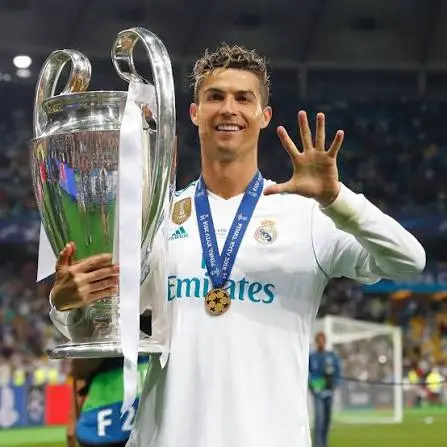
For Cristiano Ronaldo at Real Madrid, it was his first Champions League title with the Spanish club.
Three more would follow.
Ronaldo’s Record-Breaking Goalscoring Peak
Ronaldo’s scoring output during the middle of his Madrid career reached levels that had previously looked unrealistic.
Real Madrid’s official history states that his highest total in a single season for the club was 61 goals. The club also lists him as its leading La Liga scorer with 312 goals and credits him with 34 league matches in which he scored at least three times.
The numbers came from a player whose scoring methods had become remarkably diverse.
Cristiano Ronaldo at Real Madrid scored through:
- right-footed finishes;
- left-footed strikes;
- headers;
- penalties;
- free kicks;
- counterattacks;
- close-range finishes;
- long-range shooting.
Yet his most important development was probably not any individual finishing technique.
It was movement.
Ronaldo became exceptional at arriving where the next chance was likely to appear.
That skill remained valuable even as his explosive dribbling gradually declined.
Four Ballon d’Or Awards as a Real Madrid Player
Ronaldo arrived in Madrid with one Ballon d’Or from Manchester United.
He won four more while representing Real Madrid:
2013, 2014, 2016 and 2017.
Real Madrid’s official historical profile also credits Ronaldo with three European Golden Shoes, three UEFA Best Player in Europe awards, two The Best awards and three Pichichi trophies during his Madrid period.
These individual awards demonstrate how closely Cristiano Ronaldo at Real Madrid overlapped with his career peak.
The 2010s were also the central years of the Ronaldo-Messi Ballon d’Or rivalry.
Almost every major performance became part of the debate over which player was better.
That rivalry increased attention around both stars, but Ronaldo’s Madrid statistics stand independently of the comparison.
Scoring more than a goal per official appearance across nine seasons requires no rivalry to make it extraordinary.
The 2015–16 Champions League Comeback Against Wolfsburg
The 2015–16 Champions League campaign produced another defining Ronaldo performance.
Real Madrid lost the first leg of its quarter-final against Wolfsburg 2-0.
The return match at the Bernabéu required a comeback.
Ronaldo scored twice inside the opening 17 minutes to erase the deficit.
He then completed the hat-trick with a free kick as Real Madrid won 3-0 and advanced 3-2 on aggregate.
Ronaldo finished that Champions League season with 16 goals—only one below his own record of 17.
Real Madrid eventually reached the final against Atlético Madrid in Milan.
The match ended 1-1 after extra time.
Ronaldo converted the decisive penalty in the shootout as Madrid captured La Undécima, the club’s 11th European Cup.
Zidane Changes the Final Years of Ronaldo’s Madrid Career
Zinedine Zidane’s period as manager became central to the final chapter of Cristiano Ronaldo at Real Madrid.
One important development involved workload.
As Ronaldo moved deeper into his 30s, playing every available minute became less necessary than ensuring he remained decisive in the most important matches.
That approach became especially visible during the 2016–17 season.
Ronaldo’s Champions League knockout performances were extraordinary.
Against Bayern Munich, he scored twice away and then a hat-trick at the Bernabéu, becoming the first player to reach 100 Champions League goals.
In the semi-final first leg against Atlético Madrid, Ronaldo scored another hat-trick in a 3-0 victory.
Then came Juventus.
Cardiff 2017: Ronaldo Scores Twice in the Final
Real Madrid faced Juventus in the 2017 Champions League final in Cardiff.
Ronaldo opened the scoring.
After Mario Mandžukić equalized, Madrid took control in the second half.
Casemiro made it 2-1 before Cristiano Ronaldo scored again.
Marco Asensio completed a 4-1 victory.
Ronaldo’s double meant he finished as Champions League top scorer with 12 goals.
It also made him the first player to score in three separate Champions League finals.
Real Madrid became the first club to successfully defend the Champions League title in the competition’s modern era.
The victory was one of the clearest demonstrations of Cristiano Ronaldo’s late-Madrid evolution.
His impact was becoming concentrated increasingly around decisive goals in decisive matches.
Three Champions League Titles in a Row
Real Madrid went even further the following season.
The club won the Champions League again in 2018, defeating Liverpool in Kyiv.
That gave Madrid an extraordinary sequence:
2016 – Champions
2017 – Champions
2018 – Champions
Combined with La Décima in 2014, Cristiano Ronaldo won four Champions League titles in five seasons with Real Madrid.
This is central to his Madrid legacy.
Ronaldo scored enormous numbers domestically, but European competition became the stage most strongly associated with his greatest Madrid years.
UEFA credits Ronaldo with 105 Champions League goals in 101 Real Madrid appearances.
Those figures mean he scored more Champions League goals for Real Madrid than he played Champions League matches for the club.
The Bicycle Kick Against Juventus
One of the most famous goals of Cristiano Ronaldo’s Real Madrid career came during his final Champions League season.
Madrid faced Juventus in Turin in the 2018 quarter-finals.
Ronaldo had already scored when Dani Carvajal delivered a cross into the penalty area.
Ronaldo launched himself into the air and struck an overhead kick past Gianluigi Buffon.
Even Juventus supporters applauded.
UEFA described the goal as a spectacular overhead finish in Madrid’s 3-0 victory, noting the spontaneous applause from the home crowd.
The image became one of the defining visual moments of Cristiano Ronaldo at Real Madrid.
There is also historical irony in what followed.
Only months later, Ronaldo would leave Madrid for Juventus.
Cristiano Ronaldo’s Real Madrid Goals by Competition
Real Madrid’s official count gives Ronaldo the following breakdown:
| Competition | Goals |
|---|---|
| La Liga | 312 |
| UEFA Champions League | 105 |
| Copa del Rey | 22 |
| FIFA Club World Cup | 6 |
| Spanish Super Cup | 4 |
| UEFA Super Cup | 2 |
| Total | 451 |
Ronaldo scored those 451 goals in only 438 official appearances.
It is worth noting that some independent sources list 450 rather than 451 because one goal has historically been attributed differently.
For The News Ink, the cleanest formulation is:
Real Madrid officially credits Cristiano Ronaldo with 451 goals in 438 competitive appearances.
That makes the methodology clear instead of pretending no statistical disagreement exists.
Cristiano Ronaldo’s Real Madrid Trophies
Real Madrid officially lists 16 team trophies during Ronaldo’s nine seasons.
| Trophy | Number |
|---|---|
| UEFA Champions League | 4 |
| FIFA Club World Cup | 3 |
| UEFA Super Cup | 3 |
| La Liga | 2 |
| Copa del Rey | 2 |
| Spanish Super Cup | 2 |
| Total | 16 |
This trophy distribution reveals something important.
Cristiano Ronaldo at Real Madrid was extraordinarily successful in Europe, winning the Champions League four times.
Domestic league success was more limited.
Madrid won La Liga twice during his nine seasons.
Barcelona’s strength during much of Ronaldo’s Spanish career helped make domestic competition unusually demanding.
This distinction matters because a balanced career analysis should not present every aspect of Ronaldo’s Madrid years as equally dominant.
His European legacy was stronger than Madrid’s domestic league dominance during the same period.
Major Records Ronaldo Set at Real Madrid
Real Madrid’s official history credits Cristiano Ronaldo with several club records.
Among them:
- Real Madrid’s all-time leading scorer — 451 goals
- Real Madrid’s leading La Liga scorer — 312 goals
- Most goals by a Real Madrid player in one season — 61
- 34 La Liga matches with three or more goals
- 105 Champions League goals for Real Madrid
- 17 goals in one Champions League season
These achievements are only part of Ronaldo’s wider record book.
For the broader international, EURO, Champions League and World Cup milestones, see The News Ink’s dedicated Cristiano Ronaldo Records cluster when published.
Ronaldo, Benzema and Bale
The later Real Madrid attack became famous for the combination of Cristiano Ronaldo, Karim Benzema and Gareth Bale, often shortened to BBC.
Their roles were not identical.
Bale added speed, power and direct running.
Benzema often linked play, occupied defenders and moved intelligently between attacking positions.
Ronaldo increasingly became the final scorer.
This balance became important during Madrid’s Champions League successes.
Ronaldo’s goals dominated headlines, but the system around him contained elite creators and technically exceptional midfielders including Luka Modrić, Toni Kroos and Isco.
Marcelo and Dani Carvajal provided width from full-back.
Sergio Ramos contributed leadership and decisive goals from defense.
Understanding Cristiano Ronaldo at Real Madrid therefore requires avoiding one extreme: the idea that he achieved everything alone.
Ronaldo was the central goalscorer of an exceptionally talented team.
Cristiano Ronaldo and Lionel Messi in Spain
Ronaldo’s Real Madrid era also created the most intense period of his rivalry with Lionel Messi.
From 2009 until Ronaldo’s departure in 2018, they played for opposite sides of El Clásico.
Every major match produced comparisons.
Every scoring record became a competition.
Every Ballon d’Or amplified the debate.
Yet their playing styles increasingly diverged.
Messi combined deep playmaking, dribbling and scoring.
Cristiano Ronaldo became progressively more specialized around direct attacking and goalscoring.
The comparison remains one of football’s biggest debates, but a dedicated Ronaldo vs Messi article should handle the full statistical question separately.
The Real Madrid story is more focused:
Ronaldo arrived during the era of one of Barcelona’s greatest teams and helped Madrid rebuild itself into Europe’s dominant Champions League club.
Why Ronaldo’s Playing Style Changed in Madrid
Ronaldo joined Madrid at 24 and left at 33.
Those are very different physical stages in a footballer’s career.
Early Cristiano Ronaldo at Real Madrid could receive the ball far from goal and attack defenders repeatedly.
Later Ronaldo conserved more energy for decisive attacking actions.
Three major changes became increasingly visible.
Less dependence on dribbling
He no longer needed to beat multiple defenders before every chance.
More penalty-box movement
Ronaldo became increasingly skilled at appearing between center-backs and attacking space around the six-yard box.
Greater specialization as a scorer
Finishing became more important than constant involvement in build-up play.
This was not simply decline.
It was adaptation.
Ronaldo removed some activities from his game while concentrating increasingly on the area where he could remain world-class: scoring.
Why Cristiano Ronaldo Left Real Madrid
The extraordinary partnership ended in July 2018.
Cristiano Ronaldo transferred to Juventus after nine seasons in Spain.
In his departure message, Ronaldo described his Madrid years as an exceptional period of his life but said he believed the time had come for a new cycle.
Real Madrid stated that Ronaldo would remain one of the great symbols of the club’s history.
The timing made the departure particularly significant.
Ronaldo had just won a third consecutive Champions League title with Madrid.
He was still scoring at an elite level.
This was not a former star leaving after years on the margins.
One of the most productive players in world football was leaving immediately after another European championship.
Cristiano Ronaldo’s Legacy at Real Madrid
The legacy of Cristiano Ronaldo at Real Madrid begins with the simplest number:
451.
No player in the club’s official history has scored more goals.
But the deeper legacy is connected to a specific transformation in Madrid’s European fortunes.
Before Ronaldo’s arrival, Real Madrid had not won the Champions League since 2002.
During his final five seasons at the club, Madrid won it four times.
Ronaldo was the central scorer throughout that revival.
He scored 17 goals during La Décima.
He produced the comeback hat-trick against Wolfsburg in 2016.
He scored five goals across two matches against Bayern in 2017.
He followed that with a hat-trick against Atlético.
He scored twice in the Cardiff final.
He produced the famous bicycle kick in Turin during his final European campaign.
These moments explain why Cristiano Ronaldo at Real Madrid occupies a larger place in club history than ordinary statistical rankings can capture.
Frequently Asked Questions About Cristiano Ronaldo at Real Madrid
When did Cristiano Ronaldo join Real Madrid?
Cristiano Ronaldo joined Real Madrid from Manchester United in 2009 after a then-world-record £80 million transfer. He was officially presented at the Santiago Bernabéu on July 6, 2009.
How many goals did Cristiano Ronaldo score for Real Madrid?
Real Madrid officially credits Cristiano Ronaldo with 451 goals in 438 competitive appearances.
Why do some sources say Ronaldo scored 450 goals for Real Madrid?
One historic goal has been attributed differently by statistical sources. Real Madrid’s official record credits Ronaldo with 451, so The News Ink uses that figure while clearly identifying it as the club’s official count.
How many La Liga goals did Ronaldo score for Real Madrid?
Real Madrid credits Cristiano Ronaldo with 312 La Liga goals, the highest total by a player in the club’s league history.
How many Champions League goals did Ronaldo score for Real Madrid?
Ronaldo scored 105 Champions League goals in 101 appearances for Real Madrid.
How many Champions League titles did Cristiano Ronaldo win with Real Madrid?
Ronaldo won four Champions League titles with Real Madrid: 2014, 2016, 2017 and 2018.
How many trophies did Ronaldo win at Real Madrid?
Real Madrid lists 16 team trophies during Ronaldo’s nine seasons, including four Champions Leagues, two La Liga titles and two Copa del Rey trophies.
How many Ballon d’Or awards did Ronaldo win while at Real Madrid?
Cristiano Ronaldo won four Ballon d’Or awards as a Real Madrid player: 2013, 2014, 2016 and 2017.
What was Ronaldo’s highest-scoring season at Real Madrid?
Real Madrid credits him with 61 goals in his highest-scoring season, a club record.
What was Ronaldo’s best Champions League season?
His 2013–14 campaign produced a record 17 Champions League goals and ended with Real Madrid winning La Décima.
When did Cristiano Ronaldo leave Real Madrid?
Ronaldo left Real Madrid for Juventus in July 2018, ending a nine-season spell in Spain.
Conclusion: Cristiano Ronaldo at Real Madrid Became Bigger Than a Record Transfer
Cristiano Ronaldo arrived at Real Madrid carrying the pressure of a world-record transfer fee.
He left as the highest-scoring player in the club’s official history.
Those two points define the scale of what happened between 2009 and 2018.
Real Madrid officially credits Ronaldo with 451 goals in 438 matches.
He scored 312 times in La Liga.
He scored 105 Champions League goals for the club.
He won 16 team trophies.
Four of those trophies were Champions League titles.
But Cristiano Ronaldo at Real Madrid mattered because of more than totals.
His career coincided with one of the most competitive eras Spanish football had experienced.
He faced Barcelona teams built around Lionel Messi, Xavi and Andrés Iniesta.
He played under Manuel Pellegrini, José Mourinho, Carlo Ancelotti, Rafael Benítez and Zinedine Zidane.
His teammates changed.
His own body changed.
His role changed.
Yet the goals continued.
The young Ronaldo relied heavily on acceleration and individual attacking.
The older Real Madrid Ronaldo increasingly became a specialist in decisive movement and finishing.
That transition allowed him to remain extraordinarily productive throughout his nine seasons.
It also made the Champions League the competition most strongly associated with his Madrid legacy.
La Décima in 2014 ended Real Madrid’s 12-year wait for a tenth European crown.
Ronaldo scored a record 17 goals in that campaign.
Two years later came another Champions League title.
Then another.
Then another.
By the time Cristiano Ronaldo left Madrid in 2018, the club had won four Champions Leagues in five seasons.
Ronaldo had been central to all four.
The 2017 knockout run alone captured the relationship perfectly: five goals against Bayern Munich, a hat-trick against Atlético Madrid and two goals in the final against Juventus.
A year later came the bicycle kick in Turin, one of the most memorable goals of his career.
Then, after another European title, the partnership ended.
That is why Cristiano Ronaldo at Real Madrid should not be remembered simply as a successful transfer.
It became one of football’s great player-club eras.
Madrid gave Ronaldo the largest stage of his club career.
Ronaldo gave Madrid goals at a rate the club had never officially recorded before.
Together, they helped reshape Champions League history.
For Ronaldo’s full journey before and after Madrid, continue with Cristiano Ronaldo Explained: Complete Career, Goals, Records, Trophies and Legacy.
For the latest coverage of the final phase of his playing career, read The News Ink’s Cristiano Ronaldo retirement analysis.
Follow The News Ink
Stay connected with The News Ink for football, sports, technology and breaking-news coverage:
Follow us on X, Instagram and Threads, or read our longer-form analysis on Medium.