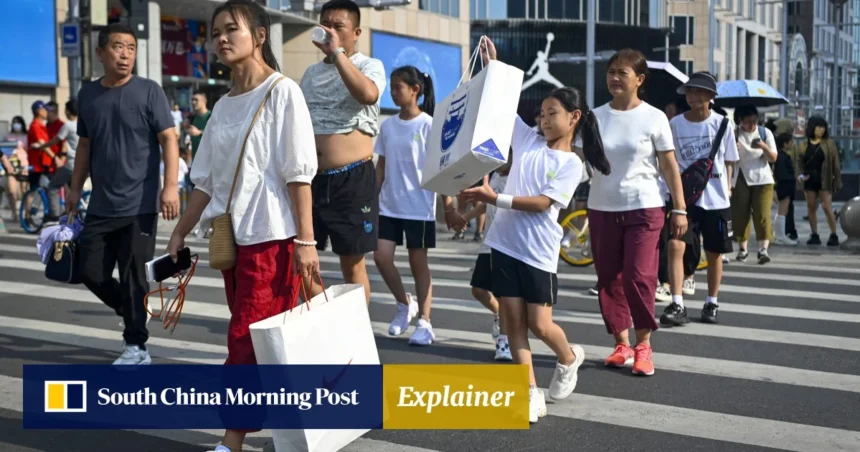
Consumer Spending in China Becomes Beijing’s Urgent 2026 Test
Consumer spending in China has become the central test of whether Beijing can build a more balanced economy after decades of relying heavily on property development, infrastructure, manufacturing and exports. The policy shift was clear at the March 2026 “Two Sessions,” when Premier Li Qiang announced an official growth target of 4.5% to 5% and placed stronger domestic demand near the centre of the government’s economic strategy.
Four months later, the latest data show why the transition is urgent. China’s economy expanded by 4.7% in the first half of 2026, but growth slowed from 5.0% in the first quarter to 4.3% in the second. Official figures showed industrial production and exports remaining comparatively strong while consumer spending, fixed investment and the property sector weakened.
The imbalance is difficult to ignore. Total retail sales of goods and services rose by 2.7% in the first half, but retail sales of consumer goods increased by only 1.3%. At the same time, fixed-asset investment fell by 5.7%, property investment dropped by 18%, and exports rose by 13.4%. Those numbers suggest that China is still producing and selling abroad more successfully than it is persuading households to spend at home.
Beijing has now responded with its first dedicated five-year plan for consumer spending. Released in July, the plan aims to lift annual retail sales to about 60 trillion yuan by 2030, strengthen services, improve social security and raise household incomes. The direction is significant. The challenge is turning policy language into enough confidence for families to reduce precautionary saving.
The Economic Picture Has Changed Since March
When China announced its 4.5% to 5% growth target, it was the least ambitious official target since 1991 and the first in decades to dip below 5%. The government described the range as pragmatic, reflecting weaker external demand, a prolonged property downturn and the need to manage financial risks rather than pursue growth at any cost.
The News Ink’s earlier analysis of China’s lower growth target explained how the figure marked a departure from the faster expansion associated with the country’s earlier development model. The July data have reinforced that message.
| Indicator | First-half 2026 result | What it suggests |
|---|---|---|
| GDP growth | 4.7% year on year | Economy remained within the annual target range |
| Second-quarter GDP | 4.3% year on year | Momentum weakened after the first quarter |
| Retail sales of goods and services | Up 2.7% | Consumer demand expanded slowly |
| Retail sales of consumer goods | Up 1.3% | Goods demand remained particularly weak |
| Services retail sales | Up 5.3% | Travel, leisure and digital services were more resilient |
| Fixed-asset investment | Down 5.7% | Investment was no longer providing its usual support |
| Property investment | Down 18.0% | Housing remained a major drag |
| Exports | Up 13.4% | External demand and manufacturing remained strong |
The table captures the central contradiction. Consumer spending is supposed to become a stronger growth engine, yet the fastest-moving parts of the economy remain high-tech manufacturing and exports. China can still meet its annual target, but the quality and durability of that growth increasingly matter as much as the headline rate.
The National Bureau of Statistics’ first-half release described the economy as operating within an appropriate range. It also acknowledged pressure from weak demand and falling investment. The official data showed per-capita disposable income rising by 5.2% in nominal terms and 4.2% after inflation, but households were not converting that income growth into equally strong retail demand.
Why Beijing Wants Households to Spend More
For much of the past three decades, China could respond to weakness by building more. Local governments financed roads, railways, industrial parks and housing. Banks supported developers and state-linked projects, while factories expanded to serve domestic and overseas markets.
That model delivered enormous improvements in infrastructure, employment and productive capacity. It also created imbalances. Property became a major store of household wealth, local governments became dependent on land sales, and industrial investment sometimes expanded faster than demand.
Consumer spending offers a different source of growth. When households spend more on services, entertainment, healthcare, travel, education and everyday goods, businesses gain a reason to hire and invest without depending entirely on construction or foreign buyers.
The International Monetary Fund’s analysis argues that a pivot towards household demand is now China’s overriding economic priority. The IMF links weak consumption to the property downturn and an incomplete social safety net, both of which encourage families to save against future medical, retirement, education and unemployment costs.
This is why consumer spending is not simply a question of encouraging people to visit shops. It depends on income security, housing wealth, public services, confidence in employment and expectations about the future.
China’s First Five-Year Plan for Consumer Spending
The strongest update since the original article is the release of China’s first five-year blueprint dedicated specifically to consumption. Approved by the State Council in July, it covers 2026 to 2030 and sets a target of roughly 60 trillion yuan in annual retail sales by the end of the decade.
The official plan summary says consumer spending should play a stronger role in economic growth. It prioritises elderly care, childcare, healthcare, culture, tourism, sport and education, while promoting digital, green, artificial-intelligence-enabled and experience-based forms of spending.
The plan also promises to:
- support wage growth and household property income;
- improve social security and public services;
- enforce paid annual leave more effectively;
- remove unreasonable restrictions on car, housing and entertainment spending;
- expand tourism, cultural events and international travel;
- improve consumer protection and the quality of services;
- direct more fiscal and financial support towards households and infrastructure that supports consumer spending.
These measures show that Beijing understands the structural nature of the problem. Consumer spending cannot be transformed by one voucher campaign or one holiday season. A durable shift requires families to believe their income is secure and that essential costs will not overwhelm them.
The target also deserves perspective. China’s retail sales exceeded 50 trillion yuan in 2025, so reaching 60 trillion by 2030 implies moderate annual growth rather than a dramatic boom. The aim is not only to increase the size of the market, but to change its composition and make services a larger share of household spending.
Services Are Growing Faster Than Goods
One of the clearest trends in consumer spending is the difference between services and physical goods. During the first half of 2026, services retail sales rose by 5.3%, compared with only 1.1% growth in goods sales.
Tourism, communications, cultural activities, sport, leisure and rental services performed better than many traditional retail categories. This supports Beijing’s view that the next stage of consumer spending growth may come less from buying another appliance and more from paying for experiences, care and convenience.
The shift also fits China’s demographic profile. An ageing population will create demand for healthcare, home support, rehabilitation, insurance and specialised housing. Families with young children need affordable childcare and education. Younger urban consumers often prioritise travel, fitness, entertainment, pets and digital services.
That makes the enforcement of paid leave more economically important than it first appears. China’s official data showed enterprise employees working an average of 48.2 hours a week in the first half of 2026. More reliable rest periods could support tourism and leisure, but only if workers feel safe taking leave and have enough disposable income to spend.
Why Consumer Spending Remains Weak Despite Higher Incomes
China’s household saving rate is unusually high, and that behaviour is often treated as a cultural preference. In reality, it reflects practical risks.
A household may need savings for medical treatment, a child’s education, an elderly parent, a home deposit or a period without work. Migrant workers can face unequal access to urban services because of the household-registration system. Private-sector employees may worry about layoffs, while young people face intense competition for stable jobs.
The property crisis has added another reason for caution. Housing represents a large share of household wealth, and falling prices or unfinished developments damage confidence. A family that feels poorer on paper is less likely to increase consumer spending even if its current salary has not changed.
The IMF has argued that stronger pensions, unemployment support, healthcare and urban social benefits could reduce precautionary saving. Reuters’ review of policy options for weak consumer spending similarly highlighted welfare reform, migrant access to services, service-sector employment and property stabilisation.
These reforms are expensive and politically difficult. They may require changes to taxation, central-local fiscal relations, land revenues and the role of state-owned enterprises. That helps explain why Beijing has often preferred targeted subsidies and trade-in schemes over large permanent transfers to households.
Trade-In Subsidies Help, but They Cannot Do Everything
China has used subsidies to encourage purchases of cars, appliances, electronics and home products. The government said its consumer-goods trade-in programmes had generated about 5 trillion yuan in sales by June 2026, covering hundreds of millions of purchases.
The official trade-in update shows that these programmes can release demand, accelerate replacement cycles and support manufacturers. They are especially effective when a household already intends to buy a refrigerator, phone or vehicle and needs only a modest incentive.
But trade-ins have limits. They can pull future purchases into the present rather than create a permanent increase in consumer spending. They also favour households that already own products eligible for replacement and have enough cash to pay the remaining cost.
Consumer spending vouchers for travel, cinema or restaurants face similar limits. They can produce a burst of activity, but they do not solve concerns about jobs, housing or retirement. If households treat a voucher as a discount on spending they would have made anyway, the wider economic effect may be smaller than the headline value.
Manufacturing and Technology Remain Central
China is not abandoning manufacturing. The 15th Five-Year Plan continues to emphasise advanced industry, artificial intelligence, robotics, semiconductors, batteries, electric vehicles and other strategic sectors.
The first-half numbers show why. High-tech manufacturing expanded by 13.3%, while production of industrial robots, lithium-ion batteries and 3D-printing equipment grew rapidly. These sectors support productivity, export earnings and technological independence.
Readers following the industrial side of the strategy can explore The News Ink’s coverage of AI trends and the expansion of Chinese technology companies.
The problem for consumer spending is not industrial success itself. It is the possibility that production capacity grows faster than domestic demand. When companies cannot sell enough at home, they turn to exports. That can intensify trade disputes and accusations of overcapacity.
Consumer spending would help absorb more output domestically, but households do not buy simply because factories can produce. The transition therefore requires Beijing to balance support for strategic industries with policies that transfer more income and security to consumers.
Exports Cannot Carry the Economy Forever
Exports rose strongly in the first half of 2026, helping offset weak investment and domestic demand. Yet relying on foreign markets creates risks.
Trading partners have become more concerned about Chinese surpluses and the pressure placed on their own manufacturers. The News Ink’s report on Germany’s trade concerns showed how European policymakers are pushing Beijing to address market access and industrial imbalances.
Geopolitical shocks can also disrupt energy, trade routes and external demand. China’s exposure to the economic effects of the Iran conflict illustrates how events far from Chinese shopping centres can affect fuel costs, shipping and export competitiveness.
A larger domestic market would make China less vulnerable to tariffs, protectionism and global downturns. That is the strategic case for stronger consumer spending: it would not replace exports, but it would reduce the economy’s dependence on them.
“Investing in People” Requires More Than a Slogan
The concept is economically sound. Spending on childcare can allow parents—especially women—to remain in the workforce. Better healthcare reduces the need for emergency savings. Stronger pensions can give older people confidence to spend. Education and training can improve productivity and wages.
The difficult part is funding and implementation. Local governments carry heavy debt and have lost revenue as the property market weakened. Some social policies create permanent annual costs rather than one-time construction bills. Benefits also vary widely between urban residents, migrants and rural households.
For consumer spending to rise sustainably, reforms must be broad enough to change expectations. A small temporary payment may be spent quickly, but a reliable pension or health benefit can alter household behaviour for years.
What a Successful Rebalancing Would Look Like
China does not need households to become reckless borrowers or abandon saving. A healthier model would involve a gradual rise in the share of national income reaching families and a smaller need to save for essential services.
Progress in consumer spending would be visible through several indicators:
- household income consistently growing faster than GDP;
- services spending remaining stronger than goods spending;
- a sustained recovery in private-sector employment;
- greater social-security coverage for migrants and flexible workers;
- stabilisation in housing sales and prices;
- retail growth that continues after subsidies are withdrawn;
- a rising household-consumption share of the economy.
The July five-year plan promises a “marked” increase in the household consumption rate, but it does not provide a precise percentage target. That leaves investors and economists watching implementation rather than slogans.
The Reuters report on the new blueprint noted that household consumption currently accounts for around 40% of the economy, well below the levels seen in many advanced countries. Comparisons are not exact because economic structures differ, but the gap shows how much room China has to rebalance.
Why the Transition Will Be Slow
The shift towards consumer spending is difficult because the old model is deeply embedded. Local officials are accustomed to delivering measurable projects. Banks are experienced in lending against land and industrial assets. Manufacturing targets are easier to monitor than household confidence.
There is another tension: Beijing wants people to spend more while also promoting financial discipline, reducing debt risks and maintaining social stability. Large cash transfers could support demand but might be criticised as wasteful or create expectations of continued payments.
As a result, policy is likely to remain incremental. The government will combine vouchers, trade-ins, service-sector liberalisation, childcare support, pension improvements, paid leave and measures to stabilise housing rather than rely on one dramatic stimulus package.
The Second Half of 2026 Will Test the Strategy
The first-half data leave China close to the lower end of its annual target range. Growth of 4.7% is not a crisis, but the second-quarter slowdown to 4.3% increases pressure for additional support.
Officials have indicated that they are prepared to strengthen counter-cyclical measures if needed. Investors will watch the Politburo, fiscal spending, local-government bond issuance and any changes to property or household-support policies.
The most important test is whether consumer spending improves without relying entirely on temporary subsidies. June retail sales rose only 1.0% from a year earlier, while investment and property remained weak. A meaningful recovery would require better employment expectations and stronger private-sector confidence.
The broader economy coverage on The News Ink follows how trade, inflation, property and household demand interact across major markets.
China’s New Model Depends on Household Confidence
Consumer spending has moved from a secondary policy objective to one of the defining economic questions of China’s 15th Five-Year Plan. The government has recognised that more factories, infrastructure and exports cannot by themselves provide balanced growth indefinitely.
The July consumption blueprint is a substantial policy signal. It commits Beijing to stronger services, improved social security, higher incomes, better paid-leave enforcement and a larger consumer market by 2030.
Yet policy direction is not the same as immediate results. The first half of 2026 showed strong manufacturing and exports alongside slow retail growth, falling investment and a deep property decline. Consumer spending will increase sustainably only when households feel secure enough to use more of their income rather than protecting themselves against uncertain costs.
That means the real work lies in jobs, pensions, healthcare, childcare, housing confidence and equal access to public services. Vouchers and trade-ins can support the transition, but they cannot complete it.
Readers can follow The News Ink on Threads for continuing updates on China, global trade and economic policy.
For Beijing, the choice is no longer whether consumer spending should play a larger role. The question is whether the government is prepared to make the structural changes that would allow millions of households to spend with confidence.