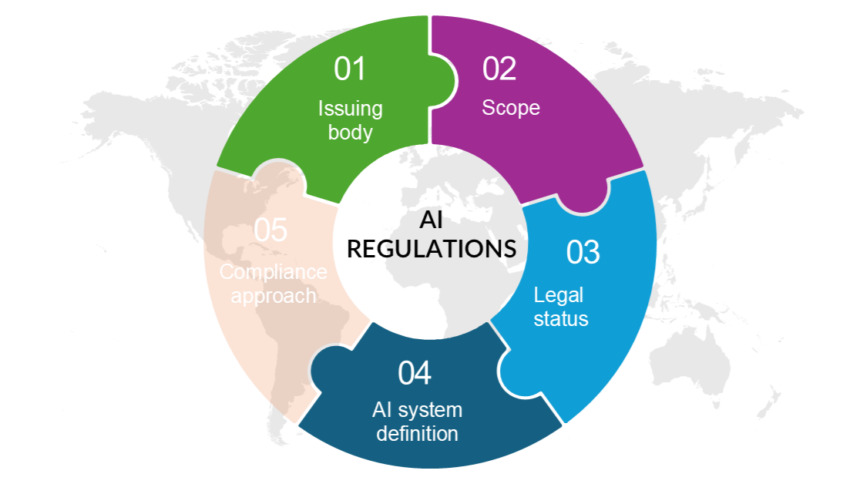
AI Regulation Explained: How Governments Are Trying to Control Artificial Intelligence
AI regulation has moved from a future policy debate to a real legal and business issue in 2026. Governments are now deciding when artificial intelligence must be disclosed, which uses require human oversight, what companies must document, when powerful models need additional safety controls and which AI applications should be prohibited entirely.
But there is no single worldwide rulebook.
The European Union has created the world’s most comprehensive cross-sector framework through the EU AI Act. The United States still relies on a mixture of existing federal law, executive policy, voluntary standards and increasingly important state legislation. The United Kingdom has largely chosen a regulator-led model instead of copying the EU. China combines generative-AI, cybersecurity, algorithm, platform and synthetic-content rules.
That means the same AI product can face very different obligations depending on where it is offered and what it does.
A useful way to understand AI regulation is to stop asking only:
“Is this AI system regulated?”
The better questions are:
- What does the system do?
- How much harm could a mistake cause?
- Does it make or influence an important decision?
- Does it process sensitive data?
- Does it generate deceptive-looking content?
- Who developed it and who actually deploys it?
- Which country’s laws apply?
That risk-based way of thinking is becoming one of the defining ideas in artificial intelligence governance.
AI Regulation Around the World at a Glance
| Region | Main approach in 2026 | Central idea |
|---|---|---|
| European Union | Comprehensive EU AI Act | Regulation increases with risk |
| United States | Existing federal law + national policy + state AI laws | No single EU-style federal AI Act |
| United Kingdom | Regulator-led and sector-specific | Existing regulators apply common AI principles |
| China | Generative AI, algorithm, cybersecurity and content rules | Strong provider and platform responsibilities |
| International bodies | Standards and voluntary principles | Safety, transparency, accountability and cooperation |
This distinction matters because discussions about AI regulation often treat “regulation” as if it means governments either banning AI or leaving it completely alone.
Reality is much more complicated.
Most governments are trying to preserve useful applications while placing stronger controls on systems capable of affecting safety, rights, money, employment, healthcare or public trust.
Why Governments Are Regulating AI
Artificial intelligence can improve productivity, accessibility, scientific research, cybersecurity and many everyday digital services.
But capabilities that make AI useful can also create serious risks.
Consider a few examples.
A recommendation algorithm choosing music creates relatively little risk.
A system deciding which job applications humans should review can influence a person’s career.
An AI credit-scoring model may influence whether somebody receives a mortgage.
Artificial intelligence used in medical equipment can affect patient safety.
A generative model can create fake audio or video that appears authentic.
An AI agent may be capable of sending messages, accessing files, executing software or making purchases.
The consequences become more serious as AI moves from suggesting information to making or influencing consequential decisions.
The News Ink’s broader AI trends in 2026 coverage examines the same shift: AI is becoming infrastructure for work, software, search and decision-making rather than remaining a standalone chatbot technology.
Modern AI regulation therefore tends to focus on several recurring areas:
| Regulatory concern | Why governments care |
|---|---|
| Discrimination | Automated decisions can disadvantage people unfairly |
| Privacy | Models may process large amounts of personal information |
| Safety | Failures can matter in healthcare, transport or infrastructure |
| Transparency | People may not know AI made or influenced a decision |
| Deepfakes | Synthetic content can enable deception and impersonation |
| Cybersecurity | Models and AI agents can create new attack surfaces |
| Copyright | Training and generated content raise rights questions |
| Human oversight | Some important decisions should remain contestable |
| Model power | Advanced general-purpose models may create broad systemic risks |
| Accountability | Someone must remain responsible when systems fail |
The EU AI Act Is the Most Comprehensive AI Regulation Framework
The European Union has taken the clearest risk-based approach.
The EU AI Act became law in 2024 and applies through a phased timetable. Rather than imposing identical requirements on every algorithm, it divides systems according to the seriousness of their potential risks.
The Commission describes four broad categories:
- unacceptable risk;
- high risk;
- transparency risk;
- minimal or no risk.
That structure is one of the most important concepts to understand in AI regulation.
A spam filter does not face the same legal treatment as an automated employment system.
A game recommendation engine is different from software influencing medical treatment.
Unacceptable-Risk AI Can Be Banned
The strongest form of EU AI regulation is prohibition.
The European Commission lists prohibited practices that include harmful manipulation, exploitation of vulnerabilities, social scoring, certain predictive-policing uses, untargeted scraping of facial images to build facial-recognition databases and emotion recognition in workplaces and educational institutions, subject to limited exceptions.
Most of those prohibitions began applying on February 2, 2025.
The 2026 AI Omnibus changes also added a prohibition involving certain AI-generated or manipulated non-consensual sexually explicit material and child sexual abuse material, scheduled to apply from December 2, 2026.
This is important.
AI regulation does not always mean “companies must disclose what they are doing.”
Some uses can simply cross a legal line.
High-Risk AI Faces Much Stronger Requirements
The EU’s next category covers systems that could seriously affect health, safety or fundamental rights.
Examples include certain AI systems used in:
- education;
- recruitment and worker management;
- critical infrastructure;
- creditworthiness decisions;
- access to essential services;
- biometrics;
- law enforcement;
- migration and border control;
- and administration of justice.
A résumé-filtering system may therefore receive greater regulatory scrutiny than software recommending a movie.
High-risk systems can face requirements involving:
- risk-management procedures;
- data quality;
- technical documentation;
- logging;
- human oversight;
- robustness;
- cybersecurity;
- and accuracy.
However, one of the most important research points in 2026 is the timeline.
Older summaries of the EU AI Act may now contain outdated implementation dates.
Following the 2026 AI Omnibus changes, major rules for high-risk systems in areas including employment, education, biometrics, migration and critical infrastructure are scheduled to apply from December 2, 2027.
For certain high-risk systems embedded in regulated products, the deadline extends to August 2, 2028.
August 2, 2026 Was a Major AI Regulation Deadline
One of the most significant dates in global AI regulation has already passed.
On August 2, 2026, major parts of the EU AI Act became enforceable.
The European Commission’s AI Office and national authorities began enforcing important obligations, including rules covering general-purpose AI and AI transparency.
For consumers, some of the most visible rules concern knowing when AI is involved.
Certain interactive AI systems must make users aware that they are communicating with artificial intelligence rather than a human.
Deepfakes must be labelled in covered circumstances.
Generative systems also face requirements intended to make AI-generated or manipulated material machine-detectable.
The reason is easy to understand.
The same technology capable of producing useful videos, translations and educational material can also create convincing impersonations.
The News Ink’s analysis of AI scams and deepfakes shows why regulators increasingly view content authenticity as a consumer-protection and security problem as well as a technology issue.
EU AI Act Timeline
| Date | What happened |
|---|---|
| Aug. 1, 2024 | EU AI Act entered into force |
| Feb. 2, 2025 | Most prohibited practices and AI-literacy requirements began applying |
| Aug. 2, 2025 | General-purpose AI obligations began applying |
| Aug. 2, 2026 | Major enforcement powers and transparency requirements began applying |
| Dec. 2, 2026 | Additional synthetic intimate-content prohibition applies |
| Aug. 2, 2027 | Older GPAI models must meet applicable obligations |
| Dec. 2, 2027 | Main Annex III high-risk requirements apply |
| Aug. 2, 2028 | High-risk product-system requirements apply |
This timetable is based on the Commission’s current 2026 implementation framework.
General-Purpose AI Models Have Their Own Rules
ChatGPT-style foundation models create a special problem for traditional AI regulation.
A recruitment algorithm is developed for a relatively specific purpose.
A general-purpose model can instead be used for writing, programming, research, customer service, education, image analysis and thousands of other applications.
Regulators therefore cannot judge its risk only by looking at one end use.
Under EU rules, providers of general-purpose AI models must maintain technical documentation, provide relevant information to downstream developers, establish a policy for complying with EU copyright law and publish a sufficiently detailed summary of the content used to train the model.
Providers of the most advanced models that meet the legal threshold for systemic risk face additional requirements involving risk assessment, model evaluation, incident reporting and cybersecurity.
The rules began applying to new general-purpose AI models in August 2025.
From August 2, 2026, the European Commission began enforcing compliance and can impose penalties. Models already placed on the market before August 2, 2025 generally have until August 2, 2027 to meet the relevant rules.
The General-Purpose AI Code of Practice is important, but it should not be confused with legislation.
The code is a voluntary compliance tool intended to help providers demonstrate that they are meeting obligations already created by the AI Act.
EU AI Regulation Has Serious Penalties
The EU AI Act is not simply guidance.
For the most serious prohibited-practice violations, penalties can reach up to €35 million or 7% of worldwide annual turnover, depending on the circumstances and company size rules.
Other violations can result in penalties reaching €15 million or 3% of worldwide turnover. General-purpose model violations can also fall under the €15 million or 3% threshold.
Those figures explain why AI compliance is becoming a board-level issue for companies operating in Europe.
The United States Has No Single EU-Style AI Act
American AI regulation looks very different.
As of August 25, 2026, the United States does not have one comprehensive federal statute equivalent to the EU AI Act.
Instead, regulation comes from several directions:
- existing federal laws;
- federal agency enforcement;
- executive orders and White House policy;
- voluntary NIST frameworks;
- sector-specific regulation;
- and state AI laws.
The Trump administration released a National Policy Framework for Artificial Intelligence in March 2026 and called on Congress to create a federal legislative framework.
A major part of the proposal is reducing what the administration considers an overly complicated patchwork of state AI regulation. It recommends federal preemption of some state rules while retaining state authority in areas such as traditional consumer protection, fraud, zoning and state-government AI use.
But this distinction is essential:
A White House legislative recommendation is not the same as a law passed by Congress.
That is one of the most common mistakes in reporting about AI regulation.
White House 2026 national AI legislative framework
Existing American Laws Still Apply to AI
The lack of a comprehensive federal AI statute does not mean companies can do anything they want with artificial intelligence.
Existing laws covering fraud, unfair business practices, discrimination, employment, lending, privacy, intellectual property and sector-specific activities can still apply.
The FTC has long maintained that existing consumer-protection laws apply when companies use AI to engage in deceptive or unfair conduct.
This principle matters.
A business does not escape discrimination law merely because a machine-learning system made a recommendation.
A company cannot legally make deceptive advertising claims merely because those claims were generated by AI.
Traditional law often regulates the outcome and conduct, even when the technology producing it is new.
NIST Uses a Voluntary AI Risk Framework
The National Institute of Standards and Technology plays an important role in U.S. AI governance.
Its AI Risk Management Framework, commonly called the AI RMF, is designed to help organizations identify and manage risks involving trustworthy and responsible artificial intelligence.
But NIST is explicit that the framework is voluntary.
The framework organizes risk-management thinking around four major functions:
Govern, Map, Measure and Manage.
NIST is also continuing to update its AI work. In April 2026, it released a concept note for a trustworthy-AI profile focused on critical infrastructure, while the broader AI RMF itself is being revised.
NIST AI Risk Management Framework
The News Ink’s cybersecurity guide is closely related because good AI governance increasingly overlaps with ordinary cybersecurity principles such as access control, monitoring, testing and incident response. The page is part of the site’s verified cybersecurity cluster.
U.S. States Are Becoming Major AI Regulators
State governments are filling some of the space left by the absence of one federal AI law.
Texas
The Texas Responsible Artificial Intelligence Governance Act, or TRAIGA, became effective on January 1, 2026.
The Texas Attorney General says it establishes rules for entities deploying AI and prohibits certain harmful uses, including some forms of manipulation, discrimination and misuse of biometric data.
Texas AI rights and TRAIGA guidance
California
California has taken a multi-law approach.
Its AI Transparency Act became operative on August 2, 2026 for covered providers.
The law addresses disclosure and provenance information for certain AI-generated image, video and audio content. It also requires covered systems to support mechanisms that help identify generated material. Some additional platform-related provisions begin later.
California also entered 2026 with several additional AI-focused laws covering areas such as major-model risk management, safeguards for minors using AI chatbots, AI impersonation of licensed professionals and disclosure when AI is used to draft police reports.
California AI Transparency Act text
Colorado
Colorado’s AI landscape has also continued changing.
The Colorado Attorney General says new automated-decision and chatbot-related laws are moving toward a January 1, 2027 effective date, with proposed rules filed in August 2026.
All of this creates a fundamental American policy conflict:
Should states continue building their own AI regulation frameworks, or should Congress replace much of that patchwork with one national standard?
That question remains unresolved.
The UK Has Chosen a Different Route
The United Kingdom has largely rejected the idea that every important AI rule must sit inside one enormous AI statute.
Instead, its approach relies heavily on existing regulators.
The UK’s framework has been built around five principles:
| UK AI principle | Meaning |
|---|---|
| Safety, security and robustness | Systems should operate safely and withstand failures |
| Transparency and explainability | Appropriate information should be available about AI use |
| Fairness | AI should operate consistently with relevant fairness laws |
| Accountability and governance | Organizations need responsibility structures |
| Contestability and redress | People should have routes to challenge harmful outcomes |
These principles are applied by regulators according to their existing responsibilities rather than through a single EU-style AI regulator.
A June 2026 House of Commons Library briefing describes the UK’s regulatory structure as context-based and spread across existing laws and regulators.
The system continues evolving.
A statutory Code of Practice on Artificial Intelligence and Automated Decision-Making under the Data Protection Act framework came into force on May 12, 2026.
The government has also launched sector-specific experiments. In August 2026, it opened an Advisory AI Growth Lab for legal services, allowing AI developers and legal-sector organizations to work with regulators while navigating existing rules.
UK House of Commons AI regulation briefing
China Uses a Layered AI Regulation Model
China’s approach is different again.
Rather than depending on one single AI Act, China has built multiple overlapping rules involving algorithms, cybersecurity, generative AI, deep synthesis, platforms and information controls.
Its Interim Measures for the Management of Generative Artificial Intelligence Services took effect in August 2023.
Those rules apply to generative AI services offered to the public in China and include requirements involving lawful content, personal information, security and provider responsibilities.
China later strengthened synthetic-content regulation.
The Measures for Labeling Artificial Intelligence Generated and Synthetic Content took effect on September 1, 2025.
They cover AI-generated or synthetic:
- text;
- images;
- audio;
- video;
- and virtual scenes.
The framework distinguishes between visible labels that users can perceive and technical or metadata-based labels that may be less obvious.
It also places responsibilities on online content-distribution platforms and restricts malicious removal, falsification or concealment of required AI labels.
China simultaneously introduced a mandatory national standard covering methods for labelling AI-generated and synthetic content.
China’s official AI-generated content labeling rules
AI Regulation Compared: EU vs U.S. vs UK vs China
| Question | EU | United States | UK | China |
|---|---|---|---|---|
| One broad AI law? | Yes | No equivalent federal law yet | No | No single equivalent law |
| Risk classification central? | Yes | Varies by law/state/standard | Sector-based | Layered sector/content approach |
| General-purpose model duties? | Yes | Limited federal model-specific regulation | Mostly existing law/guidance | Provider and security obligations |
| Deepfake labeling? | Yes | Growing state regulation | Existing law + sector rules | Yes, national requirements |
| Employment AI rules? | High-risk category | Existing laws + state rules | Equality/data/employment law | Multiple overlapping rules |
| Voluntary risk standards? | Codes supplement law | NIST AI RMF | Guidance and regulator frameworks | Standards alongside regulation |
| Major 2026 development | Enforcement begins | Federal/state conflict grows | Sector model continues | Labeling regime fully in effect |
No column should automatically be read as “better.”
Each model reflects different political, legal and economic priorities.
What AI Regulation Means for Ordinary People
Most people will not encounter AI regulation by reading legislation.
They will experience it through products.
A user may see a notice saying they are talking to an AI chatbot.
A deepfake may carry a label.
An employer may have additional duties when using AI to screen job candidates.
A bank may need human review or explanations around automated decisions.
Users may receive new rights to question or contest some high-impact outcomes.
Certain surveillance practices may become restricted entirely.
AI regulation could therefore become part of everyday digital design in the same way privacy notices, cookie choices and security warnings became normal parts of the modern internet.
What Businesses Should Do About AI Regulation
The biggest mistake a company can make is assuming it can create an AI policy simply by banning employees from entering confidential information into ChatGPT.
Modern AI governance needs to start with an inventory.
A business should know:
| Compliance question | Why it matters |
|---|---|
| Which AI systems are used? | You cannot govern tools you do not know exist |
| Who provides them? | Provider and deployer duties can differ |
| What data do they process? | Privacy and confidentiality laws may apply |
| Do they affect important decisions? | High-risk rules may become relevant |
| Can humans override them? | Human oversight is increasingly important |
| Are outputs logged? | Traceability helps audits and incident response |
| Does the system create synthetic media? | Disclosure rules may apply |
| What jurisdiction applies? | EU, U.S., UK and China obligations differ |
| What happens when it fails? | Incident and escalation processes are essential |
Companies operating internationally may need to comply with several regimes simultaneously.
That makes AI regulation increasingly similar to privacy and cybersecurity compliance: it becomes an ongoing business function rather than a one-time legal review.
AI Regulation and Copyright Are Becoming Closely Connected
Generative AI has intensified a long-running copyright question.
Can AI developers train models on enormous collections of text, images, music, software and other copyrighted works?
There is no single global answer.
The EU AI Act requires general-purpose model providers to maintain a policy intended to comply with EU copyright law and publish a sufficiently detailed summary of the content used for training.
That does not resolve every licensing or fair-use dispute.
It instead adds transparency requirements around a much wider body of copyright law.
In the United States, copyright questions continue to be fought through courts, legislation and policy debates.
The White House’s March 2026 legislative framework specifically includes intellectual-property rights and protections for creators as an area Congress should address.
AI regulation is therefore becoming increasingly important to publishers, journalists, musicians, artists, software developers and other creators.
Deepfakes May Become One of the Most Visible AI Regulation Issues
Synthetic content presents an unusually clear regulatory challenge.
AI-generated media can be useful for entertainment, advertising, education and accessibility.
It can also be used to impersonate public figures, executives, friends and family members.
That is why the EU, California and China have all developed transparency or provenance rules around synthetic content.
The News Ink’s guide to deepfake scams explains why simply telling people to “look carefully” is no longer enough. Better AI-generated media makes authentication and provenance increasingly important.
The same issue appears in The News Ink’s analysis of online privacy, because AI governance increasingly involves questions about identity, data collection and what information systems are allowed to infer about people. Both pages are present in the verified internal link library.
The Hardest Regulatory Problem Is That AI Keeps Changing
Law develops slowly.
AI models can change every few weeks.
A system can gain new tools, receive an updated model, access new data or be deployed for purposes its original developer never imagined.
This creates difficult questions.
Who is responsible when a third-party company builds a dangerous product using someone else’s model?
Should an open-source model face the same requirements as a proprietary commercial service?
Should governments regulate models based on computing power, testing results, capabilities or actual uses?
What happens when an AI agent performs an action that neither the user nor developer specifically anticipated?
AI regulation increasingly has to divide responsibility across multiple actors:
model developer → system provider → deployer → professional user → end user.
Different jurisdictions are drawing those lines differently.
Can AI Regulation Become Too Strict?
Yes.
Bad regulation can cause real costs.
If rules require expensive testing and documentation for low-risk systems, small companies may struggle while the largest technology firms absorb the cost.
Conflicting national laws can force companies to maintain several versions of the same product.
Excessive compliance burdens may discourage startups from entering the market.
That concern is central to the U.S. government’s current approach and was also one reason the EU simplified parts of its implementation timetable in 2026.
But weak regulation creates a different danger.
AI systems can be deployed before companies understand discrimination, cybersecurity or safety problems.
Fraud can spread faster.
People may struggle to challenge automated decisions.
A high-impact system can create harm at enormous scale before traditional enforcement catches up.
The goal of effective AI regulation is therefore not:
regulate everything.
It is:
regulate according to consequence.
AI Regulation Is Ultimately About Trust
Innovation and regulation are often presented as enemies.
That is not always true.
Businesses also need people to trust AI enough to use it.
A patient may be more willing to accept AI-assisted healthcare if the system has been tested and a professional remains responsible.
A worker may be more comfortable with automated HR systems if decisions can be questioned.
A customer may trust generative media more when its origin can be verified.
A company may feel safer deploying an AI tool when vendors provide documentation, security controls and incident processes.
The OECD’s modern policy framework emphasizes trustworthy AI principles including transparency, robustness, security and accountability.
Good AI regulation can therefore become part of product quality rather than merely a compliance burden.
What Comes Next for AI Regulation?
The next regulatory battle will increasingly involve AI agents and systems capable of acting independently.
The previous generation of generative AI mainly created text, images and code.
More advanced agents can browse websites, use software, interact with other systems and potentially initiate transactions.
That raises new questions about:
- identity;
- authorization;
- audit trails;
- cybersecurity;
- spending authority;
- liability;
- autonomous decision-making;
- and human control.
Frontier AI raises separate questions around powerful capabilities, cybersecurity and catastrophic-risk testing.
Governments will also face difficult policy choices involving AI companions for children, election deepfakes, autonomous weapons, biometric surveillance, AI-generated evidence and models capable of assisting dangerous scientific or cyber activities.
That means today’s AI regulation framework is unlikely to be the final one.
The laws themselves will continue changing as quickly as governments can realistically update them.
Frequently Asked Questions
What is AI regulation?
AI regulation is the collection of laws, regulatory rules, standards and government guidance governing how artificial intelligence is developed, sold and used.
It can cover safety, privacy, transparency, discrimination, deepfakes, cybersecurity, copyright and automated decision-making.
Is artificial intelligence already regulated?
Yes.
AI is already subject to existing laws in many countries, while jurisdictions including the European Union, Texas, California and China have added AI-specific rules.
The exact obligations depend on the system and location.
Is the EU AI Act fully in force?
Major parts are now applicable, but the entire framework does not take effect at once.
Important enforcement and transparency provisions began applying on August 2, 2026, while major high-risk requirements have deadlines in 2027 and 2028.
Does the United States have an AI Act?
No comprehensive federal law equivalent to the EU AI Act exists as of August 25, 2026.
The United States instead relies on existing federal law, agency authority, executive policy, voluntary standards and state legislation.
Does the EU ban ChatGPT or other generative AI?
No.
The EU AI Act does not broadly ban general-purpose generative AI.
It imposes documentation, transparency and copyright-related obligations on covered general-purpose model providers, with additional safety duties for models that meet systemic-risk criteria.
Does China require AI-generated content labels?
Yes.
China’s AI-generated and synthetic-content labeling measures took effect on September 1, 2025 and establish visible and technical labeling requirements for covered content and services.
Conclusion
AI regulation has entered a new phase in 2026.
The question is no longer whether governments will regulate artificial intelligence.
They already are.
The European Union has gone furthest with a comprehensive risk-based AI Act. Enforcement powers and transparency requirements are now active, general-purpose models face new obligations, and major high-risk rules will follow in 2027 and 2028.
The United States is following a more decentralized path. Federal laws and agencies continue to apply existing rules, NIST provides voluntary risk-management guidance, the White House is pushing for a national legislative framework, and states such as Texas and California are already enforcing AI-specific laws.
The United Kingdom continues to rely mainly on sector regulators and existing legal frameworks.
China has built a layered system covering generative AI, algorithms, cybersecurity and synthetic-content labeling.
Despite these differences, the world’s major approaches are beginning to converge around several principles:
Know what the AI system does. Understand its risks. Protect data. Maintain security. Preserve human accountability. Explain important automated decisions. Identify synthetic content. Apply stronger controls when the consequences become more serious.
For businesses, that means AI governance can no longer be treated as something to think about after deployment.
For users, it means more AI products will come with disclosures, safeguards and rights.
For governments, the difficult part is still ahead.
Artificial intelligence can change much faster than legislation.
The success of AI regulation will therefore depend not only on how strict today’s rules are, but on whether those rules can adapt without either freezing useful innovation or allowing high-impact systems to operate without meaningful accountability.
Follow The News Ink
Stay connected with The News Ink for artificial intelligence, technology, cybersecurity, business, world news and major digital developments.
Follow The News Ink on X, Instagram and Threads. Join the The News Ink WhatsApp Channel and follow The News Ink on Medium for longer research, explainers and analysis. These official links are confirmed in The News Ink’s publishing library.